A One Person Company (OPC) allows a single entrepreneur to operate a private company with limited liability and a separate legal identity. It requires one member and a nominee, and registration is completed online through the MCA incorporation system.
What Is a One Person Company (OPC)?
A One Person Company is a company that has only one person as its member. The concept is recognised under the Companies Act, 2013. In practical terms, it allows one eligible individual to own the entire shareholding of a private company while the company itself remains a separate legal person. The company can own property, enter into contracts, open bank accounts, employ people and incur liabilities in its own name.
An OPC is different from a sole proprietorship. In a proprietorship, the owner and business are legally the same person. In an OPC, the company and the member are distinct. This separation is the reason an OPC can provide limited liability, perpetual succession through the nominee mechanism and stronger corporate credibility.
Who Should Choose OPC Registration?
- A solo founder who wants to start and own a company without adding a second shareholder only for formality.
- Consultants, professionals, online businesses, agencies and small service ventures that want a corporate identity with controlled ownership.
- Founders who expect to sign formal contracts, build a brand, hire employees, work with institutional clients or maintain organised financial records.
- Entrepreneurs who may later convert into a standard private limited company when a co-founder or investor joins.
- Promoters who value limited liability but do not currently need the two-member structure of a private limited company.
If your business is expected to raise equity from multiple investors immediately, issue ESOPs, or add co-founders from the beginning, a standard private limited company may be more suitable than an OPC.

OPC Eligibility and Basic Legal Conditions
The Companies (Incorporation) framework was liberalised from 1 April 2021. The Companies (Incorporation) Second Amendment Rules, 2021 replaced the earlier resident-only condition so that an Indian citizen may be eligible whether resident in India or otherwise. The exact applicant profile and supporting documents should still be checked against the live MCA form requirements at the time of filing.
- The member must be a natural person and an Indian citizen.
- The OPC has only one member/shareholder at a time.
- A nominee must be named with the prescribed consent and particulars.
- A person cannot simultaneously be a member of more than one OPC under the applicable incorporation rules.
- The company must have at least one director. The sole member may also act as the sole director, subject to director eligibility requirements.
- Every company must satisfy the resident-director rule under Section 149(3). If the sole proposed director does not satisfy it, another eligible director may be required.
- The proposed company name and objects must comply with the Companies Act, incorporation rules and any sector-specific laws.
OPC at a Glance
| Requirement | OPC Position |
|---|---|
| Members / Shareholders | 1 |
| Minimum Directors | 1 |
| Nominee | Mandatory |
| Legal Status | Separate legal entity |
| Liability | Generally limited to unpaid amount on shares, subject to law and personal guarantees/fraud exceptions |
| Minimum Paid-up Capital | No statutory minimum for incorporation |
| Name Suffix | “(OPC) Private Limited” |
| AGM | Not required for an OPC |
| Statutory Audit | Required for company financial statements |
| Incorporation Route | Online through SPICe+ and linked MCA forms |
Main Advantages of One Person Company Registration
- Limited liability: business liabilities ordinarily remain with the company rather than automatically becoming the personal liabilities of the sole member.
- Separate legal identity: contracts, assets, invoices and bank accounts can stand in the company’s own name.
- Single-owner control: the founder can retain 100% shareholding without bringing a nominal second shareholder.
- Continuity: the nominee mechanism provides a statutory route for continuity if the sole member dies or becomes incapable of contracting.
- Professional credibility: a company structure can be easier to present to banks, vendors, marketplaces, enterprise clients and institutional counterparties.
- Scalable structure: the OPC may later convert into a private or public company by following the prescribed process and increasing members/directors as required.
Important Limitations to Understand Before Registering
OPC is useful, but it is not the best structure for every single-founder business. Before filing, consider the following practical limits:
- Only one member can hold the ownership at a time. Adding another shareholder generally requires conversion into another class of company.
- Company compliance is higher than a sole proprietorship because statutory books, financial statements, audit and MCA filings continue even if business activity is low.
- Banks, investors and counterparties may still ask the member/director for personal guarantees depending on the transaction, so limited liability does not eliminate every commercial risk.
- Certain regulated businesses may require separate licences or approvals. Incorporation by itself does not authorise a regulated activity.
Documents Required for OPC Registration
Documents of the Sole Member / Proposed Director
- PAN or other tax identification details applicable to the applicant.
- Aadhaar/passport or other accepted identity proof as applicable.
- Recent address proof, normally within the validity period accepted by MCA.
- Passport-size photograph, mobile number and email ID.
- Digital Signature Certificate (DSC) for signing incorporation forms. Vakilkaro’s Digital Signature Certificate guide explains the practical use of DSCs in MCA filings.
Nominee Documents
- Identity and address proof of the nominee.
- Nominee consent and particulars in the prescribed MCA form/workflow.
- Contact details and other declarations required by the live incorporation form.
Registered Office Documents
- Recent utility bill for the proposed registered office.
- Ownership proof or rent/lease agreement, depending on whether the premises are owned or rented.
- No-objection / consent from the owner where required.
- Address details must be consistent across supporting documents. For practical guidance, review Vakilkaro’s registered office guide.
Role of the Nominee in an OPC
The nominee is a core feature of the OPC structure. The memorandum names another eligible person who, with prior written consent, can become the member if the original member dies or becomes incapable of contracting. This is what allows an OPC to continue even though it has only one member at a time.
The nominee does not automatically become a co-owner merely because their name is recorded at incorporation. The nominee’s role is contingent. Consent, change of nominee, withdrawal and related filings must be handled in the prescribed manner. The MCA’s incorporation guidance confirms that nominee consent/details form part of the OPC incorporation documentation through the SPICe+ workflow.
How to Choose an OPC Name
- Keep at least two strong name options ready before filing.
- The name should be distinctive and should not be identical with or too close to an existing company or LLP name.
- Avoid words that need prior regulatory approval unless you actually qualify and can provide the approval.
- Check brand risk, not only MCA name availability. A name may be available for incorporation but still conflict with an earlier trademark.
Before finalising the brand, a separate Vakilkaro Trademark Registration review can help identify name conflicts. You can also verify official trademark records through IP India.
Step-by-Step OPC Registration Process
Company incorporation is filed online with the Ministry of Corporate Affairs. MCA has migrated the incorporation set to its V3 environment, and the integrated process uses SPICe+ Part A/Part B with linked forms.
1. Structure and eligibility review
Confirm that OPC is the right entity, the proposed member and nominee are eligible, the director-residency position is workable, and the proposed activity does not require a different structure or prior sector approval.
2. Obtain Digital Signature Certificate
The proposed signatory needs a valid DSC because the incorporation documents are electronically signed.
3. Name reservation
Submit the proposed name with the principal business activity and supporting explanation where needed. The suffix should reflect the OPC form.
4. Prepare charter documents
Prepare the Memorandum of Association and Articles of Association with the correct objects, capital and OPC provisions.
5. Prepare member, director and nominee information
Reconcile identity, address, contact and declaration details before submission so the same information appears consistently across the incorporation set.
6. File SPICe+ and linked forms
The integrated incorporation application covers company incorporation and linked registrations/services. The official SPICe+ and linked-filings FAQs provide the MCA filing framework.
7. Professional certification and submission
The incorporation set is digitally signed/certified as applicable and submitted with the prescribed government fees and state stamp duty.
8. Respond to resubmission, if any
If the Registrar seeks clarification, the reply should address the exact query with corrected forms or supporting documents within the allowed period.
9. Certificate of Incorporation
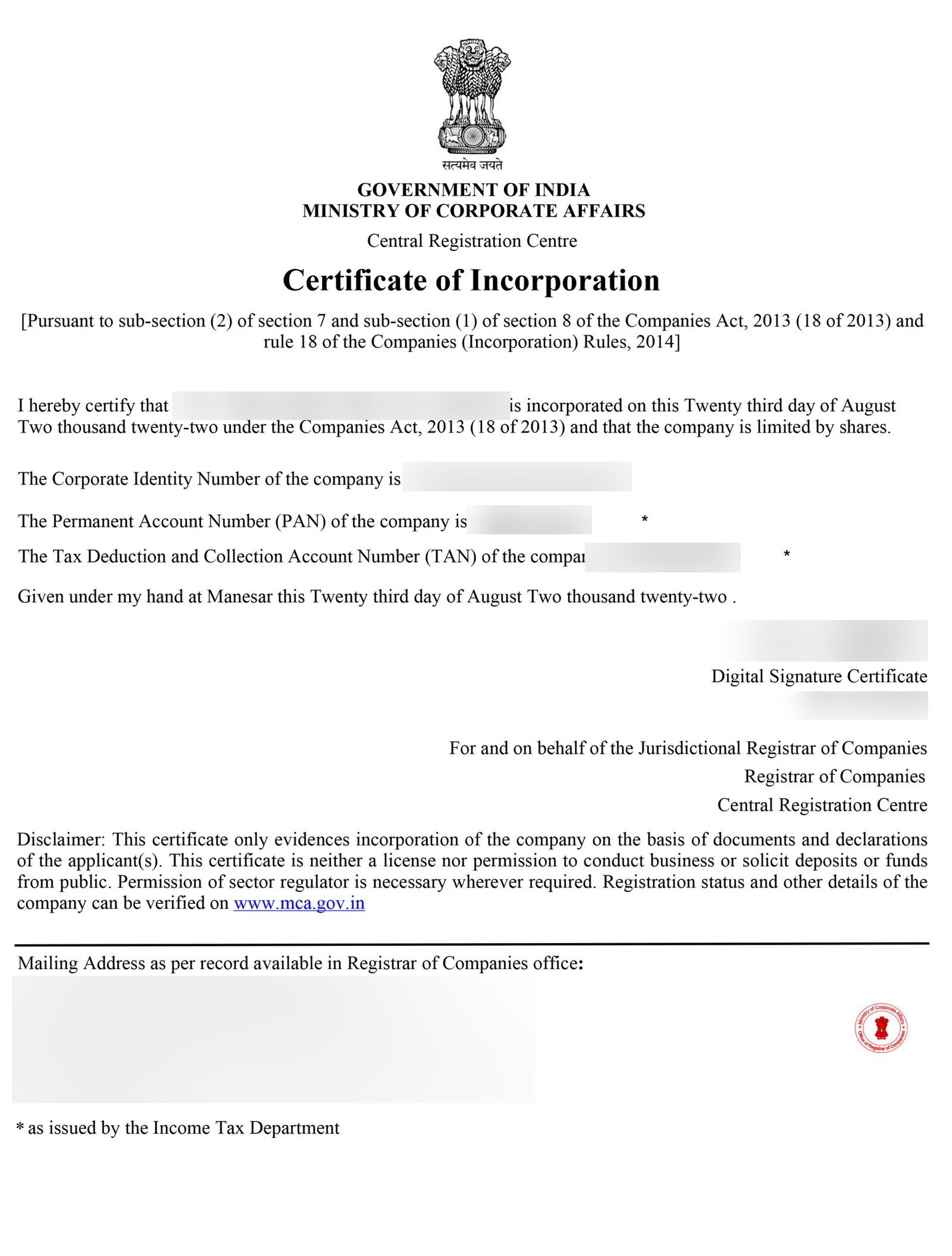
Once approved, the Registrar issues the Certificate of Incorporation with the Corporate Identity Number. PAN and TAN are integrated with the incorporation process.
What Happens After OPC Incorporation?
The certificate is the beginning of the compliance cycle, not the end. The following actions should be scheduled immediately after incorporation:
- Open and activate the company bank account and complete bank KYC requirements.
- Bring in the subscribed share capital and maintain clear banking evidence of the transaction.
- Issue share certificate and complete the statutory registers and internal records.
- Appoint the first statutory auditor within the applicable period and document the appointment correctly.
- File the commencement declaration in Form INC-20A where Section 10A applies, after the subscriber has paid for the shares agreed to be taken.
- Display and use the company’s legal name, CIN, registered office and other prescribed particulars on invoices, letterheads, website and official communications where required.
- Identify tax, labour, local and sector registrations that apply to the actual business activity.
GST, Udyam, Startup and Brand Registrations After OPC
OPC incorporation does not automatically register every other business law. GST must be assessed separately based on turnover, supply pattern and compulsory-registration categories. Vakilkaro offers GST Registration, while the official application and return system is the GST Portal.
Micro, small and medium enterprises can also check eligibility on the official Udyam Registration portal. If the business is innovation/scalability driven, it may separately assess DPIIT recognition through Vakilkaro Startup India Registration and the official Startup India portal. These are separate registrations; none is automatically granted merely because the OPC has been incorporated.
Annual Compliance for a One Person Company
An OPC receives some procedural relief compared with larger companies, but it remains a company and must maintain a proper annual compliance calendar.
- Maintain books of account, statutory registers, vouchers and supporting records.
- Prepare annual financial statements and obtain statutory audit even where turnover is low or there are limited transactions.
- File financial statements with the Registrar in the applicable form and timeline.
- File the abridged annual return for OPCs/small companies in Form MGT-7A, subject to the current MCA form framework.
- Complete income-tax return filing and tax audit/other tax compliances where applicable. The official Income Tax e-Filing Portal is used for income-tax compliance.
- Complete DIN KYC and event-based filings whenever applicable to the director/company.
- An OPC is not required to hold an Annual General Meeting. Where it has only one director, the special statutory treatment for single-director OPCs also simplifies board-meeting formalities; where it has more than one director, the reduced board-meeting framework should be followed.
OPC vs Sole Proprietorship vs Private Limited Company
| Point | OPC | Sole Proprietorship | Private Limited Company |
|---|---|---|---|
| Owners | 1 member | 1 proprietor | Minimum 2 members |
| Legal identity | Separate legal entity | Owner and business are same | Separate legal entity |
| Liability | Limited, subject to law | Unlimited personal liability | Limited, subject to law |
| Nominee | Required | Not applicable | Not required in the OPC manner |
| Statutory audit | Yes | Depends on tax/other thresholds | Yes |
| Equity investment | Limited by single-member structure | No share capital | Better suited for multiple investors |
| Compliance level | Moderate | Lower | Higher / broader corporate compliance |
| Best fit | Solo founder wanting company status | Very small/simple owner-run business | Growth/funding/co-founder model |
For a simpler non-company model, see Sole Proprietorship Registration. If there are two or more partners and operational flexibility is the priority, review LLP Registration. For co-founders, investors or a broader shareholding structure, Vakilkaro’s Private Limited Company Registration guide may be more suitable.
Can an OPC Convert into a Private Limited Company?
Yes. An OPC can convert into a private or public company by altering its constitutional documents, increasing the number of members and directors to the level required for the target class, complying with Section 18 and filing the prescribed conversion application. The 2021 rules removed the earlier compulsory conversion trigger linked to paid-up capital and turnover, so conversion is now generally a strategic choice rather than an automatic consequence of crossing those old thresholds.
Conversion is commonly considered when a co-founder joins, outside equity is proposed, ESOPs are planned or the company needs a broader ownership structure. The conversion should be planned before signing investment or share-allotment documents that an OPC cannot implement in its existing one-member form.
How Long Does OPC Registration Take?
A clean OPC incorporation is commonly completed in around 7-10 working days after the documents and digital signatures are ready, but the actual timeline depends on name approval, document accuracy, MCA processing, professional certification, state stamp duty and whether the Registrar raises a resubmission query. Foreign-address documents, regulated words or complex objects can extend the timeline.
OPC Registration Cost
The total cost is not one fixed government amount. A proper quote should separate the following components:
- Digital Signature Certificate cost.
- Name reservation / incorporation-related government filing fees, where applicable.
- State stamp duty on the Memorandum and Articles, which varies by state and capital.
- Professional drafting, certification and filing charges.
- Optional post-incorporation services such as GST, trademark, Startup India or ongoing annual compliance.
Before paying, ask for a written scope that states what is included, what is excluded, and whether resubmission support or post-incorporation handover is included.
Common OPC Registration Mistakes to Avoid
- Selecting OPC only because there is one founder, without checking future funding or co-founder plans.
- Choosing a company name without checking trademark conflicts.
- Using inconsistent spelling, address or identity details across PAN, Aadhaar/passport, DSC and MCA forms.
- Treating the nominee as an informal formality instead of checking eligibility and consent properly.
- Using a registered-office document set that is outdated, incomplete or inconsistent.
- Drafting objects too narrowly or using regulated activity wording without the necessary approval.
- Forgetting post-incorporation actions such as auditor appointment, share capital proof, share certificate, INC-20A where applicable and annual compliance.
- Assuming incorporation automatically grants GST, Startup India, MSME, trademark or sector licence approvals.
Why Choose Vakilkaro for OPC Registration?
- Structure-first guidance: we help decide whether OPC, Private Limited Company, LLP or Proprietorship fits the actual business plan.
- Document quality check before filing to reduce avoidable MCA resubmission queries.
- Name review with brand-risk awareness, not only a basic company-name check.
- End-to-end support for DSC, incorporation forms, nominee documentation and professional certification coordination.
- Clear post-incorporation handover covering auditor, share capital, INC-20A where applicable, statutory records and annual compliance calendar.
- Support for connected registrations such as GST, trademark, Startup India and other business licences where applicable.
- Transparent scope, practical updates and access to legal/compliance professionals for follow-up requirements.