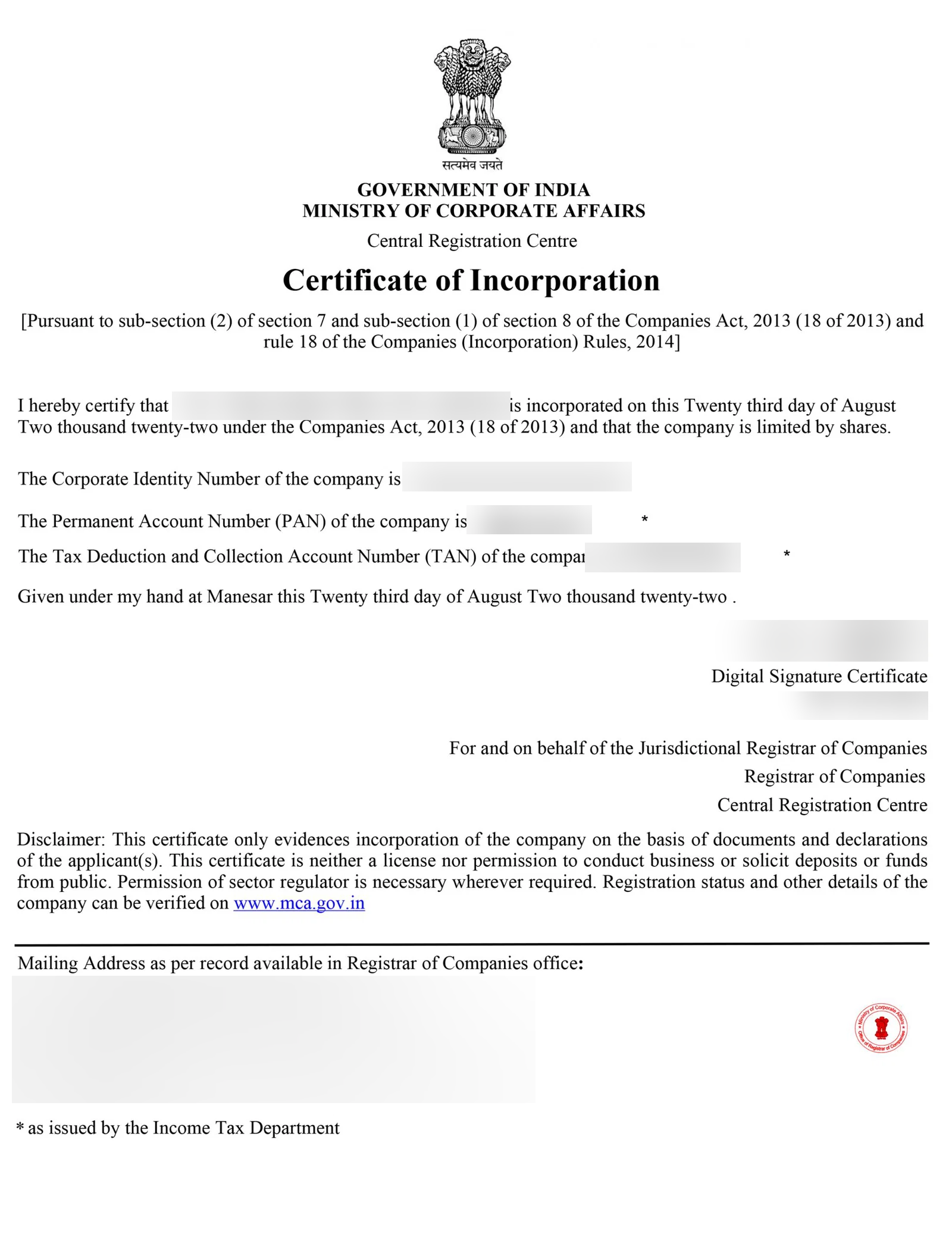
A Section 8 Microfinance Company is a not-for-profit company formed under the Companies Act, 2013 to support eligible low-income households through responsible microfinance activities. It can operate under a conditional RBI exemption only when prescribed requirements are met. Vakilkaro assists with incorporation, documentation, regulatory assessment and post-registration compliance support.
What Is a Section 8 Microfinance Company?
The expression “Section 8 Microfinance Company” is commonly used for a not-for-profit company incorporated under Section 8 of the Companies Act, 2013 that proposes to support eligible low-income households through financial-inclusion or microfinance activities. It is not a separate statutory company category and it does not, by itself, create an RBI lending licence.
Under the Section 8 model, income and surplus are applied toward the organisation’s approved objects instead of being distributed as dividends to members. Promoters who mainly want unrestricted commercial lending or personal profit distribution should compare this structure with an RBI-regulated NBFC route before committing to incorporation.
For ordinary Section 8 incorporation support, Vakilkaro’s Section 8 Company (NGO) Registration page explains the basic not-for-profit company structure. The microfinance model requires an additional regulatory and operational review because the company proposes to carry on lending-related activity.

Important MCA Position on Name and Object Drafting
The Ministry of Corporate Affairs (MCA) has published SPICe+ incorporation FAQs stating that a Section 8 company should not use “Micro Finance/Credit” words in its name or object at the time of incorporation. This makes object drafting a sensitive part of the filing.
- Do not copy a generic finance or lending object from another company.
- Do not select an unrelated activity description merely to avoid scrutiny.
- Frame the permitted Section 8 purpose around genuine social-welfare, financial-inclusion, livelihood, poverty-alleviation or community-development objectives, subject to professional review.
- Keep the proposed operating model, business plan and actual activities consistent with the approved constitutional documents.
The service-page term “Section 8 Microfinance Company Registration” should therefore be understood as a coordinated incorporation-and-readiness service for a proposed nonprofit microfinance model—not as a promise that MCA will approve a specific name or object clause.

Who Should Consider This Structure?
- Mission-led promoters: Founders whose central purpose is financial inclusion, poverty alleviation, livelihood support or community development rather than dividend distribution.
- Community programmes: Organisations planning responsible collateral-free lending for eligible low-income households within a controlled and documented programme.
- Experienced field teams: Teams that can combine household assessment, credit discipline, transparent collections, financial controls and grievance handling.
- Existing social-sector organisations: NGOs evaluating whether a separate corporate vehicle is appropriate for a proposed lending programme, after reviewing existing objects, grants and approvals.
This structure is generally unsuitable where the intended model includes public-deposit collection, secured lending as a core product, unrestricted finance activity, dividend extraction or rapid scale without a regulatory transition plan.
When Can the RBI Exemption Apply?
The RBI Master Direction on Exemptions from the RBI Act provides a conditional exemption from Sections 45-IA, 45-IB and 45-IC for qualifying not-for-profit microfinance companies. The conditions operate together; meeting only one or two is not enough.
| Condition | Practical Meaning |
|---|---|
| Section 8 / Section 25 status | The entity must be a qualifying not-for-profit company under the applicable company-law framework. |
| Only eligible microfinance loans | The financial lending activity must remain within the microfinance-loan definition relevant to the exemption. |
| 50% household repayment safeguard | Total monthly household loan obligations must not exceed 50% of monthly household income. |
| No public deposits | The company must not accept public deposits under the applicable RBI deposit definition. |
| Assets below ₹100 crore | The exemption requires asset size to remain below ₹100 crore; the threshold is about assets, not turnover or one borrower’s loan amount. |
What Counts as an Eligible Microfinance Loan?
RBI’s Microfinance Loans FAQs explain that a microfinance loan is a collateral-free loan to an individual belonging to a household with annual household income up to ₹3,00,000. Household income and indebtedness are assessed at household level, not only by looking at the applicant in isolation.
- The loan should be collateral-free. A gold-backed, equipment-hypothecated or other secured loan does not become a microfinance loan merely because the ticket size is small.
- Existing monthly repayments across household loans must be considered before a fresh loan is sanctioned.
- Expected future income from the activity being financed should not be added to current household income merely to make the borrower eligible.
- A lower internal repayment ceiling may be adopted as a risk-control measure even when the regulatory ceiling is higher.
- Old internet summaries containing historic loan caps or a universal 26% interest ceiling should not be used as current law without verification
Simple Household Affordability Example
Suppose a household has verified monthly income of ₹20,000 and existing monthly loan repayments of ₹6,500. A 50% repayment ceiling means total monthly loan obligations should not exceed ₹10,000. That leaves ₹3,500 of headroom before the ceiling is reached. A proposed instalment of ₹3,000 would take total repayments to ₹9,500, while a ₹4,000 instalment would take them to ₹10,500 and cross the ceiling. This is only an illustration; credit approval should also consider essential expenses, income stability, existing liabilities and internal credit policy.
Section 8 Microfinance vs RBI-Registered NBFC-MFI
| Decision Point | Qualifying Section 8 Model | RBI-Registered NBFC-MFI |
|---|---|---|
| Primary structure | Not-for-profit Section 8 company | RBI-registered NBFC carrying qualifying microfinance business |
| Member dividend | Not permitted | Depends on corporate structure and applicable law |
| RBI position | Conditional exemption only while all conditions continue | Certificate of Registration and continuing RBI supervision |
| Public deposits | Not permitted under exemption | NBFC-MFI is a non-deposit-taking category |
| Asset growth | Plan transition before ₹100 crore threshold is reached | Operates under ongoing RBI regulatory framework |
| Capital planning | No NBFC-style minimum NOF merely for Section 8 incorporation, but real lawful lending funds remain essential | RBI capital/NOF and other entry conditions apply |
Promoters whose model is fundamentally commercial should review Vakilkaro’s NBFC Registration service rather than choosing Section 8 only because incorporation capital may appear lower.
Basic Eligibility for Section 8 Incorporation
- A genuine nonprofit object permitted under Section 8 and a governance structure capable of supervising the programme.
- For a private Section 8 company, the usual minimum is two members and two directors; the same eligible individuals may perform both roles, subject to applicable law.
- At least one director should satisfy the resident-director requirement applicable under the Companies Act.
- A genuine registered office with acceptable occupancy/ownership evidence and owner consent where required.
- Consistent KYC, identity, address and digital-signature details for subscribers and directors.
- A realistic funding and operating plan explaining how administration, technology, staffing and the lending portfolio will be supported.
There is no fixed statutory minimum paid-up capital simply because the company is incorporated under Section 8. However, “no prescribed minimum for incorporation” does not mean a lending programme can begin without adequate capital, liquidity and risk buffers
What Vakilkaro’s Registration Support Can Cover
- Eligibility and model review: Collect the proposed social purpose, borrower segment, operating location, loan design, funding source and growth plan before filing.
- Promoter and document coordination: Prepare a practical checklist, check basic consistency and identify missing office or KYC records.
- Name and constitutional drafting support: Coordinate proposed names, Section 8 objects, MOA/AOA and supporting declarations for professional review.
- SPICe+ filing coordination: Prepare and coordinate the incorporation application and linked documents using the MCA process applicable on the filing date.
- Query and resubmission support: Assist with authority questions within the agreed scope and identify any additional professional work needed.
- Post-incorporation handover: Organise the issued records and identify pending actions for banking, governance, tax, compliance and lending readiness.
The written quotation should clearly distinguish company-incorporation work from additional services such as loan documentation, software, bureau/credit-score facilitation, accounting, audit, tax registrations, staff training or continuing compliance.
Section 8 Microfinance Company Registration Process
| Step | Stage | What Happens |
|---|---|---|
| 01 | Assess the proposed model | Review the social purpose, borrower category, products, geography, starting funds, projected asset size and regulatory route. |
| 02 | Organise promoter and office documents | Check identity, address, registered-office evidence, signatures and proposed roles for consistency. |
| 03 | Finalise name and Section 8 objects | Prepare a name/object strategy consistent with MCA restrictions and the proposed nonprofit purpose. |
| 04 | Arrange DSC/DIN and application particulars | Coordinate digital signatures, director particulars and the information required in the incorporation set. |
| 05 | File through the MCA process | Submit SPICe+ and linked Section 8 documents through the applicable professional where required. |
| 06 | Address queries or resubmission | Respond to authority observations on the facts; a filing acknowledgement is not an approval. |
| 07 | Complete post-incorporation readiness | Review banking, funds, governance, lending documents, software, controls and compliance before disbursement. |
Documents Required for Section 8 Microfinance Company Registration
The exact filing set depends on the promoters, office, ownership structure and MCA requirements on the filing date. The following documents and details are commonly prepared for incorporation and the separate operational-readiness review.
| Category | Documents / Information |
|---|---|
| Directors & Members | PAN where applicable, Aadhaar/passport or accepted identity proof, address proof, photograph where required, email, mobile number and proposed role. |
| Registered Office | Ownership/occupancy proof, rent or lease document where relevant, owner NOC/consent and a recent utility bill meeting filing requirements. |
| Company Formation | Proposed names, social-welfare/financial-inclusion objects, MOA, AOA, member/share or guarantee details, consents and declarations. |
| Financial Planning | Projected administrative budget, proposed lending fund, source-of-funds explanation and realistic financial estimates. |
| Operational Readiness | Target borrower profile, intended loan products, collection method, proposed policies, technology needs and grievance workflow. |
Registration Timeline and Cost
The timeline depends on document readiness, digital signatures, name/object scrutiny, portal availability and authority queries. Promoters should plan incorporation and operational launch as separate milestones. A certificate of incorporation does not mean the bank account, loan policies, software, credit-information arrangements or borrower documentation are ready on the same day.
| Cost Component | What Should Be Clear in the Quote |
|---|---|
| Professional incorporation support | Eligibility review, drafting, filing coordination and scope of query/resubmission assistance. |
| Government / statutory charges | Applicable filing, stamp-duty or other statutory charges for the selected structure and state. |
| Digital signatures | Number of DSCs, validity period and renewal/replacement terms. |
| Lending documentation | Whether loan agreement, sanction letter, repayment schedule, policies and borrower disclosures are included. |
| Technology & partner services | Software subscription, implementation, payment integration, credit-score/bureau facilitation and usage charges. |
| Ongoing compliance | Bookkeeping, audit, ROC filings, tax work, exemption monitoring and event-based assignments. |
Vakilkaro can provide a scope-based quotation after understanding the model. Avoid treating registration fees as the total capital required to run the organisation; the money needed for operations and the loan portfolio is a separate financial decision.
Capital, Donations and Funding Sources
Prepare separate budgets for incorporation, administration, technology, employees and the lending portfolio. Funding may involve lawful promoter/member contributions, grants, donations, permitted borrowings or institutional arrangements depending on the facts and applicable law. Each receipt should be correctly classified and supported by proper approvals and accounting records.
- Do not accept public deposits while relying on the RBI exemption.
- Do not label repayable money as a “donation” or “membership contribution” simply to avoid deposit or borrowing rules.
- Restricted grants should be used according to donor terms and tracked separately.
- Foreign contributions, donor tax benefits and charitable-tax exemptions require separate eligibility and approvals; they do not arise automatically from Section 8 incorporation.
Where the organisation later qualifies, Vakilkaro can separately assist with 12A and 80G Registration. These tax approvals should be evaluated independently from the Section 8 incorporation and RBI exemption.
Interest, Processing Fees and Borrower Protection
A nonprofit lending programme still needs a sustainable cost model, but pricing must remain transparent, reasonable and consistent with the organisation’s purpose. The current RBI framework does not use the old universal 26% microfinance interest-rate cap or a universal 1% processing-fee ceiling. A responsible lender should document how pricing is set, disclose charges before acceptance and avoid hidden deductions.
- Explain the sanctioned amount, tenure, instalments, rate, fees, total repayment and grievance contact in clear language.
- Avoid prepayment penalties on microfinance loans as a borrower-protection baseline.
- If a delayed-payment charge is used, it should be transparent and proportionate; professional review should confirm applicability.
- Do not bundle unwanted products or use coercive recovery practices.
- Do not use threats, public shaming, harassment or misleading statements in collection activity.
- RBI’s customer-centric directions are directly applicable to regulated entities in their stated scope, and RBI’s FAQs say it may be prudent for other microfinance lenders to follow those customer-protection standards as well.
What Should Be Ready Before the First Loan?
- Borrower assessment: A consistent method for identity, household income, existing debt, repayment capacity and approval records.
- Loan documentation: Clear loan terms, sanction communication, repayment schedule, acknowledgements, consent records and borrower-facing explanations.
- Money movement: Defined disbursement and collection accounts, authorised users, reconciliation controls and exception handling.
- Governance: Board-approved responsibilities, conflict management, maker-checker controls and exception-approval limits.
- Grievance and recovery: A visible complaint channel, staff conduct rules, authorised recovery process and escalation matrix.
- Technology: Loan-management software with audit trails, user permissions, backups, reports and controlled correction of entries.
A small supervised pilot is safer than opening multiple branches immediately. Test real scenarios such as a partial repayment, failed auto-debit, corrected posting, early closure and disputed charge before scaling.
CIBIL, Credit Information and Auto-Debit
Company incorporation does not automatically provide direct TransUnion CIBIL membership, credit-bureau access, credit reporting rights or the power to change a borrower’s credit score. Eligibility depends on the relevant bureau or partner arrangement, regulatory status, lawful purpose, borrower consent, contractual approval and technology readiness.
Where included in the engagement, Vakilkaro may coordinate credit-score or borrower-credit-check facilitation through eligible partner channels. The exact bureau, report type, access route, onboarding conditions, pricing and reporting capability should be confirmed in writing.
NACH, eNACH or other auto-debit facilities also depend on the bank or service provider’s onboarding and a valid customer mandate. A software subscription does not itself create collection authority, and a mandate does not guarantee successful payment.
Compliance After Incorporation
| Workstream | Practical Action |
|---|---|
| Corporate Governance | Maintain statutory records, board approvals, meeting processes and authorised signatory controls. |
| Books & Audit | Keep accurate books, vouchers, bank reconciliations and loan ledgers; arrange audit and annual financial reporting. |
| Tax & Reporting | Review the applicable return, withholding, registrations and charitable-tax position with the appropriate professional. |
| RBI Exemption Monitoring | Track asset size, eligible-loan conditions, household repayment assessments and deposit restrictions. |
| Borrower Service | Preserve receipts, schedules, complaints and recovery records; review field-staff conduct. |
| Business Changes | Reassess new products, funding, branches, technology, directors, objects or partnerships before implementation. |
Reliable bookkeeping support helps keep the loan ledger, bank records and financial statements audit-ready. Tax filing should also be separately assessed through the appropriate Company ITR Filing process instead of assuming that every Section 8 entity uses the same return or automatically enjoys an income-tax exemption.
Common Mistakes to Avoid
- Advertising the company as “RBI approved” when it only relies on a conditional exemption.
- Using outdated incorporation forms, old loan limits or old interest-cap summaries without checking current rules.
- Assuming the ₹100 crore figure is a loan limit instead of an asset-size threshold relevant to the exemption.
- Offering secured loans while describing them as qualifying microfinance loans.
- Granting a fresh loan when the household’s total monthly repayment obligations already exceed the permitted ceiling.
- Taking public deposits or informal repayable money without a legal review.
- Assuming 12A/80G, CIBIL access, bank funding or government grants arise automatically after incorporation.
- Launching software before policies, permissions, loan documents and reconciliation controls are ready.
- Mixing donations, member contributions, borrowings and lending capital without separate documentation and accounting.
Why Choose Vakilkaro?
Vakilkaro focuses on connecting the incorporation exercise with the practical decisions needed to build a controlled microfinance programme. The service is coordinated through qualified professionals where regulated professional work is required, with the scope and exclusions defined in writing.
- Eligibility before filing — review the proposed model before spending on the wrong structure.
- Clear document checklist — organise promoter, office and planning information in one controlled process.
- Practical drafting coordination — align Section 8 objects, filings and supporting information with the proposed social purpose.
- Transparent scope and pricing — separate government charges, professional work and optional third-party services.
- Post-registration support — plan accounting, compliance, lending documents, software, credit-score facilitation and staff workflows where separately agreed.
- Pan-India online coordination — handle the registration process without repeated physical office visits, subject to applicable verification and authority requirements.
Start Your Section 8 Microfinance Registration Assessment
Build the organisation around the right structure, genuine nonprofit objects, responsible borrower treatment and documented controls. Share your proposed activities, promoter details, borrower segment, expected starting funds and planned loan products with Vakilkaro so the team can coordinate an eligibility assessment and provide a defined service proposal.