

Form 15CA and Form 15CB were used for reporting specified payments to non-residents and foreign companies. From 1 April 2026, corresponding reporting is made through Form 145 and Form 146. The applicable form depends on taxability, remittance amount and whether CA or Assessing Officer certification applies.
15CA & 15CB Filing for Foreign Remittance
Indian businesses and individuals regularly make overseas payments for professional services, consultancy, software, royalty, interest, commission, technical services and other commercial transactions.
A foreign payment should not be considered only from a banking perspective. The payer may also need to determine whether the payment is taxable in India, whether TDS applies and whether prescribed remittance information must be filed with the Income Tax Department.
Under the earlier Income-tax Act, 1961, taxpayers commonly knew this compliance as Form 15CA and Form 15CB filing. From 1 April 2026, the reporting framework has changed. Form 145 now corresponds to earlier Form 15CA, while Form 146 corresponds to earlier Form 15CB. Taxpayers should therefore check the date of remittance before deciding which form applies.
15CA & 15CB Filing: Important 2026 Update
For remittances made up to 31 March 2026, Form 15CA and Form 15CB may remain relevant depending on the transaction and applicable transitional rules.
For remittances made on or after 1 April 2026:
- Form 145 replaces Form 15CA
- Form 146 replaces Form 15CB
The applicable forms can be accessed through the Income Tax e-Filing Portal. Businesses should avoid using older compliance instructions for current remittances without checking the new framework.
What Is Form 15CA?
Form 15CA was a declaration filed by a person making a specified payment to a non-resident or foreign company. Its purpose was to provide prescribed information regarding the remittance, including the nature of payment, taxability and tax deducted where applicable.
From 1 April 2026, the corresponding declaration is filed through Form 145. Form 145 continues to classify remittances according to taxability, amount and the certification route used by the payer.
What Is Form 15CB?
Form 15CB was a certificate issued by a Chartered Accountant for specified taxable foreign remittances. It was not required for every overseas payment.
The Chartered Accountant could examine matters such as:
- Nature of payment
- Taxability in India
- Applicable tax provisions
- DTAA provisions
- Withholding-tax rate
- Tax deduction
- Supporting transaction documents
From 1 April 2026, Form 146 is the corresponding CA certificate for applicable transactions.
Form 145 vs Form 146 (15CA & 15CB Filing)
| Particular | Form 145 | Form 146 |
|---|---|---|
| Earlier equivalent | Form 15CA | Form 15CB |
| Filed by | Remitter | Chartered Accountant |
| Purpose | Remittance declaration | CA certification |
| Applicable from | 1 April 2026 | 1 April 2026 |
| CA involvement | Depends on applicable part | Required |
| Filing portal | Income Tax e-Filing Portal | Income Tax e-Filing Portal |
Parts of Form 145
Form 145 contains different parts based on taxability and the value of the remittance.
Part A
Part A generally applies where the payment is taxable in India and the amount or aggregate of such remittances does not exceed ₹5 lakh during the relevant tax year.
The payer should consider the aggregate value rather than only one individual payment.
Part B
Part B generally applies where:
- The payment is taxable
- The aggregate exceeds ₹5 lakh
- The prescribed Assessing Officer certificate or order has been obtained
Part C
Part C generally applies where:
- The payment is taxable
- The aggregate exceeds ₹5 lakh
- Form 146 has been obtained from a Chartered Accountant
The relevant Form 146 details are linked with Part C filing.
Part D
Part D generally covers specified payments that are not taxable in India, subject to exclusions provided under the applicable rules. A non-taxable payment does not always mean that no reporting is required. Applicability should be checked for each transaction.
Is Form 146 Mandatory for Every Foreign Remittance?
No. Form 146 is not required for every international payment.
Its applicability generally depends on:
- Whether the payment is taxable in India
- Whether the relevant remittance threshold is crossed
- Whether the Assessing Officer certification route is being used
- Nature of the transaction
Businesses should first determine applicability rather than automatically obtaining a CA certificate for every foreign remittance.
₹5 Lakh Threshold
The ₹5 lakh threshold remains important in determining the applicable reporting route.
Broadly:
- Taxable remittances up to the applicable ₹5 lakh aggregate may fall under Part A
- Taxable remittances exceeding ₹5 lakh may fall under Part B or Part C
- Non-taxable payments may fall under Part D, subject to exclusions
The ₹5 lakh limit should not be treated as an automatic tax exemption. Taxability must be examined separately under the applicable income-tax provisions and DTAA, where relevant.
Taxability of Foreign Remittance
A payment made outside India is not automatically exempt from Indian tax merely because the recipient is located overseas.
Taxability may depend on factors such as:
- Nature of income
- Source of income
- Nature of services
- Place of performance
- Royalty provisions
- Technical or consultancy services
- Permanent establishment
- Residential status
- Beneficial ownership
- Applicable DTAA
The agreement, invoice and surrounding commercial arrangement should be reviewed before deciding whether TDS and remittance reporting apply.
DTAA and Foreign Remittance
India has entered into Double Taxation Avoidance Agreements with several countries. Where a DTAA applies, the payer may need to compare domestic tax provisions with treaty provisions.
Relevant issues may include:
- Nature of income
- Applicable treaty article
- Tax residency
- Permanent establishment
- Royalty
- Fees for technical services
- Interest
- Business profits
- Beneficial ownership
- Applicable tax rate
Treaty relief should not be claimed only because the recipient has a foreign address. Supporting documents such as a Tax Residency Certificate and prescribed information may be required depending on the transaction.
Common Payments Requiring Review
Applicability of Form 145 or Form 146 may need to be checked for payments such as:
- Professional fees
- Consultancy charges
- Technical-service fees
- Management fees
- Royalty
- Licence fees
- Interest
- Commission
- Software payments
- Subscription payments
- Contractual payments
- Reimbursements
- Intellectual-property payments
- Other payments to non-residents
This does not mean that Form 146 is automatically required for every payment listed above.
Cases Where Reporting May Not Be Required
Certain foreign remittances may be excluded from reporting under the applicable income-tax rules. Depending on the current framework, exclusions may apply to specified transactions or remittance categories.
Possible categories may include:
- Import transactions
- Overseas investments
- Loans
- Business travel payments
- Airline-related payments
- Other prescribed remittances
The correct treatment should be checked according to the actual transaction and current rules. For foreign-exchange requirements, businesses may also refer to the Reserve Bank of India.
Foreign Remittance and FEMA
Income-tax reporting and FEMA compliance are separate requirements.
A foreign payment may need to satisfy:
- Income-tax requirements
- TDS requirements
- FEMA requirements
- RBI requirements
- Bank documentation
- Contractual obligations
The Foreign Exchange Management Act, 1999 provides the broader foreign-exchange framework. Filing Form 145 or obtaining Form 146 does not replace any separate FEMA or banking compliance that may apply.
Documents Required for 15CA & 15CB Filing
The documents required for Form 145 and Form 146 filing may vary depending on the nature, value and taxability of the foreign remittance.
| Document / Information | Purpose |
|---|---|
| PAN and basic details of the remitter | Identification and filing details |
| TAN, where applicable | TDS compliance |
| Name, address and country of the recipient | Identification of the non-resident or foreign company |
| Invoice | Verification of the nature and value of payment |
| Agreement or contract | Review of the underlying transaction |
| Proposed remittance amount and currency | Remittance and threshold analysis |
| Details of previous remittances during the tax year | Aggregate remittance calculation |
| Proposed remittance date | Filing and transaction details |
| Nature and purpose of payment | Taxability and reporting review |
| RBI purpose code, where applicable | Banking and remittance classification |
| Tax Residency Certificate, where relevant | DTAA and treaty review |
| Form 10F or other treaty-related information, where applicable | Supporting treaty documentation |
| TDS computation and payment details | Withholding-tax review |
| Assessing Officer certificate or order, where applicable | Part B filing support |
| Chartered Accountant certification details, where applicable | Part C and Form 146 filing support |
Additional documents or declarations may be required depending on the transaction, applicable DTAA provisions and the requirements of the authorised dealer bank.
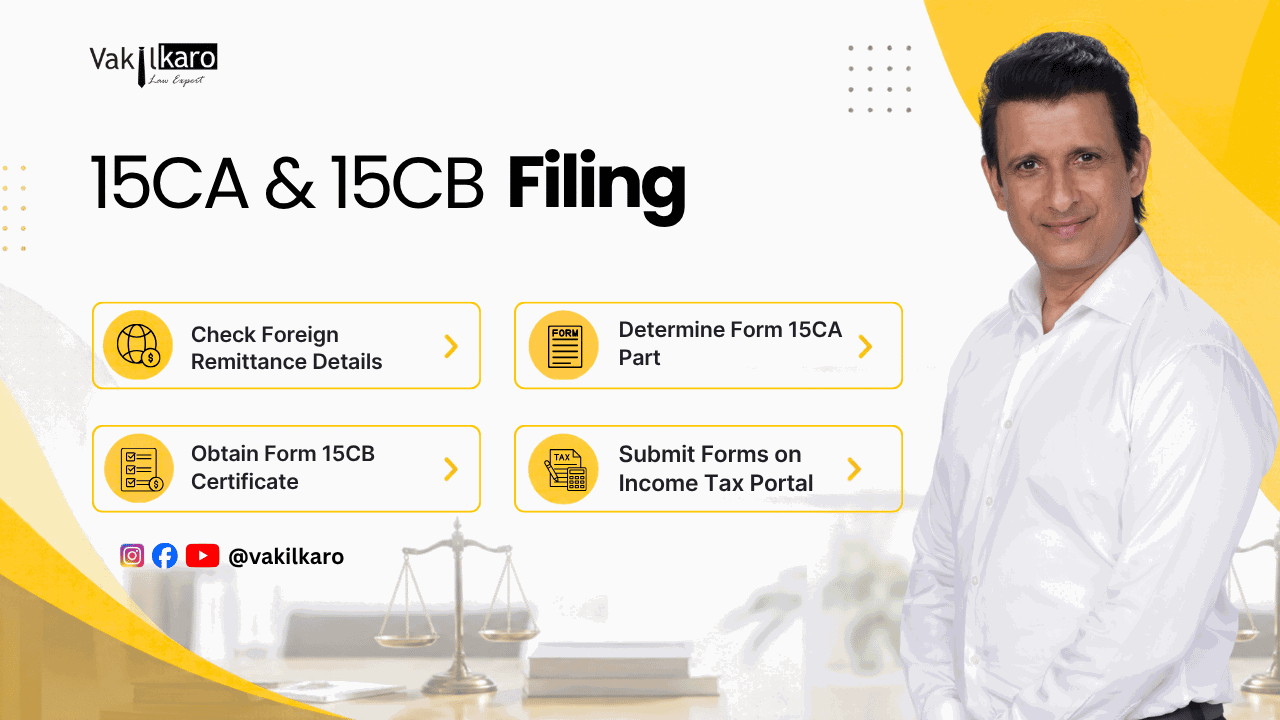
Step-by-Step 15CA & 15CB Filing Process
Step 1: Review the Transaction
Check the invoice, agreement, recipient, amount, currency and purpose of remittance.
Step 2: Check the Applicable Form
Determine whether the transaction falls under the earlier Form 15CA and Form 15CB framework or the current Form 145 and Form 146 framework.
Step 3: Determine Taxability
Review whether the amount payable to the non-resident is taxable in India. Where relevant, examine both domestic tax law and the applicable DTAA.
Step 4: Determine TDS
If withholding tax applies, calculate the applicable rate and amount.
Step 5: Check the ₹5 Lakh Threshold
Review the aggregate taxable remittances during the relevant tax year.
Step 6: Select Part A, B, C or D
Choose the appropriate part of Form 145 based on taxability, amount and certification route.
Step 7: Obtain Form 146 Where Required
Where applicable, assign the relevant form to a registered Chartered Accountant for review and certification.
Step 8: File Form 145
Complete the relevant Form 145 filing through the Income Tax e-Filing Portal.
Step 9: Complete Verification
Verify the form through the prescribed electronic method.
Step 10: Maintain Filing Records
Keep the acknowledgement, tax documents and supporting records available for the authorised dealer bank and future compliance review.
Role of the Chartered Accountant
Where Form 146 is required, the Chartered Accountant may review:
- Invoice
- Agreement
- Nature of payment
- Recipient details
- Taxability
- DTAA provisions
- Tax Residency Certificate
- TDS rate
- Tax deducted
- Remittance particulars
Clients should provide complete and accurate documents so that the transaction can be examined properly.
Common 15CA & 15CB Filing Mistakes
Businesses should avoid the following errors while filing Form 145 or Form 146:
- Using outdated Form 15CA or Form 15CB guidance for current remittances
- Assuming Form 146 is required for every foreign payment
- Selecting the wrong part of Form 145
- Ignoring the ₹5 lakh aggregate remittance threshold
- Incorrectly determining the taxability or TDS treatment of the payment
- Claiming DTAA benefits without adequate supporting documents
- Providing incorrect or inconsistent invoice, agreement or recipient details
- Using the wrong nature of remittance or purpose code
- Submitting incomplete documents for CA certification
- Filing without reviewing the underlying transaction and previous remittances
A transaction-specific review can help reduce filing errors and ensure that the correct reporting route is followed.
Form 145 and Form 146 for Companies and LLPs
Companies and LLPs may make overseas payments for software, consultancy, technical services, advertising, professional services, licence rights, commission and other business expenses. Businesses should maintain proper agreements, invoices, accounting records and tax documentation for these payments.
Foreign-remittance compliance should also remain consistent with the entity's books of account, TDS records and income-tax filings. Related services may include Private Limited Company Registration, LLP Registration and Income Tax E-Filing.
TDS and Foreign Remittance
Foreign-remittance reporting and TDS are connected but are not the same compliance. The payer should first determine whether tax is deductible from the payment.
Where TDS applies, the appropriate rate may depend on:
- Domestic tax law
- Nature of payment
- DTAA provisions
- Tax residency
- Supporting documentation
The correct withholding position should be determined before completing the remittance declaration.
15CA & 15CB Filing Timeline
The filing should generally be completed before the applicable foreign remittance is made.
The practical timeline can depend on:
- Availability of documents
- Taxability review
- DTAA analysis
- CA certification
- Assessing Officer certificate, where applicable
- Portal availability
- Bank requirements
Businesses should therefore begin compliance review before the contractual payment date.
15CA & 15CB Filing Fees
The professional fee for Form 145 and Form 146 filing may vary depending on the nature and complexity of the foreign remittance.
The cost may depend on factors such as:
- Nature and value of the remittance
- Taxability of the payment in India
- Applicability of DTAA provisions
- TDS and withholding-tax review
- Number of remittances involved
- Requirement of Form 146 certification by a Chartered Accountant
- Complexity of the supporting documents and transaction structure
Vakilkaro's professional fee for 15CA & 15CB filing starts at ₹15,000 + GST for businesses with turnover up to ₹1 crore. For higher turnover or multiple remittances, the fee is quoted after reviewing the transaction.
Why Choose Vakilkaro for 15CA & 15CB / Form 145 & Form 146 Filing?
Foreign remittance compliance requires careful review of the transaction, taxability, applicable form and supporting documents before filing. Vakilkaro helps coordinate the process so the correct filing route can be identified based on the nature and value of the remittance.
- Applicability review for Form 145, Form 146 and legacy Forms 15CA/15CB
- Review of remittance amount, nature of payment and ₹5 lakh threshold applicability
- Identification of the correct Part A, B, C or D of Form 145
- Review of invoices, agreements, remitter and recipient details
- TDS, withholding-tax and relevant DTAA document review
- Coordination with a Chartered Accountant where Form 146 certification is required
- Filing support, acknowledgement records and related foreign-remittance compliance coordination