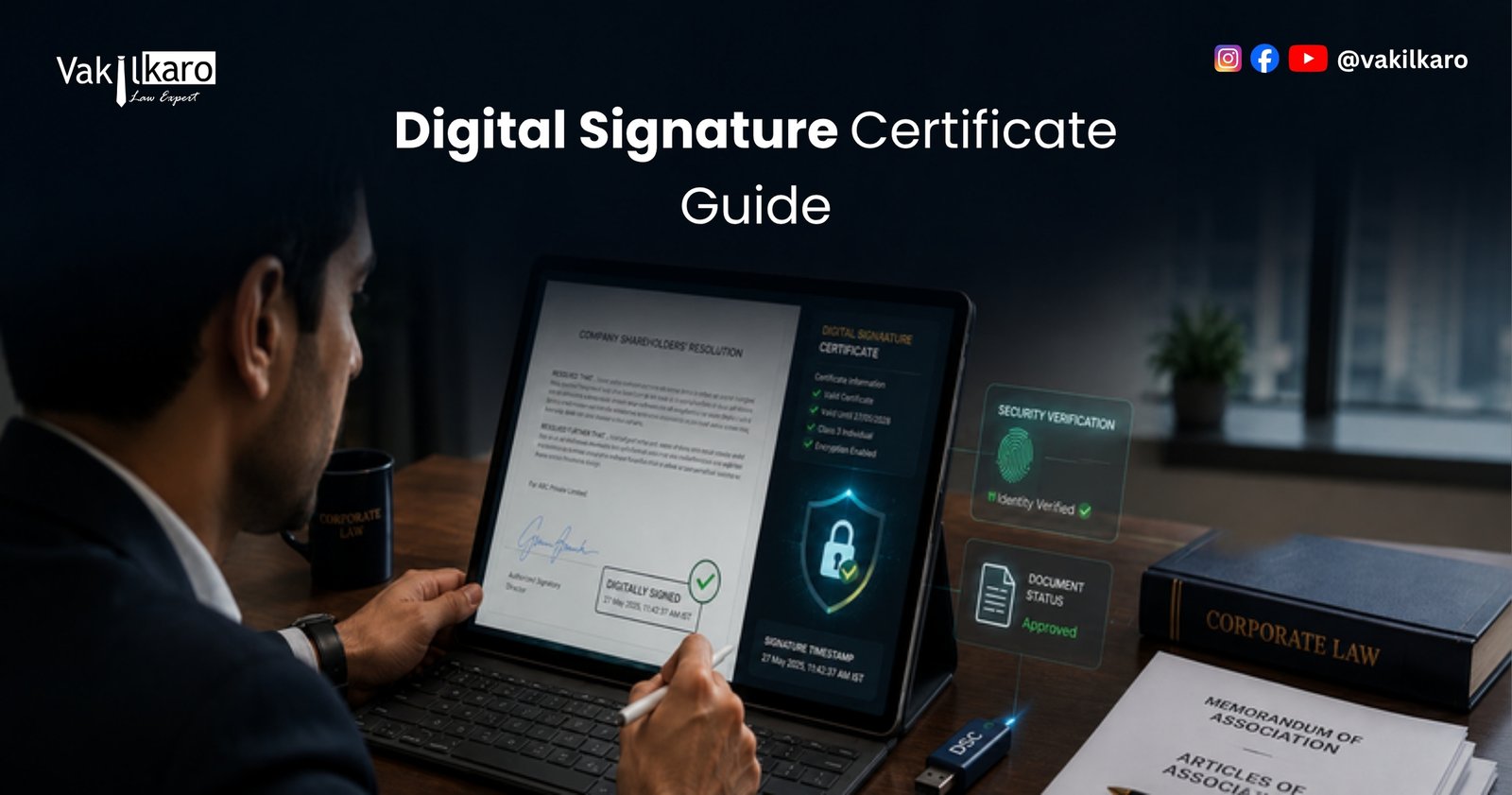
A Digital Signature Certificate (DSC) is an electronic signature issued by a licensed Certifying Authority under the Information Technology Act, 2000. It verifies the identity of the signer and enables secure online filing of documents with government authorities. A Class 3 DSC is commonly required for Company Registration, MCA filings, GST compliance, Income Tax filings, DGFT applications and government e-Tendering. Once issued, the DSC can be used to digitally sign electronic documents with legal validity.
Many incorporation applications are delayed simply because founders wait until the last moment to apply for their DSC. Since video verification and document validation may require additional time, applying for the certificate early generally accelerates the overall company registration process. A Digital Signature Certificate is issued only after the applicant's identity is verified by a licensed Certifying Authority (CA). The eligibility requirements are designed to ensure that every certificate is issued to a genuine individual or organisation whose identity can be authenticated through valid documentation.
Eligibility is rarely the reason for rejection. Most DSC applications are delayed because the documents submitted during verification do not exactly match the applicant's official identity records. The issuing authority verifies the identity of the applicant before issuing a Digital Signature Certificate.
Many applicants receive the certificate successfully but face technical difficulties during installation or browser configuration. Proper installation support ensures that the certificate is immediately usable for MCA, GST and Income Tax filings. Video Verification has become an important part of the DSC issuance process.
Many users believe that uploading a scanned handwritten signature is equivalent to a Digital Signature Certificate. It is not. A scanned signature is simply an image. A Digital Signature Certificate is a cryptographically secured electronic identity recognised under the Information Technology Act, 2000.
| Particular | Details |
|---|---|
| Certificate Name | Digital Signature Certificate (DSC) |
| Common Certificate Type | Class 3 DSC |
| Governing Law | Information Technology Act, 2000 |
| Regulated By | Controller of Certifying Authorities (CCA) |
| Issued Through | Licensed Certifying Authorities |
| Processing Mode | 100% Online |
| Typical Processing Time | 1–2 Working Days |
| Validity | As per the certificate selected at the time of issuance |
| Renewal | Required before expiry |
| Major Use | Company Registration, MCA, GST, Income Tax, DGFT, e-Tendering |
Key Highlights
- Legally Valid Electronic Signature
- Required for Company Registration
- Mandatory for Most MCA e-Filings
- Used for GST & Income Tax Compliance
- Secure Online Identity Verification
- Supports Government e-Services
- Prevents Document Tampering
- Enables Paperless Compliance
- Fast Online Application Process
- Widely Accepted Across Government Portals
The shift towards digital governance has transformed the way businesses interact with government departments in India. Most regulatory authorities now require applications, statutory forms and compliance documents to be filed electronically. To ensure that these electronic filings are authentic, secure and legally enforceable, government systems rely on Digital Signature Certificates.
Unlike scanned signatures or typed names, a Digital Signature Certificate provides cryptographic verification that confirms the identity of the signer and protects the integrity of the signed document. This technology forms the foundation of secure electronic governance and is widely accepted across various government platforms.
For entrepreneurs planning to register a Private Limited Company, obtaining a Digital Signature Certificate is generally one of the earliest compliance requirements because incorporation documents submitted through the Ministry of Corporate Affairs must be digitally authenticated by the proposed directors. Similarly, Chartered Accountants, Company Secretaries, GST practitioners, importers, exporters and businesses participating in government tenders also depend upon Digital Signature Certificates for secure online transactions.
Although the process of obtaining a DSC has become relatively straightforward, many applications are delayed because of document mismatch, incomplete verification or incorrect certificate selection. Proper guidance at the application stage significantly reduces such delays and ensures that the certificate is ready for immediate use.
What is a Digital Signature Certificate (DSC)?
- A Digital Signature Certificate (DSC) is a secure electronic credential that establishes the digital identity of an individual or organisation. It is issued by a licensed Certifying Authority (CA) regulated by the Controller of Certifying Authorities (CCA) under the Information Technology Act, 2000.
- A DSC enables users to digitally sign electronic documents in a manner that is legally recognised in India. The certificate uses Public Key Infrastructure (PKI) technology to create a unique digital signature linked to the certificate holder. Once a document is digitally signed, any unauthorised alteration can generally be detected, thereby enhancing the security and reliability of electronic transactions.
- For businesses, a Digital Signature Certificate is more than a compliance requirement—it is an essential tool for secure digital communication with government authorities. Whether filing incorporation documents with MCA, submitting GST returns, signing Income Tax forms or participating in electronic procurement systems, a valid DSC provides legal authenticity and helps ensure that online filings are accepted by the relevant government platform.
Types of Digital Signature Certificate (DSC)
Different categories of Digital Signature Certificates are issued depending upon the intended use of the certificate.
Selecting the appropriate certificate is important because different government departments and business activities may require different types of DSCs.
Class 3 Individual DSC
The Class 3 Individual DSC is the most commonly used certificate for individuals conducting secure online transactions.
It is widely used for:
- Company Registration
- MCA Filings
- ROC Compliance
- Income Tax Filings
- GST Filings
- Government e-Tendering
- Director Authentication
For company directors and business owners, this is generally the certificate used during incorporation and subsequent corporate compliance.
Class 3 Organisation DSC
This certificate is issued in the name of an organisation rather than an individual.
It is commonly used where authorised representatives digitally sign documents on behalf of the organisation.
Typical applications include:
- Corporate Filings
- Government Contracts
- Procurement Systems
- Large Organisations
Why is a Digital Signature Certificate Required?
Government departments have increasingly shifted towards paperless governance.
To ensure that electronic documents remain legally reliable, digitally authenticated signatures have replaced handwritten signatures in many statutory filings.
A Digital Signature Certificate therefore serves multiple purposes beyond merely signing documents.
Legal Authentication
A DSC confirms that the person signing the document is the authorised individual.
Document Integrity
Once a document has been digitally signed, unauthorised alterations can generally be detected during verification.
Secure Online Transactions
Digital signatures reduce the risk of identity misuse and unauthorised document modification.
Compliance with Government Portals
Several government departments require digitally authenticated submissions.
Without a valid DSC, many statutory filings cannot be completed electronically.
Faster Digital Processing
Electronic authentication enables government departments to process applications without requiring physical signatures.
Eligibility for a Digital Signature Certificate (DSC)
The eligibility criteria differ slightly depending on whether the applicant is applying as an individual, a company representative or an authorised signatory. However, in most cases, the process is straightforward if the applicant provides accurate information and valid supporting documents.
Individuals
An individual may apply for a Digital Signature Certificate if they:
- Are applying in their personal capacity.
- Require a DSC for company incorporation, tax filing or government services.
- Can complete identity verification through prescribed documents.
- Can successfully complete the online verification process.
Company Directors
Directors of Private Limited Companies frequently require a DSC for:
- Company Registration
- SPICe+ Filing
- ROC Compliance
- Director KYC
- Annual Filings
- MCA e-Forms
Since all MCA filings are completed electronically, a valid Digital Signature Certificate becomes an essential compliance requirement.
LLP Partners
Designated Partners of LLPs also require DSC for:
- LLP Registration
- LLP Annual Returns
- MCA Filings
- Partner Compliance
Chartered Accountants, Company Secretaries & Cost Accountants
Professionals authorised to file statutory documents on behalf of clients frequently require Digital Signature Certificates for:
- MCA Filings
- Income Tax Compliance
- GST Filings
- Statutory Certifications
- Regulatory Submissions
Organisations
Companies and organisations may obtain organisation-based Digital Signature Certificates where authorised signatories digitally execute documents on behalf of the entity.
Documents Required for a Digital Signature Certificate
The following documents are generally required.
Identity Proof
Accepted documents commonly include:
- PAN Card
- Passport
- Driving Licence
- Voter Identity Card
For Indian applicants, PAN is generally the primary identity document.
Address Proof
Commonly accepted address proof includes:
- Aadhaar Card
- Bank Statement
- Electricity Bill
- Telephone Bill
- Passport
- Gas Bill
The document should normally be recent and clearly display the applicant's name and address.
Photograph
A recent passport-size photograph may be required depending on the verification process followed by the Certifying Authority.
Email Address
A valid email address is required because:
- Verification links
- Certificate notifications
- Application updates
are generally communicated electronically.
Mobile Number
A mobile number is required for:
- OTP Verification
- Video Verification
- Application Updates
Additional Documents (Where Applicable)
For organisation-based certificates, additional authorisation documents may be required depending on the applicant's role and the issuing authority's requirements.
Document Checklist
Before applying, ensure that:
- PAN details are correct
- Address proof is valid
- Mobile number is active
- Email address is accessible
- Identity details match across all documents
Vakilkaro Recommendation
Before submitting your application, verify that your PAN, Aadhaar (where used), address proof and application form contain identical spelling of your name. Even minor inconsistencies frequently result in application delays or rejection.
Step-by-Step DSC Application Process
Obtaining a Digital Signature Certificate is generally completed through an online process.
Vakilkaro follows the following workflow to minimise delays and improve approval timelines.
Step 1 – Application Consultation
The applicant's requirements are reviewed to determine:
- Certificate Type
- Intended Use
- Validity Period
- Applicable Documentation
Step 2 – Document Collection
Identity and address documents are collected and verified before submission.
Incomplete or inconsistent documentation is corrected at this stage.
Step 3 – Online Application
The application is prepared and submitted to the authorised Certifying Authority.
Step 4 – Identity Verification
The applicant completes the prescribed verification process, which may include:
- OTP Authentication
- Video Verification
- Document Validation
Step 5 – Certificate Approval
After successful verification, the Digital Signature Certificate is issued.
Step 6 – Installation & Activation
The certificate is installed and configured for use on the relevant government portals and software systems.
Video Verification
During verification, the applicant may be required to:
- Confirm personal identity.
- Display original identity documents.
- Complete OTP authentication.
- Follow instructions provided by the Certifying Authority.
Successful completion of verification is generally necessary before certificate issuance.
Government & Professional Fees
The cost of obtaining a Digital Signature Certificate depends upon:
- Certificate Type
- Validity Selected
- Issuing Authority
- Professional Assistance
- Token Requirements (where applicable)
As fee structures may change from time to time, applicants should verify the latest charges before applying.
Vakilkaro provides transparent assistance by explaining both statutory charges (where applicable) and professional service fees before initiating the application.
How Does a Digital Signature Certificate (DSC) Work?
A Digital Signature Certificate (DSC) works through Public Key Infrastructure (PKI), a cryptographic technology that enables secure electronic authentication. Instead of using a handwritten signature, the certificate creates a unique digital signature linked to the identity of the certificate holder. This digital signature confirms that the document has been signed by the authorised person and helps detect any unauthorised modification made after signing.
Every Digital Signature Certificate contains two cryptographic keys:
- Private Key
- Public Key
The private key remains securely associated with the certificate holder and is used to create the digital signature. The public key is used by the receiving system to verify that the signature is genuine.
Whenever a digitally signed document is uploaded to a government portal, the portal validates the certificate, verifies the signer's identity and confirms that the document has not been altered after signing. This verification process establishes authenticity, integrity and non-repudiation, making digitally signed documents legally reliable for electronic transactions.
How the DSC Verification Process Works
The process generally follows these stages:
Step 1 – Identity Verification
The applicant's identity is verified through prescribed documentation and video verification before issuance of the certificate.
Step 2 – Certificate Issuance
After successful verification, the licensed Certifying Authority issues the Digital Signature Certificate.
Step 3 – Digital Signing
The holder uses the DSC to digitally sign electronic documents while filing forms or submitting applications online.
Step 4 – Certificate Verification
The receiving government portal verifies:
- Identity of the signer.
- Validity of the certificate.
- Integrity of the document.
- Certificate status.
Step 5 – Secure Acceptance
If verification succeeds, the document is accepted as digitally authenticated.
DGFT Digital Signature Certificate
Businesses involved in international trade may require a DSC compatible with the Directorate General of Foreign Trade (DGFT).
It is commonly used for:
- Import Export Code (IEC) related activities
- DGFT Portal
- Export Documentation
- Import Applications
Document Signer Certificate
A Document Signer Certificate is generally used by organisations issuing a large number of digitally signed documents automatically through software applications.
Examples include:
- Financial Institutions
- Insurance Companies
- Universities
- Government Bodies
- Healthcare Institutions
Vakilkaro Recommendation
For most entrepreneurs registering a Private Limited Company, Class 3 Individual DSC is generally the appropriate certificate.
Where specialised regulatory requirements exist, the appropriate certificate should be selected after evaluating the intended use.
Where is a Digital Signature Certificate Used?
A Digital Signature Certificate has applications across multiple government departments and regulatory platforms.
Ministry of Corporate Affairs (MCA)
The Ministry of Corporate Affairs requires DSC for various electronic filings including:
- Company Incorporation
- SPICe+
- Annual Returns
- Financial Statements
- Director Filings
- Company Compliance
Goods and Services Tax (GST)
Depending upon applicable requirements, DSC may be used for:
- GST Registration
- GST Return Filing
- Amendment Applications
- Refund Applications
Income Tax Department
Digital signatures are used for several electronic tax compliance activities including:
- Income Tax Return Filing (where applicable)
- Tax Audit Reports
- Statutory Certifications
Directorate General of Foreign Trade (DGFT)
Businesses engaged in international trade may use DSC for:
- Import Export Code related activities
- DGFT Applications
- Export Documentation
ICEGATE
Importers and exporters may use Digital Signature Certificates while interacting with customs-related electronic systems.
Government e-Tendering
Many government procurement platforms require Digital Signature Certificates for:
- Tender Submission
- Bid Authentication
- Contract Documentation
EPFO & ESIC
Employers and authorised representatives may require DSC for specific compliance activities under applicable regulations.
Who Needs a Digital Signature Certificate?
A Digital Signature Certificate is commonly required by:
Business Owners
For company incorporation and statutory filings.
Company Directors
For signing incorporation documents and ROC filings.
LLP Designated Partners
For LLP incorporation and compliance.
Chartered Accountants
For statutory certifications and authorised filings.
Company Secretaries
For MCA compliance and corporate filings.
GST Practitioners
For electronic tax-related submissions where applicable.
Importers & Exporters
For DGFT and customs-related electronic transactions.
Government Tender Participants
For secure submission of bids and tender documentation.
Validity of a Digital Signature Certificate
A Digital Signature Certificate is issued for a fixed validity period selected at the time of application.
Once the certificate expires, it can no longer be used for electronic authentication.
Founders and professionals should monitor the expiry date carefully because an expired DSC may prevent timely filing of important statutory forms.
Renewal of a Digital Signature Certificate
A DSC should ideally be renewed before its expiry to avoid disruption in compliance activities.
The renewal process generally includes:
- Identity Verification
- Updated Documentation (where required)
- Online Application
- Certificate Reissuance
Early renewal helps avoid interruptions during MCA, GST or Income Tax filings.
Revocation or Suspension
A Digital Signature Certificate may require revocation or replacement in situations such as:
- Loss of security token (where applicable)
- Change in identity information
- Compromise of private key
- Certificate expiry followed by replacement
Where such situations arise, the certificate holder should initiate the prescribed procedure through the issuing authority.
Common Mistakes While Applying for a Digital Signature Certificate
Although obtaining a Digital Signature Certificate is generally a straightforward online process, many applications are delayed or rejected because of avoidable mistakes. Most issues arise during document verification, identity authentication or certificate selection rather than during the issuance process itself.
Understanding these common mistakes before applying helps applicants complete the process more efficiently and reduces the possibility of resubmission.
1. Incorrect Name on Documents
One of the most common reasons for application rejection is inconsistency in the applicant's name across documents.
For example:
- PAN contains initials.
- Aadhaar contains the full name.
- Bank statement contains a different spelling.
The identity details used in the application should match the supporting documents.
2. Expired Address Proof
Submitting an outdated utility bill or bank statement frequently results in document rejection.
Always ensure that address proof satisfies the validity requirements prescribed by the issuing authority.
3. Incorrect Mobile Number or Email
Since verification generally involves OTP authentication and email communication, incorrect contact details may delay or prevent completion of the application.
4. Choosing the Wrong Certificate Type
Applicants sometimes purchase a certificate that does not suit their intended purpose.
For example:
- Company directors generally require a certificate suitable for MCA filings.
- Importers may require a certificate compatible with DGFT services.
Selecting the appropriate certificate before application avoids unnecessary replacement costs.
5. Delaying Renewal
Many businesses realise that their DSC has expired only when filing urgent statutory forms.
This may delay:
- Company Registration
- ROC Filing
- Director KYC
- GST Compliance
- Income Tax Filing
Renewing the certificate before expiry helps avoid interruptions.
6. Incomplete Video Verification
Poor internet connectivity, unclear identity documents or incomplete verification frequently delay certificate approval.
Applicants should complete verification carefully and follow the instructions issued by the Certifying Authority.
7. Improper Installation
Receiving the certificate does not automatically make it usable.
Incorrect browser configuration or incomplete installation often prevents the certificate from functioning on government portals.
8. Sharing the Certificate
A Digital Signature Certificate represents the legal identity of its holder.
It should never be shared with unauthorised persons or used by someone else to sign documents.
9. Ignoring Security of the Certificate
The private key associated with the certificate should always remain secure.
Loss or misuse of authentication credentials may expose the holder to unnecessary legal and security risks.
10. Applying Without Understanding Future Requirements
Many entrepreneurs obtain a DSC only for company incorporation.
Later they discover that the same certificate is also required for:
- Annual ROC Filings
- Director KYC
- Corporate Compliance
- Various Government Filings
Planning future usage at the beginning often avoids unnecessary duplication.
Vakilkaro Expert Insights
Insight 1
Apply for your Digital Signature Certificate before preparing incorporation documents.
Waiting until the final filing stage frequently delays company registration.
Insight 2
Always verify your PAN details before applying.
Minor spelling inconsistencies are among the most common causes of verification delays.
Insight 3
If multiple directors are incorporating a company, obtain DSCs for all proposed signatories together.
This generally simplifies scheduling and filing.
Insight 4
Keep track of your certificate expiry date.
An expired DSC can delay statutory filings and increase compliance pressure near filing deadlines.
Insight 5
Treat your Digital Signature Certificate like a legal signature rather than a technical accessory.
Its misuse may have legal consequences because documents signed using the certificate are treated as electronically authenticated.
Real Case Studies
Case Study 1 – Private Limited Company Registration
A startup planned to incorporate quickly after securing investor interest.
The incorporation application was ready, but one director's PAN and address proof contained different spellings of the surname.
The application could not proceed until the identity inconsistency was resolved.
Learning
Verify identity documents before applying for a DSC rather than immediately before company registration.
Case Study 2 – Annual ROC Filing
A company attempted to file its annual return one day before the statutory deadline.
The directors discovered that their Digital Signature Certificates had already expired.
Renewal delayed the filing process and created unnecessary compliance pressure.
Learning
Monitor DSC validity well before important compliance deadlines.
Case Study 3 – Government Tender Submission
A construction company prepared all tender documents but experienced technical issues because the certificate had not been correctly installed on the authorised system.
After proper installation and verification, the tender submission was completed successfully.
Learning
Installation and testing should always be completed before the actual filing deadline.
Frequently asked questions
Is DSC mandatory for Company Registration?+
Yes. Proposed directors generally require a Digital Signature Certificate for electronically signing incorporation documents submitted to the Ministry of Corporate Affairs.
How long does DSC issuance take?+
Where documents and verification are complete, issuance generally takes around 1–2 working days, depending upon the Certifying Authority.
Can I apply for a DSC completely online?+
Yes. The application process is generally completed online, including document submission and identity verification.
Is video verification compulsory?+
Video verification is commonly required as part of the identity authentication process followed by licensed Certifying Authorities.
Can one DSC be used for multiple MCA filings?+
Yes. A valid DSC may generally be used for multiple authorised filings during its validity period.
Can a DSC be renewed?+
Yes. Renewal should ideally be completed before the certificate expires.
Is a USB Token always required?+
The technical method of certificate storage and usage depends upon the issuing authority and the applicable certificate format.
Can NRIs obtain a DSC?+
Yes. Subject to applicable documentation and verification requirements.
Is a DSC transferable?+
No. A Digital Signature Certificate is issued to a specific individual or authorised entity and should not be transferred.
Does a DSC expire?+
Yes. Every Digital Signature Certificate has a defined validity period and should be renewed before expiry if continued use is required.
Why Choose Vakilkaro?+
Vakilkaro provides end-to-end assistance for obtaining Digital Signature Certificates with a focus on legal accuracy, document verification and practical support. Our services include: Certificate Selection Guidance Document Verification Online Application Support Video Verification Assistance Installation Guidance Renewal Assistance Support for Company Registration, MCA, GST and other government filings Rather than merely assisting with certificate issuance, we help ensure that the DSC is ready for practical use across the relevant government platforms.