
From 1 April 2026, FSSAI Registration applies to food businesses with annual turnover up to ₹1.5 crore. Registrations and licences issued from this date have perpetual validity, subject to ongoing food safety compliance and applicable FoSCoS requirements.
What Is FSSAI Registration?
FSSAI Registration is a regulatory registration for eligible food business operators under Section 31 of the Food Safety and Standards Act, 2006. It is administered through the food safety authorities and the Food Safety Compliance System (FoSCoS). The registration identifies the food business, premises, applicant and nature of food activity, and is evidenced by the registration certificate/number issued through the system.
The official Form A includes categories such as permanent or temporary stall holders, hawkers, home-based canteens or dabba wallas, petty retailers, manufacturers/processors, repackers, food stalls at gatherings, milk vendors, dhabas, and fish/meat/poultry sellers. The amended definition of a petty food business operator in 2026 also expressly refers to food trucks and similar small food businesses.
What Changed in FSSAI Registration in 2026?
The most important 2026 change is that the old ₹12 lakh turnover reference is no longer the operative threshold for new applications from 1 April 2026. FSSAI’s Order dated 13 March 2026 and the official 2026 FAQs set out the revised categorisation.
| Category | 2026 Turnover Threshold | Position from 1 April 2026 |
|---|---|---|
| FSSAI Registration | Up to ₹1.5 crore | Registration category |
| State FSSAI License | Above ₹1.5 crore and up to ₹50 crore | State licence category |
| Central FSSAI License | Above ₹50 crore | Central licence category |
The same 2026 reform package introduced perpetual validity, deemed registration for certain street vendors, and a risk-based inspection framework. Perpetual does not mean compliance-free the registration remains subject to the FSSAI Act, regulations, hygiene standards, inspections, suspension, cancellation and surrender.
Who Should Consider FSSAI Registration in 2026?
A food business should first identify its exact Kind of Business and annual turnover. Subject to the applicable FoSCoS eligibility mapping, the Registration category can cover many small or petty food activities where annual turnover is up to ₹1.5 crore. Examples may include home-based food businesses, small retailers, tea or snack shops, hawkers, mobile food vendors, small food stalls, petty manufacturers, small processors, local food sellers and similar businesses.
Because FSSAI categorisation is implemented through FoSCoS, applicants should use the official Eligibility Criteria tool before filing. A business with multiple premises, specialised activities or other regulatory characteristics should not rely only on a generic turnover statement; the selected KoB, premises and food activity must accurately match the actual business.
Deemed Registration for Street Food Vendors
The Food Safety and Standards (Licensing and Registration of Food Businesses) Amendment Regulations, 2026 introduced deemed registration for street food vendors, hawkers, food trucks, carts and similar food businesses that are already registered under the Street Vendors (Protection of Livelihood and Regulation of Street Vending) Act, 2014. This change is intended to remove dual registration and dual fee burden.
Deemed registration does not remove food-safety duties. Such vendors must continue to comply with applicable hygiene and sanitary requirements, including Schedule 4 requirements relevant to their activity.
FSSAI Registration Eligibility – 2026
| Eligibility Point | What to Check |
|---|---|
| Annual turnover | Up to ₹1.5 crore for the Registration threshold from 1 April 2026. |
| Food activity | Select the correct Kind of Business (KoB) on FoSCoS. |
| Premises | Use the actual place from which the food business operates. |
| Food category | Declare the food products/categories actually manufactured, processed, stored or sold. |
| Hygiene commitment | Comply with applicable hygiene and sanitary requirements under Schedule 4. |
| State-specific documents | Check FoSCoS for any state/UT-specific document requirements. |
| Multiple activities | Map all eligible activities accurately modification may be needed if activities later change. |
Documents Required for FSSAI Registration
The official FoSCoS document list for a Registration Certificate currently identifies a short core document set. Applicants should also check the FoSCoS Documents Required page for state-specific additions or activity-specific requirements.
| Document | Purpose / Note |
|---|---|
| Recent photograph of the applicant | Used to identify the person applying for Registration. |
| Government-issued photo ID | Aadhaar, PAN, Voter ID or other acceptable government-issued photo identification as permitted by FoSCoS. |
| Proof of business activity address | Required where the business address is different from the address appearing on the photo ID. |
| Food activity / product details | Details of food items and nature of business are entered in the application. |
| Additional state-specific or KoB documents | May be required depending on state/UT, activity or portal validation. |
Reference: Official FoSCoS document list for Registration Certificate. Applicants should upload clear, current and readable documents. A mismatch in name, address, business activity or premises details can lead to a query or delay.
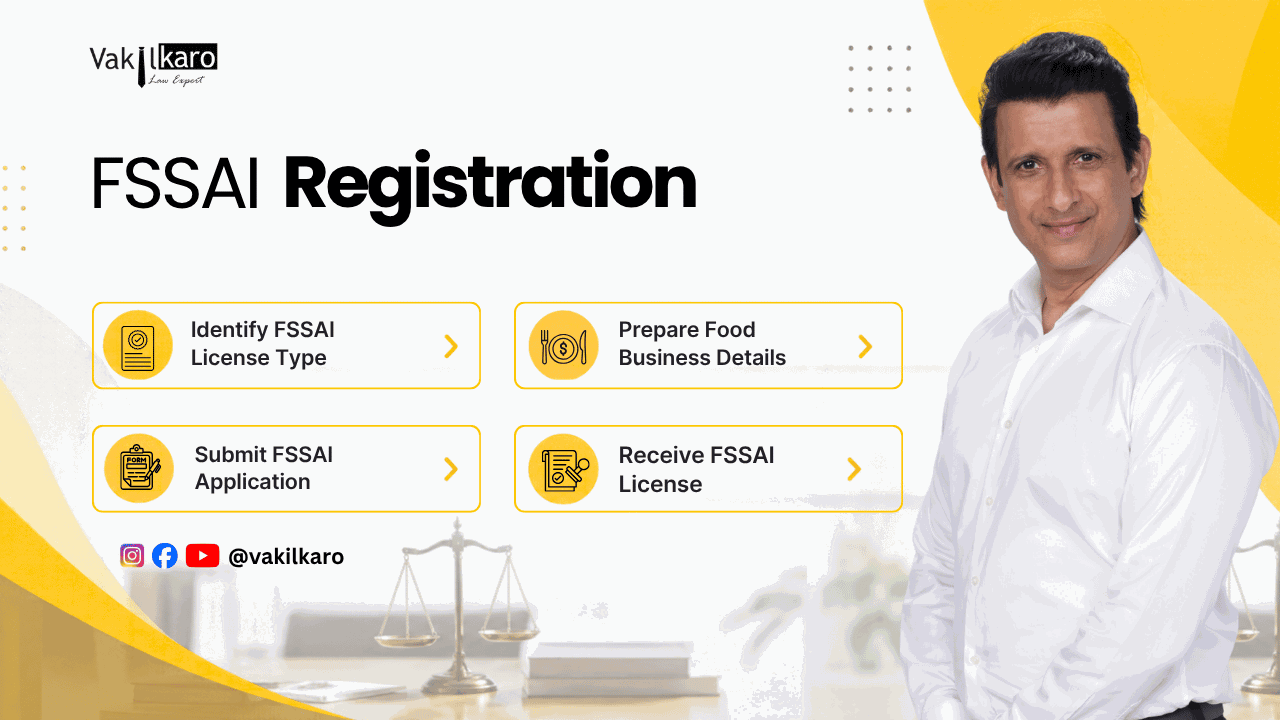
Step-by-Step FSSAI Registration Process
1. Check eligibility: Review annual turnover, premises, food activity and KoB. Confirm that Registration rather than State or Central License is the correct category under the 2026 threshold.
2. Open the official FoSCoS portal: Use the government FoSCoS system for the application. Avoid websites that may look like government portals but are private intermediaries.
3. Select the place of operation: Choose the state/UT and the relevant premise category. Railway, airport/seaport and other special premises may have separate flows.
4. Select the correct Kind of Business: Choose the business activity that accurately describes what the applicant does, such as retailer, hawker, petty manufacturer or other eligible activity.
5. Complete the registration application: Provide applicant details, business address, food categories, contact details and other information requested by the portal. Registration applications correspond to Form A under the regulations.
6. Upload supporting documents: Upload the applicant photograph, government photo ID, business address proof where applicable, and any additional documents shown by FoSCoS.
7. Pay the applicable fee: Pay the government fee displayed by FoSCoS. The underlying Schedule 3 registration fee is ₹100 per annum the 2026 perpetual-validity framework allows fee payment for any number of years at once and payment at any time of the year.
8. Submit and retain the reference number: After submission, save the application reference number and payment record for status tracking.
9. Respond to queries or inspection requirements: The Registering Authority may grant, reject with reasons, or order inspection as permitted under the regulations. If the authority raises a query, provide an accurate response and supporting documents within the permitted period.
10. Download the Registration Certificate: After approval/issuance, download the certificate from FoSCoS and keep the registration details available at the business premises as required.
Official application portal: Apply for New License/Registration on FoSCoS. Application status can also be checked through the FoSCoS Track Application page.
FSSAI Registration Fees in India (2026)
| Cost Component | Amount | Note |
|---|---|---|
| Government fee (FSSAI Registration) | ₹100 per year | Paid on FoSCoS |
| Vakilkaro professional fee | ₹999 + 18% GST | Eligibility check, documents, filing, query support |
| FSSAI State License (if turnover above ₹1.5 crore) | From ₹2,999 + GST | Govt fee as per FoSCoS category |
| FSSAI Central License (if turnover above ₹50 crore) | From ₹4,999 + GST | Govt fee as per FoSCoS category |
Vakilkaro's professional fee for FSSAI Registration starts at ₹999 + GST. If your turnover is above ₹1.5 crore, our team will guide you to the correct State or Central License instead. You get a clear written quote after a free consultation.
How Long Does FSSAI Registration Take?
Regulation 2.1.1 provides that the Registering Authority may grant registration, reject with reasons, or issue notice for inspection within seven days of receiving the application. Where inspection is ordered, registration is to be granted after satisfaction regarding safety, hygiene and sanitary conditions within the regulatory timeline. the Licensing and Registration Regulations for the detailed procedure.
Actual processing time can vary depending on the state/UT, accuracy of the application, document quality, inspection requirement, portal workflow and whether a query is raised. A service page or advertisement should not promise guaranteed approval or a guaranteed government processing time.
Perpetual Validity – Does FSSAI Registration Still Need Renewal?
For registrations issued under the 2026 framework, FSSAI states that perpetual validity means the registration remains valid unless it is suspended, cancelled or surrendered. FBOs are not required to renew the Registration in the earlier periodic-renewal manner. However, perpetual validity is conditional on continuing statutory compliance.
A change in business details, premises, activities or other registration particulars may require FSSAI Registration Modification through FoSCoS. Existing FBOs migrating because of the revised turnover thresholds are addressed separately in FSSAI’s 2026 migration FAQs.
Risk-Based Inspection and Ongoing Compliance
The 2026 amendment introduced a risk-based inspection framework. FSSAI explains that the computer-assisted system can consider compliance history, enforcement or surveillance inputs, self-compliance testing and third-party audits. The objective is to reduce repeated inspections for compliant FBOs while focusing attention on repeat non-compliance.
Registered food businesses should therefore treat the certificate as the beginning of compliance, not the end. Premises hygiene, safe handling, storage, contamination control, personal hygiene, food-grade equipment where relevant, water quality where applicable, accurate food information and other standards continue to matter.
High-Risk Food Businesses and the ₹1.5 Crore Threshold
FSSAI’s 2026 FAQs specifically clarify that the higher Registration threshold does not dilute safety requirements for high-risk food commodities. Businesses involved in dairy, meat, packaged drinking water, infant food and fishery products must continue to comply with applicable hygiene, safety and testing requirements.
Accordingly, a food business should not interpret turnover eligibility as permission to ignore product-specific standards, testing obligations, labelling rules, hygiene requirements or any other condition that applies to its food category.
FSSAI Registration vs State License vs Central License
| Point | Registration | State License | Central License |
|---|---|---|---|
| Turnover threshold from 1 Apr 2026 | Up to ₹1.5 crore | Above ₹1.5 crore to ₹50 crore | Above ₹50 crore |
| Application level | Registration | Licence | Licence |
| Portal | FoSCoS | FoSCoS | FoSCoS |
| Validity framework | Perpetual unless suspended/cancelled/surrendered | Perpetual unless suspended/cancelled/surrendered | Perpetual unless suspended/cancelled/surrendered |
| Exact eligibility | Check FoSCoS KoB mapping | Check FoSCoS KoB mapping | Check FoSCoS KoB mapping |
Common Mistakes to Avoid
- Using the pre-April 2026 ₹12 lakh threshold on a new 2026 application.
- Selecting State or Central License based on outdated turnover figures.
- Choosing a Kind of Business that does not match the real activity.
- Entering a business address that is inconsistent with the supporting proof.
- Uploading unclear, cropped or outdated identity/address documents.
- Assuming perpetual validity means no future compliance or inspection obligations.
- Ignoring product-specific hygiene, safety or testing requirements.
- Failing to update or modify registration details after a material business change.
- Claiming or implying that a private facilitator is FSSAI or a government authority.
- Promising guaranteed approval or a fixed approval time when the decision rests with the competent authority.
Benefits of FSSAI Registration for Food Businesses
FSSAI Registration is not only a statutory requirement for eligible food businesses it also helps create trust between a food business and its customers. A valid FSSAI Registration number shows that the business is identified within the food safety system and follows the applicable food safety framework. It can help small food entrepreneurs build credibility, expand operations and maintain better compliance records.
Key benefits include better customer confidence, improved business credibility, support during business expansion, compliance readiness for online platforms and organised food business operations.
When FSSAI Registration Is Not Enough?
FSSAI Registration is applicable only where the business falls within the Registration category. If the business exceeds the applicable turnover limit or falls under a category requiring a licence, the Food Business Operator may need a State FSSAI Licence or Central FSSAI Licence. Applicants should verify their eligibility before filing to avoid incorrect applications and future compliance issues. Businesses may require a State FSSAI Licence or Central FSSAI Licence depending on turnover, business activity and specific regulatory requirements.
Why Choose Vakilkaro for FSSAI Registration?
Vakilkaro helps food businesses understand and complete FSSAI compliance requirements with proper documentation, application review and regulatory guidance. Along with FSSAI Registration, businesses can also explore related compliance services such as GST Registration, Trademark Registration for brand protection, and Company Registration for setting up a suitable business structure. With a focus on accurate filings and simplified compliance processes, Vakilkaro supports businesses in managing their legal and regulatory requirements efficiently.