

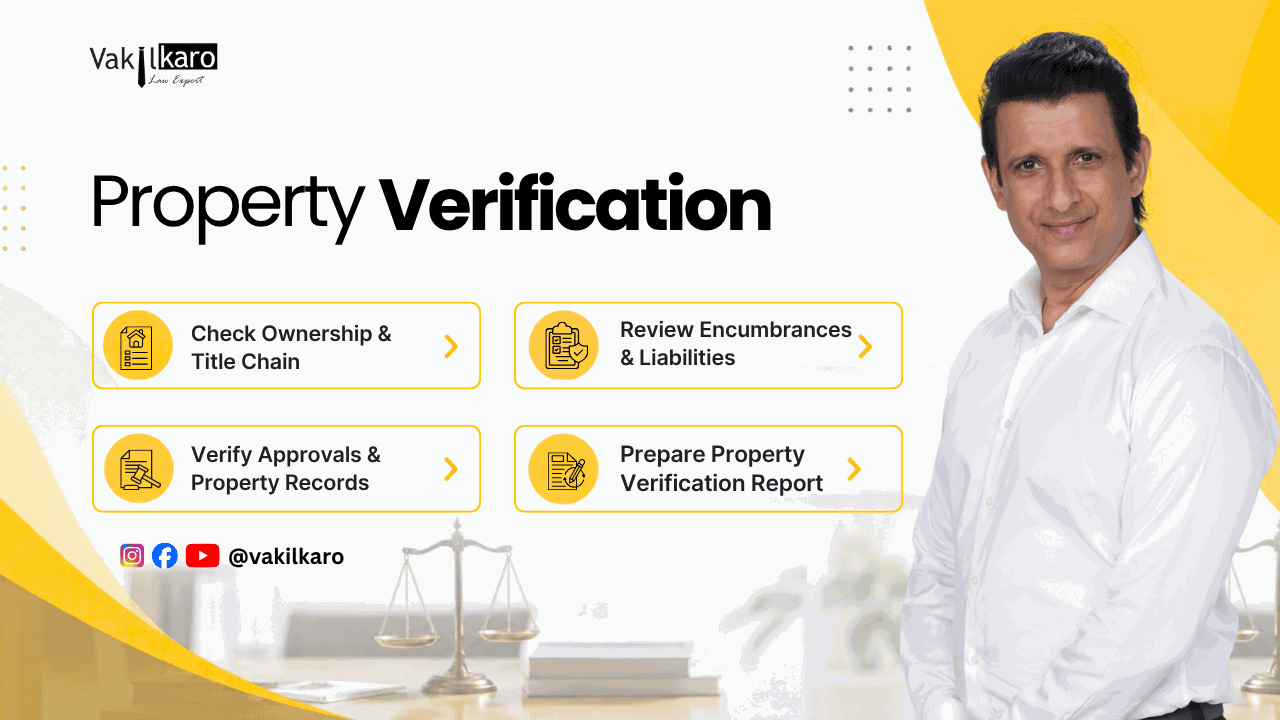
Property Verification is the process of reviewing ownership, title documents, previous transactions, encumbrances and available land or property records before a purchase, sale or transfer. The purpose is to identify documentation gaps and legal risks before money or rights are transferred. The exact verification required depends on the property, location and transaction.
What is Property Verification?
Property Verification is the process of reviewing the documents, ownership records and legal information connected with an immovable property.
It may be carried out before purchasing a flat, house, commercial property, plot or land, or before completing a Sale Deed, Gift Deed, Lease Deed or Property Registration.
The verification process generally checks whether the seller or owner has supporting title documents and whether the available records show any mortgage, encumbrance, earlier transfer, restriction or other issue affecting the property.
Common checks may include:
- Current and previous title documents
- Chain of ownership
- Property and survey details
- Mutation and revenue records
- Encumbrances and mortgages
- Property tax records
- Applicable approvals
- RERA information, where relevant
- Seller identity and authority
- Available dispute or court information
The Department of Land Resources supports digitisation of land records through the Digital India Land Records Modernization Programme.
Property Verification helps identify documentation gaps or issues that may require clarification before the transaction proceeds. It does not, however, guarantee that every possible future risk or dispute will be eliminated.
Why is Property Verification Important?
Buying or accepting immovable property involves significant financial and legal commitments. A property may appear complete and occupied, while its documents contain issues relating to ownership, previous transfers, mortgages, land records or approvals.
Proper Property Verification can help identify such issues before executing the final Sale Deed or completing Property Registration.
Verification is particularly useful where:
- The property is a resale property
- Previous ownership has changed several times
- The property is inherited or jointly owned
- A company or other entity owns the property
- The property is mortgaged
- Original title documents are unavailable
- A representative is acting through a Power of Attorney
- The property forms part of a real estate project
- Land or registration records contain differences
- The property is agricultural or converted land
The Registration Act, 1908 and the Transfer of Property Act, 1882 may be relevant depending on the transaction. For applicable real estate projects, information under the Real Estate (Regulation and Development) Act, 2016 may also be relevant.
When Should Property Verification Be Done?
Property Verification should preferably be completed before making a major financial or legal commitment relating to the property.
The most useful stage is generally before signing or registering the final transfer document.
Verification may be considered:
- Before paying a substantial advance
- Before signing an Agreement to Sell
- Before executing a Sale Deed
- Before Property Registration
- Before accepting property through a Gift Deed
- Before entering into a long-term Lease Deed
- Before purchasing inherited, jointly owned or resale property
- Before relying on a Power of Attorney
- Before lending against the property
Early verification allows the buyer or concerned party to identify missing documents, title issues, mortgages, approvals or other matters before the transaction is completed.
If verification is delayed until after registration, resolving documentation or ownership issues may become more difficult.
Which Laws May Be Relevant to Property Verification?
Property Verification may involve different laws depending on the property and nature of the transaction.
1. Registration Act, 1908
The Registration Act, 1908 governs registration of specified property documents. Registered deeds and registration details may be reviewed to understand the recorded transaction history.
2. Transfer of Property Act, 1882
The Transfer of Property Act, 1882 contains important provisions relating to sale, mortgage, lease, gift and exchange of immovable property.
3. State Stamp and Registration Laws
Stamp duty, registration procedures and related requirements vary by state. The applicable state registration authority should be checked for current local requirements.
4. Real Estate (Regulation and Development) Act, 2016
For applicable real estate projects, RERA information may be relevant for reviewing project registration, promoter details and other available project records.
5. Land and Revenue Laws
Land records, mutation, land classification and revenue entries are governed through state-specific systems. The Digital India Land Records Modernization Programme supports digitisation of land-record information across India.
What Does Property Verification Cover?
Property Verification may cover different checks depending on the property, ownership structure and available records.
1. Seller Identity Verification
The identity and authority of the person or entity claiming ownership should be checked.
This may include:
- PAN and identity proof
- Address proof
- Entity registration documents
- Board resolution or other authorisation
- Power of Attorney, where applicable
2. Ownership Document Review
The current and previous ownership documents should be reviewed to understand how the seller acquired the property.
These may include:
- Sale Deed
- Gift Deed
- Conveyance or Partition Deed
- Relinquishment Deed
- Allotment documents
- Succession or court-related documents
3. Chain of Title Review
Previous property documents may be reviewed to understand the ownership history and identify any unexplained gap or inconsistency in the title chain.
4. Property Description Verification
Property details should be compared across available records, including:
- Address
- Plot or flat number
- Survey or Khasra number
- Area and boundaries
- Khata or other land details
- Land use, where relevant
5. Land and Revenue Record Review
Available land and revenue records may include mutation entries, Record of Rights, Khasra, Khata, survey details, land classification and other state-specific records.
The Digital India Land Records Modernization Programme supports digitisation of land-record information.
6. Encumbrance and Mortgage Review
Available records should be checked for mortgages, charges, leases or other interests affecting the property.
Where a loan or mortgage exists, relevant repayment, release or lender-consent documents may also require review.
Documents Required for Property Verification
The documents required for Property Verification may vary depending on the property, ownership history and nature of the transaction.
| Document | Purpose |
|---|---|
| Current Title Deed | Helps identify the present ownership document. |
| Previous Title Deeds | Helps review the ownership history and earlier transfers. |
| Seller Identity Documents | Used to verify the identity of the seller or recorded owner. |
| Mutation / Revenue Records | Helps review recorded ownership and relevant land entries. |
| Survey / Khasra / Property Details | Helps confirm the property or land particulars. |
| Encumbrance Information | Helps review mortgages, charges, leases or other registered interests. |
| Loan / Mortgage Documents | Relevant where the property is or was mortgaged. |
| Approval / RERA Documents | Relevant for constructed properties or applicable real estate projects. |
| Power of Attorney / Authorisation | Required where a representative or entity is involved. |
| Succession Documents | Relevant where the property has been inherited. |
Additional documents may be required depending on the property type, location and issues identified during verification.
Property Verification Process
The exact Property Verification process may vary depending on the property, location and nature of the transaction.
Step 1: Collect Property and Ownership Details
Obtain the basic property information, seller details and current ownership documents.
Step 2: Review Title Documents
Review the current and previous title documents to understand how the present owner acquired the property. Where applicable, the proposed Sale Deed or Property Registration documents may also be reviewed.
Step 3: Verify Seller and Property Details
Compare the seller's identity, property description, area, boundaries, survey or Khasra details and other available identifiers with the relevant records.
Step 4: Review Title Chain and Land Records
Check the previous ownership chain and available mutation, revenue or land records. The Digital India Land Records Modernization Programme supports digitisation of land-record information.
Step 5: Check Encumbrances and Approvals
Review available records for mortgages, charges, leases or other interests affecting the property. For applicable projects, approvals and relevant RERA information may also be reviewed.
Step 6: Identify Documentation Issues
Note any missing documents, inconsistencies, title gaps, unresolved mortgages or other matters requiring clarification.
Step 7: Complete Final Review
After receiving the required clarifications or additional documents, complete the final review and identify any remaining documentation issues before the proposed transaction proceeds.
Property Verification for Residential Property
Residential Property Verification may apply to:
- Flats and apartments
- Independent houses and villas
- Residential plots
- Builder properties
- Resale properties
Verification may include review of title documents, allotment records, property details, approvals, society or association records and applicable RERA information.
For resale properties, additional attention may be required for previous transfer documents, ownership history, mortgages, encumbrances and outstanding dues.
After verification, the transaction may proceed with the appropriate Sale Deed and Property Registration, where applicable.
Property Verification for Commercial Property
Commercial Property Verification may apply to:
- Shops and offices
- Warehouses and business premises
- Commercial plots
- Industrial units
- Commercial buildings
Verification may include review of ownership documents, permitted land use, lease rights, existing tenancy, applicable approvals, mortgages and authority of the person signing the transaction.
Where the property is owned by a company, LLP Registration, firm or other entity, the relevant ownership and authorisation documents should also be reviewed.
If the property is being leased instead of purchased, the proposed Lease Deed should be checked along with the available ownership documents.
Plot and Land Verification
Plot and land verification generally requires review of title documents along with available land and revenue records.
Important checks may include:
- Survey or Khasra number
- Khata or Record of Rights
- Mutation details
- Recorded area and boundaries
- Land classification
- Revenue records
- Cadastral or land maps
- Access details
- Conversion or land-use information
Where available, ULPIN / Bhu-Aadhaar may also be checked as an additional land-parcel identifier.
ULPIN should be considered together with the relevant title, ownership and land records and not as a substitute for them.
Resale Property Verification
Resale Property Verification requires careful review of the property's ownership history and previous transaction documents.
Important checks may include:
- Previous registered Sale Deed
- Earlier title and ownership documents
- Current seller ownership
- Property tax records
- Mutation details
- Mortgage and encumbrance history
- Society or association dues, where applicable
- Existing occupancy or tenancy
- Required approvals
- Seller authority
The latest property document should not be reviewed in isolation. Previous ownership records should also be checked to understand the title chain and identify any gap, mortgage, pending interest or other issue affecting the property.
Where required, the available documents should be clarified before proceeding with the final Sale Deed or Property Registration.
Property Verification for Builder Property
Where property is purchased from a builder, promoter or developer, additional project-related checks may be required.
Important checks may include:
- Project registration
- Promoter or developer details
- Approved building or layout plan
- Development approvals
- Allotment documents
- Agreement terms
- Construction or project status
- Available project disclosures
For projects covered under RERA, buyers should review the relevant state RERA portal for available project and promoter information.
The Real Estate (Regulation and Development) Act, 2016 provides the statutory framework for registration and regulation of applicable real estate projects and promoters.
Property Verification After Inheritance
Inherited property may have a different document trail from purchased property.
Relevant documents may include:
- Previous title deed
- Death certificate
- Will
- Probate or court order, where applicable
- Legal-heir documents
- Succession-related documents
- Mutation
- Family settlement
- Relinquishment Deed, where applicable
Verification should identify how the claimed ownership passed to the present owner and whether other persons may have rights in the property.
Property Verification Through Power of Attorney
A representative may participate in a property transaction through a Power of Attorney where legally permitted.
During verification, check:
- Name of principal
- Name of attorney
- Date of document
- Scope of authority
- Property description
- Execution and authentication
- Registration requirements
- Whether the authority is still effective
A Power of Attorney should not automatically be treated as a document transferring ownership.
The underlying title and the representative's authority should be examined separately.
RERA Verification for Property
For applicable real estate projects, RERA information may provide useful project-level information.
A buyer may check:
- Project registration
- Promoter information
- Declared completion timeline
- Project documents
- Approvals uploaded by the promoter
- Registered agents
- Regulatory orders or information available on the portal
The applicable state RERA portal should be used because implementation is state-based.
The statutory framework is available through the Real Estate (Regulation and Development) Act, 2016.
Online Property Verification
Property records are increasingly available through state registration and land-record portals.
Depending on the state, online facilities may include:
- Land-record search
- Registration document search
- Property valuation
- Appointment information
- Registration status
- Record of Rights
- Mutation information
- Project information
The Government's NGDRS supports digitisation of document-registration functions.
The NGDRS state portal directory provides links to participating state and Union Territory systems.
The DILRMP portal provides information relating to digitisation of land records across India.
Online information is useful, but the scope and completeness of available records vary by state.
Property Verification and Tax Checks
Certain property transactions may involve income-tax compliance.
Depending on the transaction, relevant factors may include:
- Buyer PAN
- Seller PAN
- Seller residential status
- Property value
- Stamp-duty value
- Payment dates
- TDS requirements
For relevant transactions from the current Income-tax Act, 2025 framework, the Income Tax Department provides Form 141 for specified PAN-based TDS transactions.
Schedule B relates to transfer of immovable property.
Tax verification is separate from title verification, but applicable tax requirements should be considered before completing the transaction.
Common Property Verification Mistakes
Common mistakes that may lead to property-related issues include:
- Checking only the latest title document
- Relying only on physical possession
- Ignoring previous ownership records
- Failing to verify seller identity or authority
- Not checking mortgages, encumbrances or pending dues
- Ignoring mutation, revenue or land records
- Overlooking differences in property area or description
- Treating mutation or Power of Attorney as complete proof of ownership
- Failing to review RERA information, where applicable
- Ignoring inheritance or co-ownership rights
- Proceeding with payment before sufficient document review
- Assuming registration alone guarantees clear title
A structured Property Verification process can help identify document gaps, inconsistencies and other issues before the final deed is executed.
Property Verification Checklist
Before proceeding with the property transaction, check that:
- Seller identity and ownership documents are verified
- Previous title documents have been reviewed
- Ownership chain is reasonably clear
- Property details match available records
- Survey, Khasra or other land details are checked
- Mutation and revenue records are reviewed
- Encumbrance and mortgage status is clarified
- Property tax and pending dues are checked
- Required approvals are available
- RERA information is reviewed, where applicable
- Power of Attorney or signatory authority is verified, where relevant
- Proposed deed and registration requirements are confirmed
The exact checklist may vary depending on the property type, ownership history and nature of the transaction.
Benefits of Proper Property Verification
Proper Property Verification can provide several practical benefits before a property transaction is completed.
Better Understanding of Ownership
Helps review the documents supporting the seller's ownership claim.
Clearer Title History
Previous title documents help understand how ownership moved between earlier owners.
Identification of Encumbrances
Available records may reveal mortgages, charges, leases or other interests affecting the property.
Early Detection of Document Issues
Differences in names, property area, survey details or property description may be identified before registration.
Better Transaction Decisions
The buyer can seek clarification, additional documents or corrections before making a final commitment.
Support for Sale and Registration
A properly reviewed document set can help make the Sale Deed and Property Registration process more organised.
Better Record Management
A structured verification file helps maintain important ownership and property records for future use.
Difference Between Property Verification and Property Registration
| Property Verification | Property Registration |
|---|---|
| Reviews property and ownership records. | Formally records a registrable document. |
| Usually carried out before completing a transaction. | Usually occurs at the execution/registration stage. |
| Focuses on title, records and possible risks. | Focuses on statutory registration formalities. |
| May identify missing documents or encumbrances. | Creates an official registration record of the document. |
| Does not itself transfer ownership. | A registered transfer deed may form part of the legal transfer process. |
Property Verification and Property Registration are therefore connected but different processes.
Property Verification Fees
Vakilkaro's professional fee for Property Verification starts at ₹____ + GST. The final fee depends on the property type, location and number of documents to be reviewed. Government fees for certified copies or encumbrance certificates, if any, are payable separately.
Why Choose Vakilkaro for Property Verification?
Property Verification involves review of ownership documents, available records and transaction-specific issues. Vakilkaro follows a structured process to help clients understand important documentation before proceeding with a property transaction.
Key benefits include:
- Clear and step-by-step verification process
- Property-specific document checklist
- Review of seller and ownership details
- Review of current and previous title documents
- Ownership chain and encumbrance review
- Mortgage and land-record review, where applicable
- Guidance on state-specific property records
- RERA information review, where applicable
- Review of Power of Attorney or entity authorisation
- Identification of document gaps or inconsistencies
- Guidance on additional documents required
- Coordination with Sale Deed and Property Registration
- Clear and transparent communication
- Guidance on next documentation steps