

Property Registration is the legal process of recording a property-related document with the concerned registration authority. It generally involves property verification, deed preparation, payment of stamp duty and registration charges, and registration before the Sub-Registrar. The process and charges may vary by state, property type and nature of the transaction.
What is Property Registration?
Property Registration is the legal process through which a document relating to immovable property is formally recorded with the competent registration authority.
Depending on the transaction, the document may relate to a Sale Deed, Gift Deed, Lease Deed, mortgage, exchange or another transfer of rights in immovable property.
The Registration Act, 1908 provides the primary legal framework governing registration of documents in India. Certain documents relating to immovable property are required to be registered under the Act.
A property document is generally presented before the concerned Sub-Registrar or other authorised registration authority under the applicable legal framework.
Registration creates an official record of the document and transaction. It also forms an important part of the property's transaction and document history.
However, registration by itself should not be treated as a complete guarantee of clear ownership. Before purchasing or accepting property, parties should consider proper Property Verification, including review of available title documents, previous ownership records, encumbrances, mortgages, approvals and other relevant property records.
The Government also promotes digitisation of land records through the Digital India Land Records Modernization Programme.
Why is Property Registration Important?
Property Registration is important because it formally records a document relating to immovable property with the registration authority.
A properly registered Sale Deed or other registrable property document can become an important part of the property's transaction and ownership history.
Property Registration may be relevant when a person intends to:
- Purchase residential property
- Purchase commercial property
- Buy a plot or land
- Sell immovable property
- Transfer property through a Gift Deed
- Execute a registrable Lease Deed
- Exchange property
- Create specified rights through a mortgage
- Transfer ownership rights
- Record other registrable property transactions
Section 17 of the Registration Act, 1908 contains provisions relating to compulsory registration of specified documents.
Where registration is legally required, non-registration may affect the legal effect or evidentiary use of the document, subject to applicable law.
Property Registration in India
Property Registration in India is governed by central law along with state-specific registration and stamp duty rules.
The Registration Act, 1908 provides the main statutory framework for registration of documents.
However, the actual property registration process may vary from one state or Union Territory to another. Stamp duty rates, property valuation methods, registration charges, required documents and online procedures can differ according to the location of the property.
Before beginning property registration, the following should be checked:
- State and district where the property is located
- Jurisdiction of the Sub-Registrar Office
- Type of property
- Nature of transaction
- Property value
- Applicable stamp duty
- Registration charges
- Required documents
- Local registration rules
- Available online registration facilities
State-specific requirements should therefore be verified before executing and registering the property document.
Which Laws Govern Property Registration in India?
Property registration in India is mainly governed by the following laws:
1. Registration Act, 1908
The Registration Act, 1908 governs registration of documents, including compulsory registration, presentation of documents, place and time of registration, verification and the legal effect of registration.
2. Transfer of Property Act, 1882
This law contains key provisions relating to transfer of immovable property through sale, mortgage, lease, gift and other recognised modes.
3. State Stamp Laws
Stamp duty and registration charges are governed by applicable state laws and may vary based on property value, location, type of deed and available concessions.
4. Income Tax Provisions
Certain property transactions may also attract tax deduction, reporting or other compliance requirements under applicable income-tax law.
Which Property Documents Require Registration?
Whether a property document requires registration depends on the nature of the transaction, the rights created or transferred, and the applicable law.
| Property Document | When It Is Used | Registration Requirement |
|---|---|---|
| Sale Deed | Transfers ownership of property from seller to buyer for consideration. | Registration is generally required to complete the transfer of ownership in immovable property. |
| Gift Deed | Transfers immovable property voluntarily without consideration. | Registration is compulsory for a gift of immovable property. |
| Lease Deed | Records the lease of property for an agreed period and on agreed terms. | Registration is generally required for leases from year to year, for a term exceeding one year, or reserving yearly rent. |
| Exchange Deed | Records exchange of ownership rights between parties. | Registration may be required where the document transfers rights in immovable property. |
| Mortgage Deed | Creates an interest in property as security for a debt. | Registration depends on the nature and form of the mortgage. |
| Other Property Instruments | Create, declare, assign, limit or extinguish rights in immovable property. | Registration depends on the nature and legal effect of the document. |
The Department of Land Resources also provides model formats for documents such as Sale Deed, Gift Deed, Lease Deed, Exchange Deed, Power of Attorney, Simple Mortgage Deed, Agreement to Sell and Will.
Who Needs Property Registration?
Property Registration may be required when individuals, businesses or organisations buy, sell, gift, lease or otherwise transfer rights in immovable property.
Common parties include:
- Individual buyers and sellers
- Joint property owners
- Companies and LLPs
- Partnership firms
- Trusts and societies
- Section 8 companies
- Other entities legally permitted to own or transfer property
Where a company, firm, trust or other organisation is involved, additional documents may be required, such as:
- Certificate of Incorporation or registration
- PAN
- Constitutional documents
- Board resolution or authorisation
- Authorised signatory details
- Identity documents
- Power of Attorney, where applicable
The exact document requirements depend on the type of entity, property and transaction.
When Should Property Registration Be Completed?
Property documents should be presented for registration within the time prescribed under applicable law.
Under Section 23 of the Registration Act, 1908, a document other than a Will is generally required to be presented for registration within four months from the date of execution, subject to applicable provisions and exceptions.
Before registration, it is advisable to keep the following ready:
- Final property deed
- Property and ownership documents
- Stamp duty and registration charges
- Buyer and seller documents
- Required approvals
- Witnesses
- Registration appointment details
- Applicable tax documents
Proper preparation can help reduce delays and avoid incomplete registration formalities.
Where is Property Registered?
Property Registration is generally completed at the Sub-Registrar Office (SRO) having jurisdiction over the area where the property is located, subject to applicable state rules.
Many states also provide online or e-registration facilities for functions such as deed entry, payment, appointment booking and document-related services.
Before registration, the correct Sub-Registrar jurisdiction and applicable state procedure should be checked.
Property Registration Process
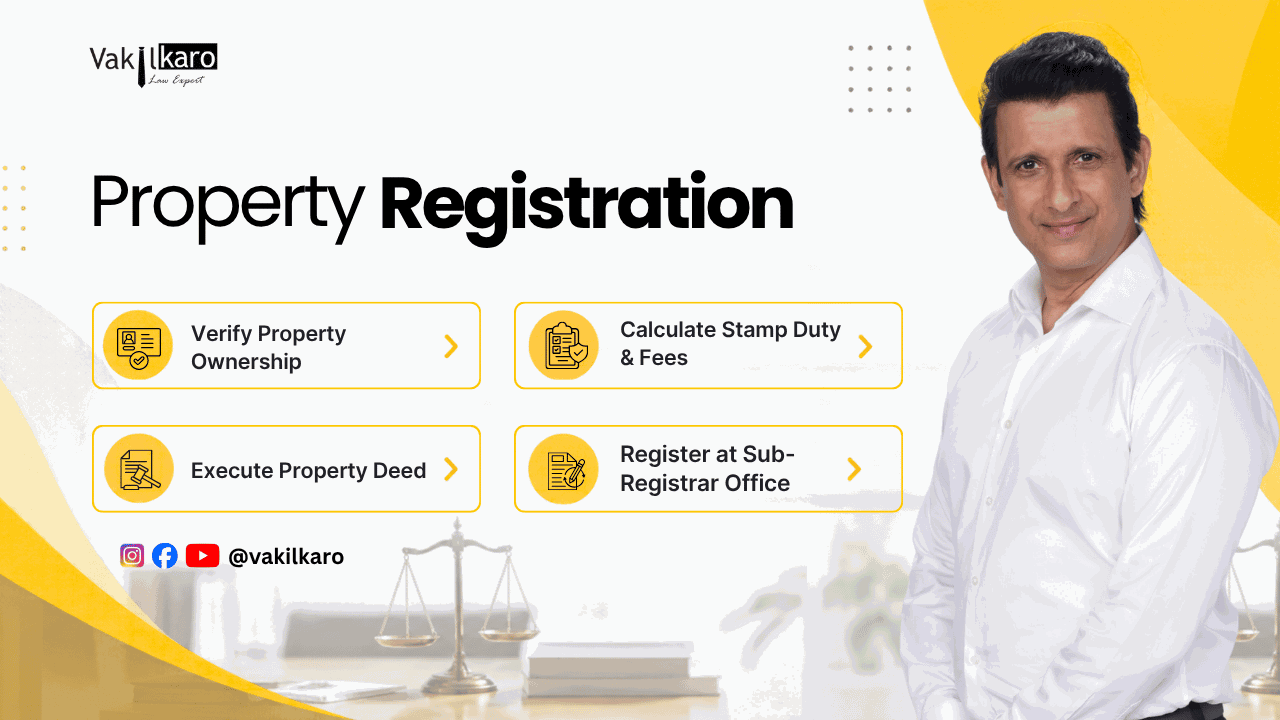
The exact Property Registration Process may vary by state, but it generally involves the following steps:
Step 1: Verify Property Details
Confirm the complete property information, including address, plot or flat number, survey or Khasra number, area, boundaries and other available land details.
Step 2: Check Ownership and Title Documents
Review the seller's ownership documents and previous property records, such as Sale Deed, Gift Deed, Conveyance Deed, Partition Deed, allotment documents, mutation and revenue records.
Step 3: Review Title and Encumbrances
Check the chain of ownership and available records for mortgages, charges, leases or other registered interests affecting the property.
Step 4: Verify Land and Revenue Records
Confirm the recorded owner, property area, survey details, land classification and applicable revenue records.
Step 5: Determine Property Value and Stamp Duty
Identify the applicable government valuation, such as circle rate, DLC rate, guideline value or Ready Reckoner rate, and calculate the applicable stamp duty and registration charges.
Step 6: Prepare the Property Deed
Prepare the relevant Sale Deed, Gift Deed, Lease Deed, Exchange Deed or other applicable property document with complete details of the parties, property and transaction.
Step 7: Pay Stamp Duty and Registration Charges
Make the required payment through the method permitted by the concerned state and retain the receipt or challan.
Step 8: Book Appointment and Complete Verification
Where required, book an appointment with the concerned Sub-Registrar. The parties may need to complete identity verification, signatures, photographs, biometrics and execution formalities.
Step 9: Complete Registration
After verification and completion of the required formalities, the document is registered and assigned the relevant registration details. The registered document should be preserved as part of the property's ownership records.
Documents Required for Property Registration
The documents required for Property Registration may vary depending on the state, property type and nature of the transaction.
| Document | Purpose |
|---|---|
| Property Deed | Sale Deed, Gift Deed, Lease Deed or other applicable deed. |
| Previous Title Documents | Helps verify ownership and title history. |
| PAN and Identity Proof | Used for identity and applicable tax formalities. |
| Address Proof and Photographs | Required for registration verification. |
| Property Records | May include mutation, land, tax, survey or Khasra records. |
| Stamp Duty and Registration Fee Proof | Confirms payment of government charges. |
| Tax Documents | Required where TDS or other tax provisions apply. |
| Power of Attorney / Authorisation | Required where a representative or entity is involved. |
| NOCs or Approvals | Required where specific approvals apply. |
| Witness Identity Proof | Used for witness verification. |
Additional documents may be required for inherited property, agricultural land, leasehold property, company-owned property or other special transactions.
Types of Property Registration
Property Registration requirements may differ depending on the property and nature of the transaction. Common situations include:
Sale Property Registration
For the sale of immovable property, ownership documents, property details, previous title records, encumbrances, valuation, stamp duty and registration charges should be checked before executing the Sale Deed.
Residential and Commercial Property Registration
Registration may apply to flats, apartments, houses, plots, shops, offices, warehouses and other residential or commercial properties. Additional documents may be required depending on land use, ownership structure and applicable local rules.
Plot and Land Registration
Land or plot registration generally requires verification of survey or Khasra details, mutation records, Record of Rights, land classification and other available revenue records.
Resale Property Registration
For resale property, the previous ownership chain, registered deeds, mutation records, property tax records, encumbrances, mortgages and pending dues should be reviewed before registration.
Gift, Lease, Exchange and Mortgage Deeds
Property may also be transferred or dealt with through a Gift Deed, Lease Deed, Exchange Deed or Mortgage Deed. Registration requirements, stamp duty and documentation depend on the nature of the document and applicable state law.
Special Property Registration Cases
Additional documentation may be required for:
- Inherited property
- Jointly owned property
- Property transactions through an authorised representative
- Company or entity-owned property
- Agricultural or leasehold property
The required documents depend on the ownership position and type of transaction.
Stamp Duty and Registration Charges
Stamp duty and registration fees vary across states and may depend on:
- Property value
- Location
- Type of property
- Nature of deed
- Government valuation
- Buyer category
- Available concessions
The applicable rates should be verified through the concerned state stamp and registration authority.
Tax Requirements
Certain property transactions may involve TDS or other income-tax requirements depending on the transaction value, seller status and applicable tax provisions. Tax requirements should be checked before completing the transaction.
Online Property Registration
Many states provide online facilities for property registration, including:
- Deed entry
- Property valuation
- Stamp duty payment
- Appointment booking
- Document search
However, the process varies by state, and physical appearance or biometric verification may still be required.
Common Property Registration Mistakes
Common mistakes that may cause delays or registration issues include:
- Incorrect property or party details
- Failure to verify title documents
- Ignoring encumbrances or pending dues
- Incorrect stamp duty or valuation
- Using the wrong property deed
- Missing approvals or NOCs
- Delayed registration
- Missing signatures or witness details
- Using outdated property records
- Ignoring applicable tax requirements
Careful review of the documents before execution can help reduce errors, delays and future disputes.
Property Registration Checklist
Before registration, check that:
- Property title and ownership are verified
- Buyer and seller details are correct
- Property details match available records
- Previous deeds and encumbrances are checked
- Correct deed is prepared
- Stamp duty and registration charges are confirmed
- Required approvals and tax documents are available
- Parties, witnesses and appointment details are ready
Benefits of Proper Property Registration
Proper Property Registration can provide several practical benefits:
Official Record of Transaction
Registration creates an official record of the property document and transaction.
Clear Document Trail
Registered deeds form an important part of the property's ownership and transaction history.
Better Property Verification
Proper documentation makes it easier to review ownership details, previous transactions and available property records.
Easier Future Transfer
A clear registration record can simplify documentation when the property is later sold, gifted, mortgaged or otherwise transferred.
Better Record Management
A registered deed can be maintained along with land, municipal and revenue records for future property-related requirements.
Property Registration Fees
Vakilkaro's professional fee for Property Registration support starts at ₹____ + GST. It covers document review, stamp duty calculation and Sub-Registrar appointment assistance. Stamp duty and registration charges, as per the State, are payable separately.
Why Choose Vakilkaro for Property Registration?
Property registration involves document review, government charges and state-specific procedures. Vakilkaro follows a structured process to help clients complete the required registration formalities with clear communication at every stage.
Key benefits include:
- Clear and step-by-step registration process
- Document checklist based on the property transaction
- Review of buyer, seller and property details
- Review of available title and ownership documents
- Guidance on the appropriate property deed
- Support with stamp duty and registration charge review
- Coordination of required documents and approvals
- Guidance on Sub-Registrar Office formalities
- Registration appointment and process coordination, where applicable
- Regular updates from documentation to registration
- Simple and transparent communication
- Post-registration document and record guidance