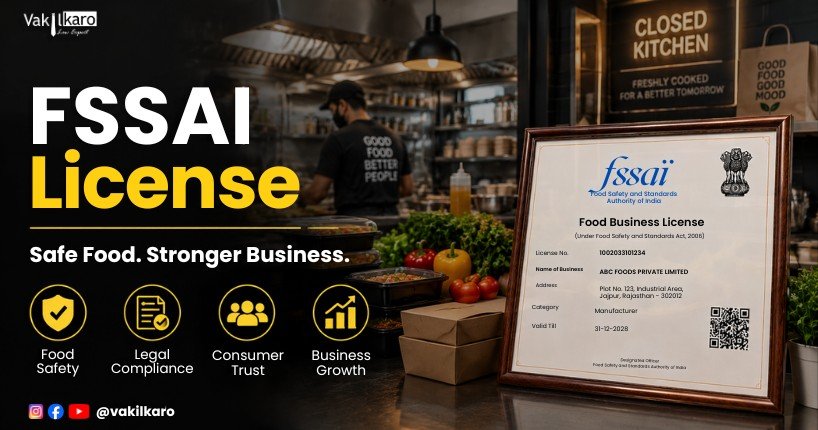
FSSAI Licence is required for eligible food businesses to operate legally in India. From 1 April 2026, revised turnover limits apply, and licences follow a perpetual validity framework subject to compliance requirements.
What Is FSSAI License?
FSSAI License is the regulatory authorisation required for food business operations covered by the Food Safety and Standards Act, 2006 and the rules and regulations made under it. The FSSAI official website publishes the governing standards, notifications, advisories and food-safety resources, while applications and many compliance actions are handled digitally through FSSAI food business services. The purpose is not merely to obtain a number; it is to place the food business within an identifiable compliance framework for safe manufacturing, handling, storage, distribution, sale or import of food.
The authorisation is premise- and activity-sensitive. A business should choose the correct Kind of Business, identify the correct premises, declare relevant food categories and provide documents that match its constitution and operations. The apply for new licence or registration page is the official starting point for a new application, and the new licence application manual explains the digital filing flow. Incorrect classification can lead to queries, delayed processing, migration issues or later modification requirements.
For website users who want filing assistance, the FSSAI License service can be positioned as end-to-end support covering eligibility review, document preparation, application filing and response coordination. Applicants should understand that FSSAI approval is a government decision and no private service provider can guarantee approval.
Who Needs FSSAI Licence?
Any person or entity carrying on a covered food business should evaluate FSSAI applicability before commencing operations. This can include food manufacturers, processors, repackers, relabellers, restaurants, cafes, cloud kitchens, caterers, hotels, grocery stores, wholesalers, distributors, warehouses, transporters, online food sellers, food importers, exporters and other operators in the food supply chain.
A home-based kitchen, bakery or small food brand can also fall within the regulatory framework even when the business operates at a small scale. Entrepreneurs often combine food licensing with a suitable legal structure such as Sole Proprietorship Registration, Partnership Firm Registration or One Person Company Registration depending on ownership, liability and growth plans.
Growing brands may choose a company or LLP structure before or alongside FSSAI filing. Relevant options include Private Limited Company Registration, LLP Registration and, where scale or ownership structure requires it, Public Limited Company Registration. The legal entity name, authorised signatory and address records should be consistent across filings.
Foreign-owned or group structures may also require additional corporate and foreign investment compliance. An Indian operating entity can review Indian Subsidiary Company Registration and, where applicable, post-investment reporting through FDI Filing and FLA Return Filing.

Types of FSSAI Authorisation Under the 2026 Turnover Framework
The turnover thresholds were materially revised in 2026. The following table reflects the current turnover bands stated in FSSAI’s March 2026 order. Special rules, category-specific requirements, location or activity conditions may still need separate checking on FoSCoS before filing.
| Category | Turnover band (from 1 Apr 2026) | Typical authority level | Practical use |
|---|---|---|---|
| Registration | Up to ₹1.5 crore | Registering authority | Smaller food businesses, subject to current eligibility and activity rules. |
| State Licence | Above ₹1.5 crore and up to ₹50 crore | State licensing authority | Mid-sized food businesses operating within the applicable jurisdiction, subject to KoB rules. |
| Central Licence | Above ₹50 crore | Central licensing authority | Larger businesses and situations requiring central licensing under the applicable framework. |
The best practice is to validate the proposed category using the FoSCoS eligibility checker and then read the latest FSSAI orders before payment. Older web pages and third-party articles may still display the pre-2026 ₹12 lakh / ₹20 crore thresholds, so applicants should prefer the latest official order and the FSSAI gazette notifications when there is any conflict.
How to Choose the Correct Kind of Business (KoB)
Choosing the correct KoB is as important as choosing the licence level. A manufacturer, restaurant, retailer, wholesaler, distributor, transporter, warehouse, importer, exporter or e-commerce operator may have different declarations, documents and compliance obligations. The official FoSCoS licensing FAQs and FoSCoS user manuals should be consulted for current workflow guidance.
A single premises may conduct more than one food activity. Where the regulations and portal design permit, multiple activities at that same premises can be endorsed under the appropriate licence rather than creating unnecessary duplicate filings. Each additional activity should be described accurately so the issued authorisation reflects the actual business model.
Food importers should coordinate FSSAI with trade registrations. The DGFT portal administers the Import Export Code ecosystem, while customs transactions operate through the ICEGATE portal. Businesses that need implementation support can separately review Import Export Code Registration before importing food commercially.
Documents Required for FSSAI License
The document set changes with the applicant type, premises and KoB. The official central licence document checklist should be treated as the primary reference for a Central Licence application, and the portal will display activity-specific requirements during filing. The following checklist is a practical preparation guide rather than a substitute for the current portal-generated list.
Identity and applicant details
- PAN and government-issued identity proof of the proprietor, partners, directors or authorised signatory.
- Recent photograph and active mobile number/email for OTP and communication.
- Constitution proof such as incorporation certificate, partnership deed or equivalent record.
Premises proof
- Ownership document, rent agreement, lease deed or other acceptable possession proof.
- Owner NOC where the premises is rented and the portal or authority requires it.
- Electricity bill, property tax document or other address evidence, as applicable.
Business and operational records
- Nature of food business, products, food categories and proposed activities.
- Layout plan for manufacturing/processing premises where required.
- List of equipment and installed capacity for manufacturing or processing units.
- Water analysis report where water is used as an ingredient or process input and the applicable checklist requires it.
Business and operational records
- Nature of food business, products, food categories and proposed activities.
- Layout plan for manufacturing/processing premises where required.
- List of equipment and installed capacity for manufacturing or processing units.
- Water analysis report where water is used as an ingredient or process input and the applicable checklist requires it.
Entity-specific and special documents
- List of directors, partners or office bearers with contact details where applicable.
- Form IX nomination and board authorisation where a company requires nomination of a responsible person.
- IEC details for import activity and supporting approvals/NOCs for regulated or special categories when applicable.
Premises documentation should be consistent with the entity records. A rented office or kitchen may require a legally usable occupancy document; businesses can obtain a properly drafted Rent Agreement where appropriate. Corporate applicants should ensure board authorisations, signatory details and corporate records align with the MCA portal data.
Step-by-Step FSSAI License Process
1. Map the business model
Identify the actual activities performed at the premises: manufacture, processing, storage, distribution, retail, food service, import, export, e-commerce or a combination. Make sure the proposed food categories and operational scale are known before the application starts.
2. Check eligibility and licence level
Use the FoSCoS eligibility checker and compare the current 2026 threshold rules. For new applications after 1 April 2026, use the revised turnover framework and review special conditions before selecting Registration, State Licence or Central Licence.
3. Create or access the FoSCoS account
Use the official FoSCoS sign-in environment and keep the registered mobile number and email accessible. Correct contact details matter because OTPs, queries and status messages may be sent to these channels.
4. Select state, premises and KoB
Choose the actual location of the food premises and select the correct Kind of Business. Avoid choosing a category merely because it appears simpler; the category should reflect what the business really does.
5. Complete the application
Fill the business name, address, constitution, turnover/operational details, product categories, responsible person information and other fields. Review spelling and numbers carefully before final submission.
6. Upload supporting documents
Upload clear, legible documents in the requested format. The applicant should avoid mismatched names, expired identity documents, incomplete layouts and unreadable scans.
7. Pay the applicable fee
Government fees vary by category and licence type. Use the official current fee structure for the latest amount instead of relying on old blogs or screenshots. Professional assistance fees, if any, are separate from statutory payments.
8. Track scrutiny, query or inspection
After filing, use the application reference number to track an application. If the authority raises a query, respond within the applicable time and upload a complete, evidence-based reply. Certain businesses may be subject to inspection or risk-based verification.
9. Download and verify the certificate
After grant, verify the licence/registration details and ensure the correct name, premises, KoB and food categories are reflected. Public verification tools such as the FBO licence search can help confirm records.
10. Start ongoing compliance
Display the certificate/number as required, implement hygiene controls, train staff where applicable, keep records, update changes through modification and complete applicable returns or product-specific obligations.
FSSAI Fees and Perpetual Validity After the 2026 Reform
The 2026 reform introduced perpetual validity. The 2026 licensing reform FAQs explains that licences and registrations remain valid unless suspended, cancelled or surrendered, and periodic renewal is generally no longer required under the revised framework. This is a major change from the earlier one-to-five-year renewal cycle.
Perpetual validity does not mean “one filing and no future compliance.” FSSAI states that food businesses must continue to comply with applicable hygiene, safety and statutory requirements. The same FAQ also states that FBOs can select fees for any number of years at once and may pay fees at any time of the year. For legacy records or transitional support, businesses may still encounter older renewal references; the FSSAI Renewal support page should therefore be positioned as transition/compliance assistance rather than a claim that every licence requires periodic renewal.
The 2026 reforms were also summarised in the official [2026 food safety reform press release](https://www.fssai.gov.in/upload/uploadfiles/files/Press Release_FSSAIReforms_130326.pdf) and a later PIB licensing reform update. Where portal pages conflict with the newer notification or order, the latest legally operative FSSAI direction should be followed.
Inspection, Hygiene and Food Safety Readiness
Food licensing is linked to actual food-safety practices. Businesses should review the applicable Schedule 4 hygiene requirements, sector-specific guidance and inspection expectations. The FSSAI guidance documents provide practical sector material, and the FSSAI regulations page is a useful source for regulatory texts.
Food service establishments that want to demonstrate stronger hygiene practices may explore the voluntary Hygiene Rating Scheme. The scheme evaluates food-safety compliance and can support consumer confidence when the business meets the programme conditions.
Licensed food businesses may also need trained Food Safety Supervisors depending on the applicable requirement. The FoSTaC training portal and FoSTaC basic courses provide official training information for food handlers and supervisors.
Where laboratory testing is needed, use recognised or notified testing facilities. The official Food Safety laboratories page publishes information about FSSAI-recognised and notified laboratories. Keep reports linked to the correct product, batch, water source or compliance purpose.
Special FSSAI Scenarios
Restaurants, cafes and cloud kitchens
Food service businesses should map the exact premises, cooking/serving model and turnover. They should also evaluate connected tax and employment compliance such as GST Registration and ESI Registration when the respective legal conditions are met.
Home kitchens and small food sellers
Small operators should not assume that a home address automatically removes FSSAI obligations. The current threshold and KoB must be checked. A micro enterprise may also consider Udyam Registration portal and business-structure support such as Proprietorship Compliance for broader formalisation.
Manufacturers and processors
Manufacturers may require more operational documentation, including layout, machinery/capacity information, product categories, water testing and an FSMS approach depending on the activity. Product claims and labels should be checked against the Labelling and Display FAQs and applicable food standards.
Food importers
Food importers normally coordinate FSSAI compliance with an IEC and customs systems. Implementation may therefore involve ICEGATE Registration plus the official CBIC portal and DGFT resources, in addition to food import requirements.
Export-oriented food businesses
Exporters should confirm FSSAI licensing and destination-country requirements. Where export proceeds or cross-border remittances create tax reporting needs, related services such as 15CA and 15CB Filing may become relevant depending on the transaction.
Export-oriented food businesses
Exporters should confirm FSSAI licensing and destination-country requirements. Where export proceeds or cross-border remittances create tax reporting needs, related services such as 15CA and 15CB Filing may become relevant depending on the transaction.
E-commerce food sellers and platforms
Online food sales may create separate responsibilities for the seller, marketplace or e-commerce entity. The licence should reflect the actual business model and location. Product listings, labels, claims and traceability records should be kept consistent with the licensed entity.
Multi-state operations
Businesses operating across multiple States/UTs should carefully structure head-office and unit-level licensing. Corporate housekeeping may also involve Authorized Capital Increase or Company Name Change when the legal entity changes as the business scales.
Street vendors and hawkers
The 2026 framework introduced deemed registration for eligible street food vendors already registered under the Street Vendors Act framework. Applicants should keep municipal/vendor documentation available and review official implementation information, including the broader public-facing resources of the Consumer Affairs ecosystem where relevant to consumer-facing food businesses.
Compliance After FSSAI Registration
Certificate display and number usage: The FSSAI licence or registration number should be displayed and used in the manner required by the applicable regulations. Packaged foods must also comply with labelling rules, and businesses should avoid misleading claims that are not supported by the applicable standards.
Annual return: Certain categories, including specified manufacturers/importers, may need to file annual returns. The Form D-1 annual return resource and the FoSCoS annual return portal are the key official references. Other categories may not have the same annual-return requirement, so the KoB should be checked before filing.
Modification: Changes in business name, address, KoB, products, constitution or other licence particulars may require a modification application. Companies should keep corporate filings aligned, including records such as MOA Amendment or AOA Amendment where those changes are independently required under company law.
Food recall and traceability: If an unsafe or non-compliant product must be withdrawn, businesses should maintain batch identification and distribution records. FSSAI now provides a dedicated Food Recall portal to support recall visibility and compliance handling.
Employment and workplace records: As food businesses hire employees, they may need labour and social-security compliance. Useful official systems include the EPFO portal and ESIC portal; internal HR documentation can be supported through an Appointment Letter when appropriate.
Tax and accounts: Good books of account help support turnover declarations and reconciliations. Businesses can review Bookkeeping and Business ITR Filing support, while tax filings themselves should be completed through the official Income Tax portal where applicable.
Common Mistakes That Delay or Weaken an FSSAI Application
- Using old turnover thresholds without checking the 1 April 2026 change.
- Selecting the wrong Kind of Business merely to reduce documents or government fee.
- Using a trade name that does not match the underlying proprietor/company/partnership records.
- Uploading a rent agreement or premises proof with an inconsistent address.
- Providing unclear scans, expired identity documents or missing signatures.
- Ignoring product-category endorsement for manufactured or relabelled foods.
- Not responding completely to a licensing authority query.
- Assuming perpetual validity means hygiene, inspection, modification and filing duties have ended.
- Failing to update the licence after a material operational change.
- Using claims, labels or packaging that do not match applicable food standards.
A professional pre-filing review should compare the FSSAI application with entity, tax and premises records. For example, a company should ensure its incorporation data and authorised signatory records are aligned with the Private Limited Company Registration documents, while an LLP should keep its filing details consistent with LLP Form 11 Filing and other MCA compliance where applicable.
Related Registrations and Compliance for Food Businesses
FSSAI License is an important compliance requirement for food businesses, but some businesses may also need additional registrations depending on their activities, structure and growth plans.
Common related compliances may include:
- GST Compliance: Food businesses may require GST Registration, GST Return Filing and other GST-related services based on applicable tax rules.
- Import & Export Compliance: Businesses involved in food import or export may need Import Export Code (IEC) and related customs compliance.
- Brand Protection: Food brands can protect their name, logo and packaging through Trademark Registration, Copyright Registration or Design Registration where applicable.
- Employee Compliance: Businesses with employees may require PF Registration, ESI Registration and related return filings.
- Business & Corporate Compliance: Companies, LLPs and partnerships may require entity-specific filings, agreements and compliance support as they grow.
- Quality Certifications: Businesses looking for management or quality standards may consider ISO Certification and other applicable certifications.
The exact compliance requirements depend on the nature of the food business, products, premises, employees and operational structure.
Why Choose Vakilkaro for FSSAI License Support?
- Eligibility review before filing so the application uses the current turnover framework and the correct business activity.
- Document checklist mapped to the applicant’s constitution, premises and food activity.
- Application preparation and FoSCoS filing support with consistent entity, contact and address details.
- Assistance in organising replies to government queries and preparing for inspection-related document requests where applicable.
- Connected compliance support for GST, IEC, company/LLP, employment, tax and intellectual-property needs when they genuinely apply.
- Clear distinction between professional service fees and government fees, with no representation that government approval is guaranteed.
Where annual-return filing applies, businesses can use FSSAI Return Filing support. For policy and website compliance around online food sales, related pages such as Website Privacy Policy and Website Disclaimer Policy may also be useful when a business operates its own website or app.