

GST Registration is the process of registering an eligible person or business under the Goods and Services Tax framework. A registered taxpayer receives a GSTIN and becomes responsible for applicable invoicing, tax payment, return filing and record keeping. Registration may be compulsory because of turnover or business activity, or it may be obtained voluntarily.
What Is GST Registration?
GST Registration is the process through which an eligible person or business becomes registered under India’s Goods and Services Tax system. Once the application is approved, the taxpayer receives a unique Goods and Services Tax Identification Number, commonly known as a GSTIN. The registration process is completed online through the official GST Portal. It is governed mainly by the Central Goods and Services Tax Act, 2017, applicable State GST laws, the CGST Rules and relevant Government notifications.
GST Registration is not limited to obtaining a tax number. After registration, the taxpayer may be required to issue GST-compliant invoices, file applicable returns, pay tax, maintain prescribed records and follow input tax credit requirements. Businesses that are being newly established can also coordinate GST Registration with Private Limited Company Registration or LLP Registration to keep the legal name, PAN, business address and authorised signatory details consistent across registrations.
Who Needs GST Registration?
GST Registration is generally determined by considering:
- Aggregate turnover
- Nature of goods or services supplied
- State or Union Territory
- Inter-State transactions
- E-commerce activity
- Reverse charge liability
- Nature of the taxpayer
- Compulsory registration provisions
- Applicable Government exemptions
A business should not rely only on one turnover figure.
Under the present framework, the general threshold for suppliers of services is ordinarily ₹20 lakh, while a ₹10 lakh threshold applies in specified States. For eligible persons engaged exclusively in the supply of goods, the threshold can be ₹40 lakh, subject to prescribed conditions. A lower ₹20 lakh threshold applies in specified States and Union Territories. Businesses can review the official CBIC GST information and GST Registration resources before determining liability.
GST Registration Turnover Limit
The commonly applicable threshold structure can be understood as follows:
| Nature of Supply | General Threshold | Important Point |
|---|---|---|
| Supply of services | ₹20 lakh | ₹10 lakh in specified States |
| Exclusive supply of goods | Up to ₹40 lakh | Subject to conditions |
| Goods in specified States/UTs | ₹20 lakh | Subject to applicable notification |
| Compulsory registration cases | Normal threshold may not apply | Check Section 24 and exemptions |
The ₹40 lakh threshold should never be presented as the universal GST Registration limit. The correct threshold depends on the business activity and applicable State. CBIC's official GST update identifies the lower threshold for suppliers of goods in specified States and Union Territories. The position should always be read together with current Central Tax Notifications.
What Is Aggregate Turnover?
Aggregate turnover is an important concept for deciding whether GST Registration is required. It is generally calculated on an all-India PAN basis.
Under the CGST framework, aggregate turnover broadly includes:
- Taxable supplies
- Exempt supplies
- Exports
- Inter-State supplies
The calculation is subject to statutory inclusions and exclusions. A business operating through multiple branches cannot normally check the turnover of only one branch while ignoring other establishments operating under the same PAN. For example, if a proprietor has business operations in two States under the same PAN, turnover should be examined on the applicable aggregate basis while determining registration liability.
Compulsory GST Registration
Certain categories may require registration even when normal turnover thresholds have not been crossed. Section 24 of the CGST Act contains compulsory registration provisions.
Depending on the facts and current exemptions, such categories can include:
- Certain inter-State taxable suppliers
- Casual taxable persons
- Non-resident taxable persons
- Persons liable under specified reverse charge provisions
- Persons required to deduct GST
- Persons required to collect GST at source
- Certain agents
- Input Service Distributors
- Specified electronic commerce operators
- Certain suppliers operating through electronic commerce operators
- Other notified categories
However, Section 24 should not be read in isolation. Government notifications provide exemptions for certain categories. Therefore, the business activity and applicable notification should be checked before concluding that GST Registration is compulsory.
Inter-State Supply and GST Registration
A common misconception is that every person making even one inter-State transaction must automatically obtain GST Registration. The actual position is more specific. Although compulsory registration provisions cover certain inter-State taxable supplies, exemptions have been notified for qualifying suppliers.
For example, eligible persons making inter-State supplies of taxable services can receive threshold-based registration relief under Notification No. 10/2017 – Integrated Tax. Therefore, a consultant or service provider should not be advised to register merely because one customer is located in another State. Turnover, nature of service, place of supply and the applicable notification should first be examined.
GST Registration for E-Commerce Businesses
Businesses selling through e-commerce platforms require a separate eligibility review.
The GST position may depend on:
- Whether goods or services are supplied
- Aggregate turnover
- Nature of the electronic commerce operator
- Whether TCS provisions apply
- Whether the supplier falls under a notified exemption
- Whether tax is payable by the e-commerce operator for a specified service
The rules relating to online sellers have changed over time. Therefore, old statements claiming that every online seller requires GST Registration from the first sale should not be used without checking current provisions. E-commerce businesses should review current CBIC notifications and GST Portal guidance before filing.
Who May Not Be Required to Register?
Section 23 of the CGST Act provides relief to specified persons. A person engaged exclusively in supplying goods or services that are wholly exempt from GST or not liable to tax may not be required to register. An agriculturist is also not liable to registration to the extent provided under GST law for produce arising from cultivation of land.
However, businesses making a combination of taxable and exempt supplies should examine their position carefully. The existence of some exempt turnover does not automatically mean that the entire business is outside GST Registration.
Voluntary GST Registration
A business below the applicable compulsory threshold may choose voluntary GST Registration.
Voluntary registration may be considered where a business:
- Works mainly with GST-registered customers
- Requires GST invoices for commercial purposes
- Expects rapid growth in turnover
- Wants to enter organised B2B supply chains
- Has substantial eligible business inputs
- Plans expansion into new markets
Voluntary GST Registration should be taken after understanding the continuing obligations. Once registered, the taxpayer becomes subject to applicable GST compliance even if turnover remains below the normal threshold. Registration should therefore be a commercial and compliance decision rather than simply a marketing decision.
GST Registration for Different Business Types
GST Registration is available for different legal structures, including:
- Sole proprietorship
- Partnership firm
- Limited Liability Partnership
- Private Limited Company
- One Person Company
- Public Limited Company
- Section 8 Company
- Society
- Trust
- Hindu Undivided Family
- Association
- Other eligible legal entities
The correct constitution must be selected while filing the application. For a proprietorship, the proprietor's PAN is used. For a company or LLP, the PAN of the respective entity is relevant.
If a proprietorship is later converted into a company or another structure resulting in a different PAN, the GST implications should be reviewed because an amendment to the old registration may not be sufficient.
What Is a GSTIN?
GSTIN stands for Goods and Services Tax Identification Number. It is a unique 15-character number issued to a registered taxpayer and is used for GST invoices, return filing, tax payments and other GST compliance. Businesses can verify a GSTIN through the official Search Taxpayer facility on the GST portal.
Documents Required for GST Registration
Document requirements vary according to the legal constitution and premises used by the applicant.
| Document / Information | Purpose |
|---|---|
| PAN | Identification of applicant |
| Aadhaar details | Authentication where applicable |
| Photograph | Promoter, partner or authorised person |
| Incorporation certificate | Companies and LLPs where applicable |
| Partnership deed | Partnership firms |
| Business address proof | Principal place of business |
| Rent or lease agreement | Rented premises where applicable |
| Consent documentation | Consent-based premises where applicable |
| Authorisation document | Authorised signatory |
| Mobile number | OTP and communication |
| Email address | OTP and GST communication |
| Business activity details | Registration particulars |
| Goods or service information | Classification details |
Applicants should also review the current GST Registration Document Checklist.
Proof of Principal Place of Business
The principal place of business is the primary location from which the taxpayer carries on business.
Owned Property
Suitable ownership-supporting documents may be required depending on the portal requirements.
Rented or Leased Property
The applicant may need the relevant rent or lease document along with prescribed supporting proof relating to the premises.
Consent-Based Property
Where a property is used with the owner's permission, suitable consent documentation and ownership-supporting records may be required. Address details should be entered carefully.
Step-by-Step GST Registration Process
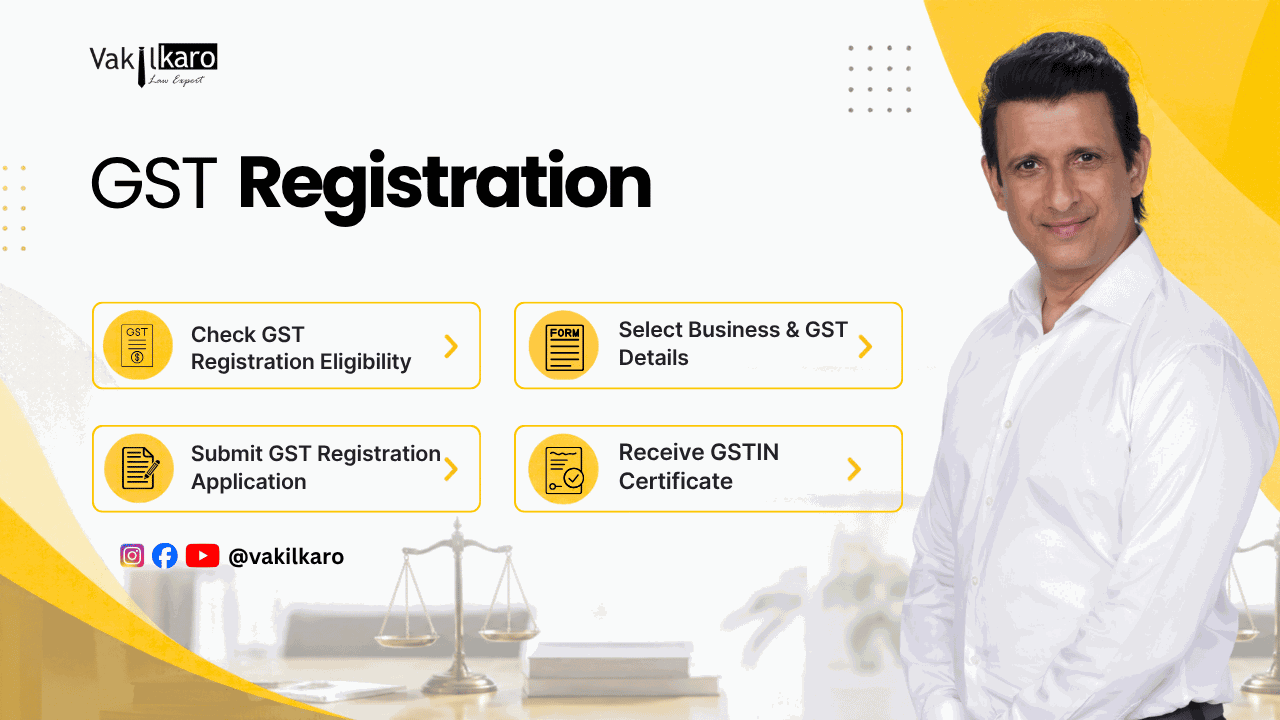
Step 1 – Check Eligibility
Check whether GST registration is mandatory or voluntary based on turnover, business activity and place of supply.
Step 2 – Start Registration
Visit the official GST Portal and select the New Registration option.
Step 3 – Enter Basic Details
Provide PAN, legal name, state, email address and mobile number, and complete OTP verification.
Step 4 – Complete Business Details
Enter business information, promoter/director details, authorised signatory, business address and goods or services details.
Step 5 – Upload Documents
Upload the required identity, address, business and authorisation documents.
Step 6 – Verify & Submit Application
Complete the applicable authentication or verification process and submit the application. An ARN is generated for tracking.
Step 7 – GST Registration Approval
Respond to any clarification raised by the GST officer. After approval, the GST Registration Certificate can be downloaded from the GST Portal.
How Long Does GST Registration Take?
Once Aadhaar authentication is done and documents are complete, a GSTIN is usually issued within 3–7 working days. It can take up to 30 days if the officer orders physical verification or raises a clarification.
The actual time can depend on:
- PAN validation
- Aadhaar or biometric authentication
- Risk-based verification
- Correctness of documents
- Business address verification
- Clarification raised by the officer
- Response provided by the applicant
- Physical verification where applicable
An application with complete and consistent records is generally easier to process than one containing mismatched information. Businesses should avoid relying on claims such as guaranteed registration within a particular number of hours.
GST Registration Fees in India (2026)
There is ordinarily no separate Government application fee for normal GST Registration through the official GST portal.
A business may separately incur professional charges where it engages a professional for:
- GST eligibility review
- Document checking
- Registration application
- Classification review
- Clarification response
- Post-registration guidance
There is no government fee for GST registration. Vakilkaro's professional fee starts at ₹2,000 + GST, covering eligibility check, document review, application filing and clarification support until your GSTIN is issued.
| Fee Component | Amount | Note |
|---|---|---|
| Government fee | Nil | No fee on the GST portal |
| Vakilkaro professional fee | ₹2,000 + 18% GST | Eligibility check, filing, query support |
| GST Return Filing (optional) | From ₹500 per month + GST | Monthly or quarterly returns after registration |
Compliance After GST Registration
GST compliance continues after the GSTIN is granted.
Depending on the taxpayer's activities and category, responsibilities may include:
- Issuing proper invoices
- Maintaining business records
- Filing GST returns
- Paying applicable GST
- Reporting outward supplies
- Reviewing input tax credit
- Reconciling purchase information
- Maintaining registration details
- E-way bill compliance
- E-invoicing where applicable
- Responding to GST notices
- Annual compliance where applicable
Businesses can coordinate ongoing compliance through GST Return Filing. Registration should therefore be followed by a practical compliance system rather than treating the GSTIN as a one-time certificate.
GST Registration for Exporters
Export transactions require proper GST planning. Exports are treated as zero-rated supplies under the IGST framework, subject to applicable conditions.
Eligible registered exporters may use the Letter of Undertaking mechanism for specified zero-rated supplies without payment of integrated tax.
Businesses planning export transactions may separately review GST LUT Filing. Exporters should also correctly determine place of supply, documentation, foreign currency requirements and refund implications where applicable.
GST Registration for Freelancers and Consultants
Freelancers and independent consultants are not automatically outside GST merely because they operate individually or from home.
Their registration position depends on:
- Aggregate turnover
- Nature of service
- Location of recipient
- Place of supply
- Inter-State transactions
- Export of services
- Applicable exemptions
A freelancer should therefore check actual GST liability rather than relying solely on the fact that no company has been incorporated.
GST Registration Amendment
Registration details may change after a GSTIN has been obtained.
An amendment may be required for changes relating to:
- Trade name
- Principal place of business
- Additional place of business
- Promoter or partner details
- Authorised signatory
- Contact details
- Other registration particulars
GST distinguishes between core and non-core amendments. Certain amendments require officer approval. Businesses requiring changes can review GST Amendment. A change involving a new PAN should be separately examined because fresh registration may be required.
Cancellation of GST Registration
A taxpayer who closes a business or no longer requires registration should not simply stop filing returns. A proper cancellation process may be required.
Cancellation may arise because of:
- Business closure
- Transfer of business
- Change in constitution
- Amalgamation
- Cessation of taxable supplies
- No longer being liable for registration
- Other permitted reasons
Cancellation does not automatically remove liabilities arising during the period for which registration was active. Pending returns, tax dues and other compliance matters should therefore be reviewed before completing closure.
Common GST Registration Mistakes
Businesses should avoid errors that may delay registration or trigger unnecessary clarification.
Common mistakes include:
- Applying without checking GST eligibility
- Assuming the ₹40 lakh threshold applies to every business
- Entering a legal name that does not match PAN records
- Selecting the wrong business constitution
- Mentioning an incorrect date of liability
- Uploading incomplete or inconsistent address documents
- Selecting the wrong nature of possession for the premises
- Providing incorrect promoter, partner, director or authorised signatory details
- Ignoring applicable Aadhaar authentication requirements
- Selecting incorrect business activities or supply details
- Failing to respond properly to a clarification raised by the GST officer
- Filing duplicate registration applications
- Choosing voluntary registration without understanding ongoing compliance requirements
A pre-filing review can help prevent avoidable errors and support a smoother GST Registration process.
GST Registration and Other Business Registrations
GST Registration serves a different purpose from company registration, income-tax registration or trademark protection.
A newly established business may separately require:
Private Limited Company Registration, LLP Registration, Trademark Registration and Income Tax E-Filing, depending on its legal structure and activities. Obtaining a GSTIN does not create ownership rights over a business name or trademark. Similarly, incorporating a company does not automatically provide GST Registration. Each registration should be evaluated separately.
Why Choose Vakilkaro for GST Registration?
GST Registration requires careful review of eligibility, business details and supporting documents before filing. Vakilkaro helps businesses organise the process and maintain consistency across the application and related records.
- GST Registration eligibility and turnover threshold review
- Business constitution, PAN and legal name verification
- Principal place of business and address document review
- Promoter, partner and authorised signatory detail checking
- Business activity and goods or service information review
- GST application preparation and filing coordination
- Assistance with clarification or additional document requirements
- Support for GST amendment, return filing, LUT filing and notice-related compliance
The aim is to reduce avoidable errors and support a smooth GST Registration process with properly organised information and documents.