

A Rent Agreement is a written contract between a landlord and tenant that records the terms on which a property is given for use and occupation. It commonly covers rent, security deposit, duration, maintenance, notice period and other agreed conditions. Stamp duty, registration and tenancy requirements may vary depending on the state, property and duration of the arrangement.
What is a Rent Agreement?
A Rent Agreement is a written contract between a landlord and tenant that records the terms for use and occupation of a property.
It may be used for residential properties such as flats, apartments and houses, as well as commercial properties such as shops, offices and business premises.
A properly drafted Rent Agreement generally covers:
- Landlord and tenant details
- Property description
- Monthly rent
- Security deposit
- Tenancy duration
- Rent payment terms
- Maintenance and utility charges
- Permitted use of the property
- Notice and termination terms
- Renewal and subletting conditions
The agreement should reflect the actual terms agreed between the parties.
Where the arrangement is for a longer period or creates more detailed lease rights, a Lease Deed may be more appropriate.
The Transfer of Property Act, 1882 and the Registration Act, 1908 may also be relevant depending on the duration and nature of the tenancy.
Why is a Rent Agreement Important?
A written Rent Agreement creates a clear record of the terms agreed between the landlord and tenant.
It can help define:
- Monthly rent and payment date
- Security deposit
- Tenancy duration
- Maintenance and repair responsibilities
- Utility and other charges
- Permitted use of the property
- Notice period
- Renewal and termination terms
- Vacating and handover conditions
Clear written terms can help reduce misunderstandings regarding rent payments, deposit deductions, maintenance responsibilities and termination of the tenancy.
A properly drafted Rent Agreement also provides a useful record of the agreed conditions during the tenancy.
Where the arrangement is for a longer period, the parties should also check whether a Lease Deed and Property Registration requirements apply.
Who Should Use a Rent Agreement?
A Rent Agreement may be used where a property is given for temporary use or occupation against agreed rent.
It may be relevant for:
- Individual landlords and tenants
- Families, students and working professionals
- Owners renting residential property
- Shops, offices and other business premises
- Companies, LLPs and partnership firms
- Commercial landlords and business tenants
- Property managers or authorised representatives
Where a company, LLP, firm, trust or other entity is involved, appropriate registration and authorisation documents may also be required.
If a representative signs on behalf of the landlord or tenant, the authority under the Power of Attorney or other authorisation should be reviewed.
Which Laws May Apply to a Rent Agreement?
Rent Agreements in India may be governed by central laws together with applicable state-specific tenancy, stamp and registration rules.
1. Transfer of Property Act, 1882
The Transfer of Property Act, 1882 contains important provisions relating to leases of immovable property, including the rights and responsibilities of landlords and tenants.
2. Registration Act, 1908
The Registration Act, 1908 requires registration of certain leases, including leases from year to year or for a term exceeding one year.
Where registration is applicable, the relevant Property Registration procedure should be followed.
3. State Stamp Laws
Stamp duty on a Rent Agreement or Lease Deed varies by state and may depend on factors such as rent, duration, security deposit and nature of the property. The current state stamp requirements should be checked before execution.
4. State Tenancy and Rent Control Laws
State-specific laws may regulate matters such as rent, security deposits, repairs, eviction, tenancy reporting and dispute resolution. The applicable local law should therefore be checked before finalising the agreement.
5. Model Tenancy Act, 2021
The Model Tenancy Act, 2021 provides a model framework for tenancy agreements, rent, security deposits, maintenance and rent authorities.
It should not be treated as a uniform law automatically applicable across India. The law adopted and in force in the concerned state or Union Territory should be checked.
Rent Agreement vs Lease Deed
A Rent Agreement and a Lease Deed both record the terms for use and occupation of property, but their duration and legal structure may differ.
| Rent Agreement | Lease Deed |
|---|---|
| Commonly used for shorter rental arrangements. | Commonly used for longer or more structured lease arrangements. |
| Usually records rent, security deposit, duration and tenancy terms. | Usually contains more detailed rights, obligations and lease conditions. |
| Often used for residential or short-term occupancy. | Commonly used for long-term residential or commercial use. |
| Registration depends on the duration and applicable law. | Longer leases may fall within compulsory registration requirements. |
The appropriate document should be selected according to the property, duration and rights intended to be created.
Where the arrangement is from year to year, exceeds one year, or reserves yearly rent, registration requirements under the Registration Act, 1908 should be checked.
Is an 11-Month Rent Agreement Mandatory?
No. An 11-month Rent Agreement is commonly used in India, but there is no general rule that every rental agreement must be for 11 months.
The parties may choose a different duration depending on their requirements and applicable law.
Under the Registration Act, 1908 and the Transfer of Property Act, 1882, certain leases—such as those from year to year or for a term exceeding one year—may require registration.
Shorter agreements may be treated differently, but applicable state stamp duty, tenancy and registration requirements should still be checked.
The agreement period should therefore be selected according to the actual tenancy rather than only following the common 11-month format.
Types of Rent Agreements
Rent Agreements may vary depending on the property and nature of occupancy.
Residential Rent Agreement
Used for flats, apartments, houses, rooms and other residential premises. It should clearly record rent, security deposit, duration, maintenance and notice terms.
Commercial Rent Agreement
Used for shops, offices, warehouses and other business premises. It may include additional terms relating to business use, maintenance, lock-in period, renewal, subletting and other commercial conditions.
For longer or more structured arrangements, a Lease Deed may be more appropriate.
Rent Agreement for Company or Firm
Where a company, LLP Registration or partnership takes property on rent, the agreement should identify the entity, authorised signatory and permitted business use. Relevant entity and authorisation documents may also be required.
What Should a Rent Agreement Contain?
A properly drafted Rent Agreement should clearly record the agreed terms between the landlord and tenant.
Important clauses may include:
- Parties: Names and details of the landlord and tenant.
- Property Description: Complete address and details of the rented premises.
- Monthly Rent: Agreed rent payable by the tenant.
- Rent Due Date: Date by which rent should be paid each month.
- Security Deposit: Deposit amount and refund or deduction conditions.
- Tenancy Period: Start date and duration of the agreement.
- Possession: Date and conditions for handing over possession.
- Permitted Use: Residential, commercial or other authorised use.
- Maintenance: Responsibility for routine maintenance and repairs.
- Utility Charges: Responsibility for electricity, water, gas or other charges.
- Society / Common Charges: Responsibility for applicable maintenance or common-area charges.
- Notice Period: Period required for termination or vacating.
- Lock-in Period: Minimum agreed period, where applicable.
- Rent Escalation: Agreed increase in rent on renewal or during the term.
- Subletting: Whether subletting or transfer of occupancy is permitted.
- Alterations: Restrictions on structural or other changes.
- Entry and Inspection: Conditions for landlord access to the premises.
- Termination: Circumstances in which the agreement may be terminated.
- Handover: Condition in which the premises should be returned.
- Dispute Clause: Agreed approach for handling disputes.
- Witnesses: Details of witnesses, where applicable.
The final agreement should reflect the actual arrangement between the parties.
Documents Required for Rent Agreement
The documents required for a Rent Agreement may vary depending on the parties, property and applicable state procedure.
| Document | Purpose |
|---|---|
| Landlord Identity Proof | Used to verify the landlord or property owner. |
| Tenant Identity Proof | Used to verify the tenant. |
| Property Ownership Proof | Helps confirm the landlord's right to rent the property. |
| Property Address Details | Used to correctly identify the rented premises. |
| PAN, where applicable | May be required for identification or tax-related formalities. |
| Power of Attorney / Authorisation | Required where a representative signs on behalf of a party. |
| Entity Documents | Required where a company, LLP or firm is involved. |
| Witness Identity Documents | Used where witness verification is required. |
Additional documents may be required depending on the property, parties and registration procedure.
Where ownership is unclear, Property Verification may be considered before executing the agreement.
Rent Agreement Process
The Rent Agreement process may vary depending on the property, state and tenancy terms.
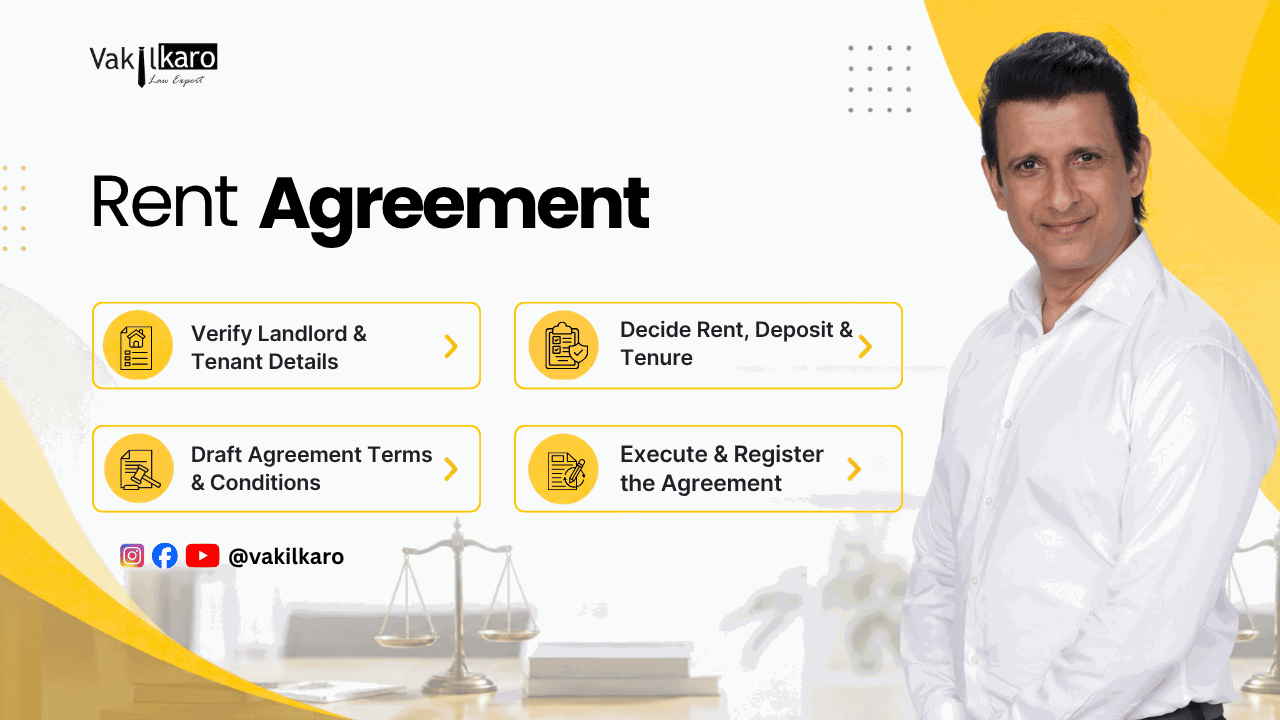
Step 1: Confirm Party and Property Details
Verify the landlord, tenant and complete property details. Where ownership is unclear, Property Verification may be considered.
Step 2: Finalise Rental Terms
Agree on the monthly rent, security deposit, duration, payment date, maintenance, notice period and other important conditions.
Step 3: Draft the Rent Agreement
Prepare the Rent Agreement according to the actual property and agreed terms.
Step 4: Check Stamp Duty
Confirm the applicable stamp duty according to the relevant state rules.
Step 5: Sign the Agreement
The landlord and tenant should review and sign the final agreement. Witness signatures may also be required.
Step 6: Complete Registration, Where Required
If registration is applicable, complete the relevant Property Registration formalities.
Step 7: Keep Signed Copies
Both parties should keep a signed copy of the agreement and related payment or registration records.
Rent and Payment Terms
The Rent Agreement should clearly state:
- Monthly rent
- Payment due date
- Mode of payment
- Late-payment terms
- Rent escalation
- Advance rent, where applicable
Clear payment terms help avoid confusion regarding rent and payment obligations.
Security Deposit in Rent Agreement
The agreement should clearly mention the security deposit and related conditions.
Important points may include:
- Deposit amount
- Refund conditions
- Permitted deductions
- Damage-related deductions
- Outstanding dues
- Refund timeline
Security-deposit requirements may vary according to applicable state law.
Maintenance and Repair Responsibilities
The Rent Agreement should clearly divide maintenance and repair responsibilities between the landlord and tenant.
This may include:
- Routine repairs
- Plumbing and electrical work
- Society or common-area charges
- Structural repairs
- Damage caused by the tenant
- Major maintenance
The final responsibility should be clearly recorded in the agreement.
Notice Period and Termination
The agreement should clearly state how the tenancy can be ended.
Important terms may include:
- Notice period
- Lock-in period
- Early termination
- Non-payment of rent
- Misuse of property
- Unauthorised subletting
- Breach of agreement
- Handover obligations
The agreed notice and termination terms should be clearly recorded.
Rent Agreement Registration
Registration requirements depend on the duration and nature of the tenancy.
Certain leases, including those from year to year or for a term exceeding one year, may require registration under the Registration Act, 1908.
The process may include:
- Final agreement
- Stamp duty payment
- Registration charges
- Identity verification
- Signatures and witnesses
- Photograph or biometric verification, where applicable
Where required, the applicable Property Registration process should be followed.
Is Notarisation the Same as Registration?
No. Notarisation and registration are different.
Notarisation generally verifies signatures or execution of a document, while registration formally records the document with the registration authority.
Where registration is legally required, notarisation should not be treated as a substitute.
Stamp Duty on Rent Agreement
Stamp duty on a Rent Agreement varies by state.
The amount may depend on:
- Monthly rent
- Agreement duration
- Security deposit
- Advance rent
- Type of property
- Nature of tenancy
The applicable rate should be checked with the concerned state stamp and registration authority before execution.
Residential Rent Agreement
A residential Rent Agreement may be used for flats, apartments, houses or other residential premises.
Important terms may include:
- Monthly rent
- Security deposit
- Occupants
- Maintenance
- Utility bills
- Society rules
- Notice period
- Lock-in period
- Handover terms
Where ownership requires review, Property Verification may be considered.
Commercial Rent Agreement
A commercial Rent Agreement may be used for shops, offices and other business premises.
Important terms may include:
- Permitted business use
- Commercial rent
- Security deposit
- Lock-in period
- Rent escalation
- Maintenance
- Common-area charges
- Subletting
- Renewal
- Termination
For longer arrangements, a Lease Deed may be more appropriate.
Rent Agreement Through Power of Attorney
A landlord or tenant may act through an authorised representative where legally permitted.
Where a Power of Attorney is used, check:
- Identity of the principal and attorney
- Scope of authority
- Property details
- Authority to rent or lease
- Whether the authority remains valid
A Power of Attorney should not automatically be treated as proof of ownership.
Online Rent Agreement
Certain parts of the Rent Agreement process may be available online depending on the state.
Online facilities may include:
- Agreement drafting
- E-stamping
- Stamp duty payment
- Appointment booking
- Registration-related services
- Document status
The exact process varies by state, and physical appearance or biometric verification may still be required where registration applies.
Common Rent Agreement Mistakes
Common mistakes include:
- Incorrect landlord or tenant details
- Incomplete property description
- Unclear rent or payment terms
- Missing security-deposit conditions
- Missing notice period
- Unclear maintenance responsibilities
- Ignoring rent-escalation terms
- Not checking stamp duty
- Ignoring registration requirements
- Failing to verify landlord authority
- Using a generic agreement without reviewing the actual tenancy
Proper drafting, Property Verification and Property Registration, where applicable, can help reduce documentation issues.
Rent Agreement Checklist
Before signing a Rent Agreement, check that:
- Landlord and tenant details are correct
- Property address is complete
- Rent and payment terms are clear
- Security deposit is correctly stated
- Agreement duration is correct
- Notice and lock-in terms are recorded
- Maintenance and utility responsibilities are clear
- Permitted use and subletting terms are stated
- Stamp duty has been checked
- Registration requirements are confirmed
- Signatures and witness details are complete
The exact checklist may vary depending on the property, state and tenancy arrangement.
Benefits of a Proper Rent Agreement
A properly drafted Rent Agreement can provide several practical benefits for both landlord and tenant.
Clear Rental Terms
Clearly records the rent, security deposit, duration and other agreed conditions.
Better Security Deposit Record
Helps document the deposit amount, permitted deductions and refund terms.
Clear Maintenance Responsibilities
Defines which repairs, maintenance and charges are the responsibility of the landlord or tenant.
Clear Notice and Termination Terms
Helps both parties understand the notice period, termination conditions and handover requirements.
Reduced Misunderstandings
Written terms can reduc e confusion regarding payments, property use, maintenance and possession.
Support for Registration or Lease Documentation
Where required, a properly drafted agreement can support a Lease Deed or Property Registration process.
Better Record Management
Signed copies can be maintained with rent receipts, deposit records and other property documents.
Drafting Fees
Vakilkaro's professional fee for drafting starts at ₹____ + GST. It covers drafting of rent, deposit, lock-in, maintenance and notice clauses, along with stamp duty guidance. Stamp duty and registration charges, as per the State, are payable separately.
Why Choose Vakilkaro for Rent Agreement?
A Rent Agreement should clearly reflect the property, tenancy period and terms agreed between the landlord and tenant. Vakilkaro follows a structured process to help prepare clear, practical and transaction-specific rental documentation.
Key benefits include:
- Clear and step-by-step agreement process
- Property-specific document checklist
- Review of landlord, tenant and property details
- Guidance on the appropriate agreement structure
- Drafting of rent and security deposit terms
- Drafting of notice, termination and renewal clauses
- Guidance on maintenance, utility and other payment responsibilities
- Guidance on lock-in period and tenancy conditions
- Guidance on state-specific stamp duty requirements
- Guidance on applicable registration requirements
- Review of Power of Attorney, where applicable
- Coordination with Property Verification, where required
- Coordination with Property Registration, where applicable
- Guidance on Lease Deed where a longer or more structured arrangement is required
- Clear and transparent communication
- Guidance on final execution and documentation