
Startup India Registration is the process of obtaining DPIIT Startup Recognition from the Department for Promotion of Industry and Internal Trade. Eligible Private Limited Companies, LLPs and registered partnership firms can apply online by providing business, innovation and scalability details.
What is Startup India Registration?
Startup India Registration, also known as DPIIT Startup Recognition, is the process through which eligible businesses apply for official recognition under the Startup India Initiative launched by the Government of India in 2016.
The recognition is granted by the Department for Promotion of Industry and Internal Trade (DPIIT) after reviewing the startup’s eligibility, business details, innovation approach and growth potential.
After successful approval, the startup receives a digitally generated Startup Recognition Certificate, which establishes its recognised startup status and may provide access to eligible government benefits, schemes and startup ecosystem facilities.
To apply for DPIIT recognition, a startup must provide details related to:
- Business incorporation and legal structure
- Product or service offering
- Innovation or improvement activities
- Business model and scalability potential
- Employment generation potential
The application process is completed online through the official Startup India Portal.
Before applying, startups should ensure proper business setup through suitable structures such as:
- Private Limited Company Registration
- LLP Registration
- One Person Company Registration
- MSME Registration
Choosing the right business structure helps startups maintain proper compliance, manage funding requirements and plan future expansion.
Startup India Recognition and Company Registration Are Different
| Point | Business Registration | DPIIT Startup Recognition |
|---|---|---|
| Purpose | Creates a legal entity or registered firm. | Recognises an eligible entity as a startup under the applicable DPIIT framework. |
| Authority | MCA or relevant firm-registration authority, depending on structure. | Department for Promotion of Industry and Internal Trade through the Startup India system. |
| When done | First. | After valid incorporation or registration. |
| Result | Certificate or registration record for the entity. | Startup recognition certificate. |
| Tax benefit | No automatic startup tax benefit. | Recognition alone does not automatically grant every tax exemption; separate eligibility and approval may apply. |
For company data and statutory filings, founders should refer to the Ministry of Corporate Affairs. A founder planning a single-member structure can review One Person Company registration, while a large ownership or capital plan may require consideration of public limited company registration. Not every structure is eligible for DPIIT recognition, so entity selection should be made carefully.
Who is Eligible for Startup India Registration?
| Eligibility Criteria | Requirement |
|---|---|
| Eligible Business Entity | The applicant should generally be incorporated as a Private Limited Company, Limited Liability Partnership (LLP), or Registered Partnership Firm. |
| Entity Registration in India | The business entity must be legally incorporated or registered in India before applying for DPIIT recognition. |
| Age of Entity | The startup should satisfy the applicable DPIIT age criteria from the date of incorporation or registration. |
| Turnover Limit | The entity should meet the applicable DPIIT turnover conditions as prescribed under the current guidelines. |
| Innovation Requirement | The startup should be working towards innovation, development or improvement of products, services or processes, or have a scalable business model with employment or wealth creation potential. |
| Original Business Formation | The entity should not have been formed by splitting up or reconstructing an existing business. |
| Business Details | The startup should provide clear information about its product/service, problem being solved, solution, business model and scalability potential. |
Choosing the Right Legal Structure Before Applying
Choosing the right legal structure is an important step before applying for Startup India recognition. A startup may operate as a Partnership (LLP), Private Limited Company, Limited Liability or Registered Partnership Firm, depending on its ownership structure, liability requirements, funding plans, compliance needs, and future growth objectives.
Private Limited Company
A private limited company is commonly selected by startups that expect equity investment, employee stock options or a formal board structure. It offers limited liability and a familiar fundraising framework, but it also involves company-law filings, accounting and governance. Read the practical SPICe Plus incorporation guide, Memorandum of Association guide and Articles of Association guide before finalising the structure.
Limited Liability Partnership
An LLP may be suitable where founders want operational flexibility and limited liability without a conventional share-capital structure. Investment mechanics differ from a company, so founders planning institutional equity should compare the options carefully. The private limited company versus LLP guide, registered office guide and LLP compliance service explain important practical differences.
Registered Partnership Firm
A registered partnership firm may qualify, but founders should consider unlimited liability, partner relationships and future fundraising. A properly drafted partnership deed is essential. Where co-founders want clearer rights on ownership, roles, exits and intellectual property, a founders agreement can help document the commercial understanding.
Documents Required for Startup India Registration
The documents and information required for DPIIT Startup Recognition may vary depending on the entity type, business model and details provided in the application. Startups should keep accurate and supporting records ready before submitting the application.
| Document / Information Required | Purpose / Details |
|---|---|
| Certificate of Incorporation / Registration Certificate | Proof of legal existence of the startup entity, including incorporation date and registration details. |
| PAN Details of Entity | Used for verification of the startup’s identity and official records. |
| Authorised Representative Details | Name, designation, mobile number and email details of the founder or authorised person submitting the application. |
| Business Description | Details about the problem being solved, proposed solution, target customers and revenue model of the startup. |
| Innovation and Scalability Details | Information explaining the innovation, improvement, unique approach or scalability potential of the product, service or process. |
| Website / Product Details / Supporting Evidence | Website links, product demonstrations, pitch deck, videos, photographs, research details, pilot results or customer evidence (where applicable). |
| Intellectual Property Details | Details of patents, trademarks, copyrights or other intellectual property rights, if relevant to the startup. |
| Funding and Recognition Details | Information related to investments, grants, incubator association, awards or government programmes, if applicable. |
| Employee and Business Details | Relevant information regarding team size, employment generation and business operations, wherever required. |
| Self-Certification Documents | Declaration confirming that the entity meets DPIIT recognition conditions and is not formed by splitting or reconstructing an existing business. |
Startups should ensure that all submitted information matches their official records and supporting documents. Any mismatch in entity details, business information or supporting evidence may delay the recognition process.
Step by Step Startup India Registration Process
The Startup India Registration process involves obtaining DPIIT Startup Recognition through the official Startup India Portal. Startups should ensure eligibility, prepare required information and submit accurate details during the application process.
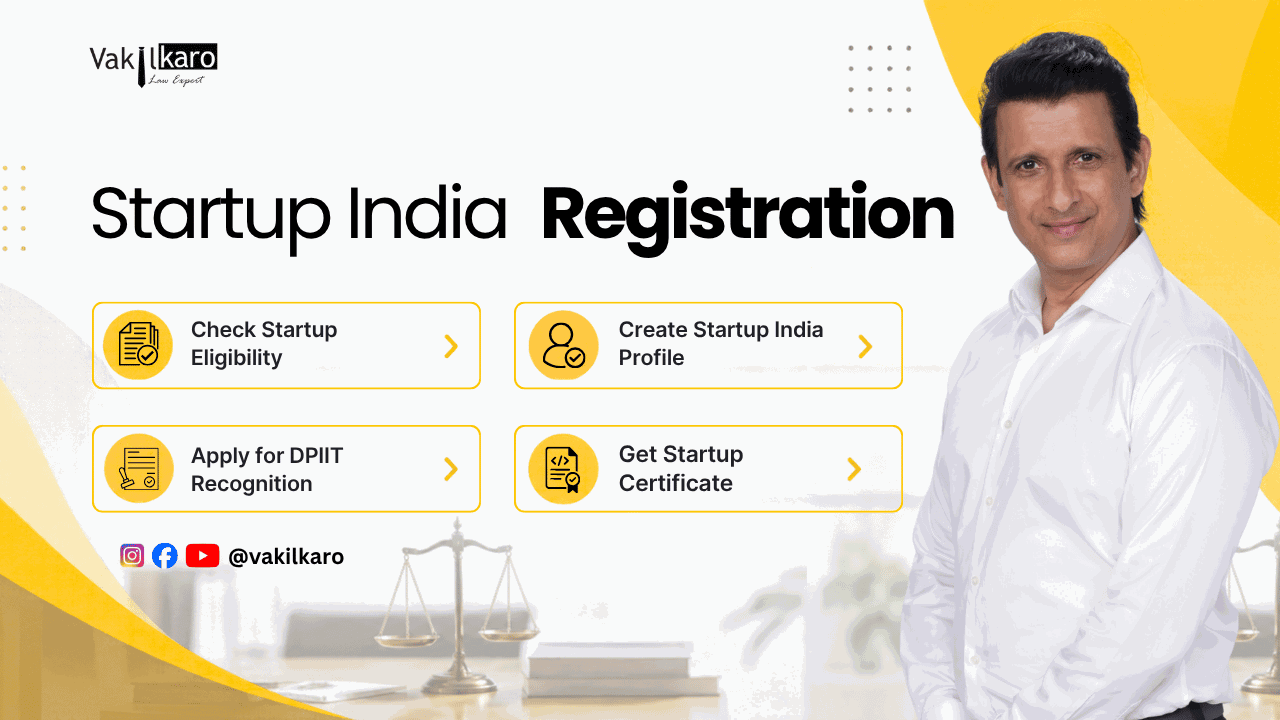
Step 1: Check Eligibility
Verify whether the business entity meets DPIIT recognition requirements, including eligible entity type, incorporation details, turnover criteria and innovation requirements.
Step 2: Prepare Required Information & Documents
Collect incorporation details, business information, innovation details, supporting documents and other required information before starting the application process.
Step 3: Create Account on Startup India Portal
Register on the official Startup India Portal using the authorised representative’s details and complete the required profile information.
Step 4: Submit DPIIT Recognition Application
Complete the recognition application form with accurate details about the startup’s business model, product/service, innovation and scalability potential.
Step 5: Upload Supporting Details & Submit Declaration
Upload required documents, supporting evidence and self-certification details as required under the DPIIT recognition process.
Step 6: Application Review & Query Response
The application may be reviewed by the concerned authority. If any clarification is required, the startup should provide appropriate information and supporting documents.
Step 7: Receive Startup Recognition Certificate
After successful approval, the startup can download the digitally generated DPIIT Startup Recognition Certificate through the Startup India platform.
Before applying, startups should ensure proper legal setup through suitable business structures such as Private Limited Company Registration, LLP Registration or One Person Company Registration depending on their business requirements.
Benefits of Startup India Registration
DPIIT recognition may provide eligible startups access to various government schemes, intellectual property benefits and startup ecosystem opportunities, subject to applicable conditions.
Reason:
- Intellectual property support: eligible recognised startups may access facilitation and fee-related benefits under applicable patent and trademark rules. Consider a trademark registration, copyright registration or patent registration according to the asset being protected.
- Government procurement opportunities: recognised startups may receive relaxations from prior turnover or experience requirements in specified procurements, subject to quality, technical and tender conditions. The Government e Marketplace is an important official procurement platform.
- Tax incentives: certain eligible startups may seek tax benefits under the Income-tax Act through the separate prescribed process. Use the Income Tax e Filing portal for official tax services and do not assume recognition equals automatic exemption.
- Self-certification: eligible startups may use self-certification mechanisms under specified labour and environmental laws, subject to the current scheme and conditions. This does not remove the duty to maintain records or comply with substantive law.
- Funding ecosystem: recognition may strengthen access to incubators, challenges, grants and government-backed funding programmes, but it does not guarantee investment or a loan. Explore the official Startup India funding resources.
- Faster exit: qualifying startups may be eligible for a faster insolvency resolution or exit route under applicable law. The correct route depends on liabilities, litigation, creditors and statutory status.
Tax Exemption Is a Separate Process
DPIIT recognition and income-tax exemption are different decisions. A startup that wants an exemption under section 80-IAC must separately check the current statutory requirements and prescribed approval process. Recognition is an eligibility gateway in some contexts, not a final tax order. The startup should maintain audited financial statements, income-tax returns, shareholding data and supporting commercial records.
For ongoing tax work, the entity may need company income tax return filing, business income tax filing or partnership and LLP tax filing, depending on its structure. TDS obligations may also require TAN registration and timely return filing.
Founders should check the latest law and portal guidance because tax provisions and application procedures can change. Use official resources from the Income Tax help centre and obtain professional advice based on the startup’s facts.
Intellectual Property Readiness for Startups
A startup’s value may sit in its brand, software, content, product design, invention, data or confidential methods. DPIIT recognition does not itself create intellectual property rights. Each asset needs the correct protection strategy.
- Brand name and logo: conduct a search and file in the correct classes. If the Registry raises issues, the business may need a trademark objection reply or later trademark hearing support.
- Confidential information: use a properly drafted non disclosure agreement with employees, vendors, consultants and potential collaborators where appropriate.
- Product design: Consider Design Registration to protect the unique visual features, shape, configuration, pattern or ornamentation of a product where the design meets the applicable legal requirements.
- Ownership between founders: the founders agreement and employment or consultancy contracts should state who owns code, research, content, brand assets and inventions created for the startup.
A startup preparing for investment should also review its trademark strategy for a private limited company and keep assignment documents ready if intellectual property was initially created in a founder’s personal name. Where a mark is transferred, a formal trademark assignment process may be required.
Funding and Investment Readiness
Recognition can improve credibility, but investors examine far more than the certificate. They typically review the cap table, legal structure, founder commitments, intellectual property ownership, customer evidence, financial model, regulatory exposure and compliance history. The Startup India government schemes directory can help founders identify programmes, while the SIDBI Fund of Funds for Startups explains an important government-backed funding framework.
- Prepare a realistic business plan, use of funds and financial forecast. Avoid presenting revenue as guaranteed.
- Maintain an accurate shareholding record and document new issuances or transfers. Founders may need support for share transfer, authorised capital increase or dematerialisation of shares.
- Document investor rights through appropriate agreements. Depending on the transaction, this may include a shareholders agreement, share purchase agreement or joint venture agreement.
- Open and operate the business bank account in the entity’s name. A board-approved account opening resolution may be required for a company.
- For debt funding, compare the lender’s eligibility conditions, collateral requirements, cash flows and repayment terms. The CGTMSE official portal provides information on its credit guarantee framework.
Registrations That May Be Needed After Recognition
DPIIT Startup Recognition does not replace other business registrations or statutory compliances. Startups may require additional registrations depending on their business activity, turnover, employee strength and operational requirements.
Common registrations and compliance requirements may include:
- GST Registration for businesses that become liable for GST registration based on their turnover, supply nature and applicable GST provisions.
- MSME Registration for eligible enterprises that want to obtain Udyam registration and access applicable MSME-related benefits.
- Trademark Registration for protecting the startup’s brand name, logo and other intellectual property assets.
- PF Registration and ESI Registration when employee-related statutory compliance requirements become applicable.
- Company Compliance Services and tax-related filings based on the startup’s legal structure and ongoing business operations.
Post Recognition Compliance
Recognition is not a substitute for annual compliance. A company must maintain books, conduct required meetings, prepare financial statements and file prescribed returns. An LLP must complete its own annual filings and tax compliance. A recognised startup should also preserve the records supporting its eligibility and notify or update information where the portal or applicable scheme requires it.
- Complete commencement-related compliance where applicable, including INC 20A filing support.
- Appoint the auditor and complete relevant filings, including ADT 1 filing where required.
- Review deposits and outstanding receipts for DPT 3 filing applicability.
- Maintain director KYC and resolve status issues on time.
- Keep bookkeeping updated and reconcile bank, tax, payroll and invoice records.
- Prepare an offer letter, Appointment Letter or Consultancy Agreement.
- Protect your website with terms, privacy policy and an appropriate disclaimer.
Business Launch and Expansion Checklist
Recognition should fit into a wider launch plan. The startup should decide how it will sell, contract, hire, receive investment and enter new markets. Each document or filing below should be used only when the underlying transaction makes it necessary.
- Commercial relationships may require a memorandum of understanding, a detailed agency agreement or a model-specific franchise agreement.
- A startup using independent talent should define scope, fees, confidentiality and intellectual property through a freelancer agreement. A consumer brand may also need professional logo design support and timely trademark renewal to preserve brand rights.
- A company receiving or making cross-border investment should review the applicable foreign-exchange reporting, including FDI filing, ODI filing and FLA return filing where the facts trigger them.
- Exporters may need a GST letter of undertaking, while distributed businesses should assess virtual office GST registration support carefully against place-of-business requirements.
- Growing employers should track periodic PF return filing and ESI return filing obligations after registration.
Common Reasons for Startup India Registration Rejection
- The applicant is not an eligible entity, or the entity is outside the applicable age or turnover limits.
- The business description is generic and does not explain innovation, improvement or scalability.
- The business lacks a clear innovative or scalable element.
- Entity data does not match incorporation records, PAN, address or authorised representative details.
- Uploaded evidence is unreadable, outdated or unrelated to the claims made in the application.
- The startup claims patents, customers, funding, awards or technology without verifiable support.
- The restructuring of an existing business is not properly addressed.
- The applicant treats DPIIT recognition as automatic and submits the form without a final legal and factual review.
A careful pre-filing review reduces these risks. Founders can also study the Startup India learning resources and the founder questions guide to identify gaps before submission.
Startup India Registration Fees in India (2026)
The Startup India Registration (DPIIT Startup Recognition) application process is completed online through the official Startup India Portal. Generally, startups do not need to pay any separate government fee for submitting the DPIIT recognition application.
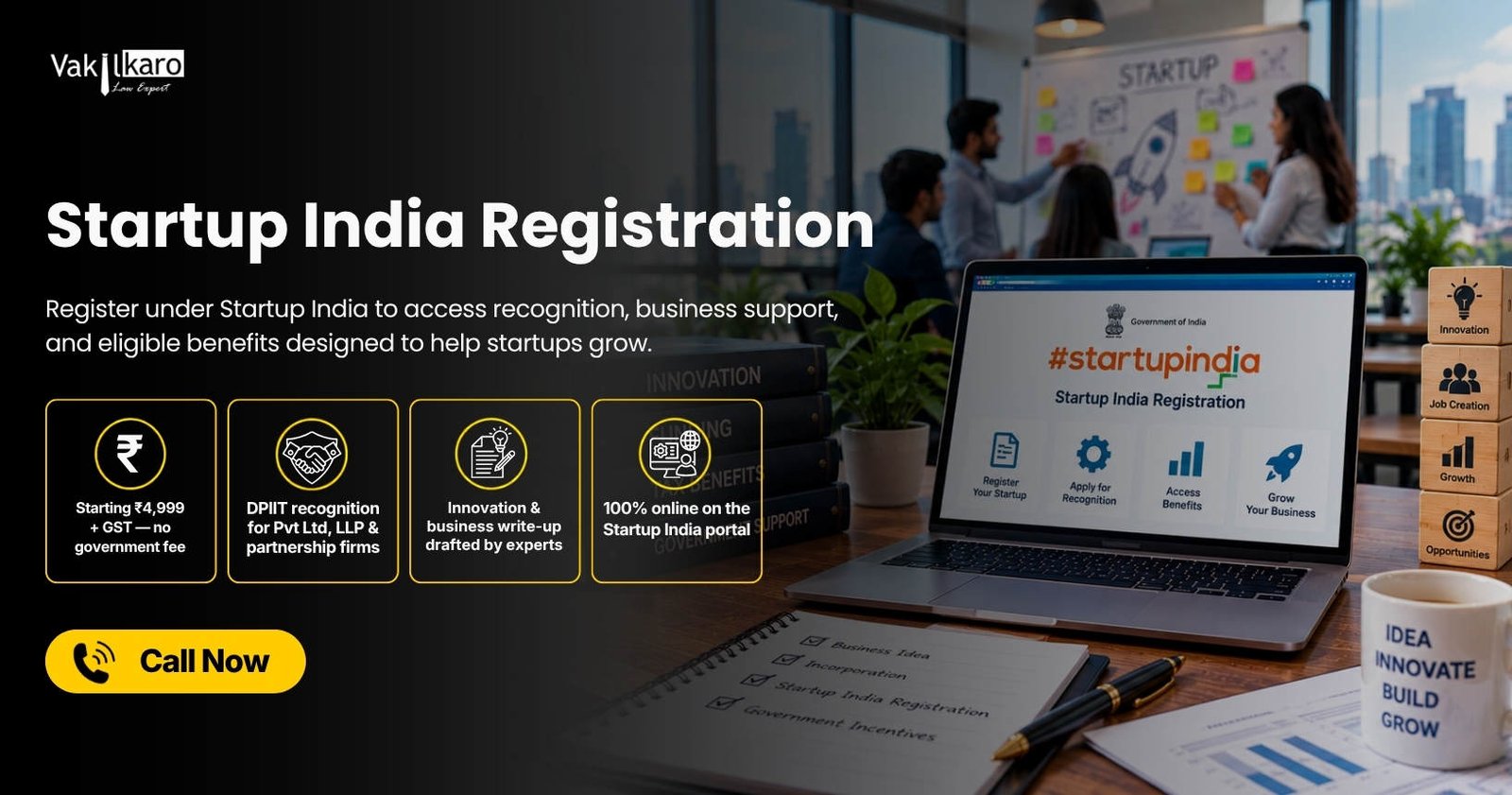
Vakilkaro's professional fee for Startup India Registration starts at ₹4,999 + GST, covering eligibility review, innovation write-up, document preparation and portal filing. There is no government fee for DPIIT recognition.
| Cost Component | Details |
|---|---|
| Government Application Fee | No separate government fee is generally charged for applying for DPIIT Startup Recognition through the Startup India Portal. |
| Professional Assistance Fee | Depends on the scope of support required, including eligibility review, documentation assistance, application preparation and query support. |
| Business Setup Cost (If Required) | If the startup is not already incorporated, additional costs may apply for setting up a suitable entity such as Private Limited Company Registration, LLP Registration or other eligible structures. |
| Additional Compliance Requirements | Costs may vary depending on additional requirements such as Trademark Registration, GST Registration or other business compliance services. |
Startups should keep their incorporation details, business information and supporting documents ready to ensure a smooth DPIIT recognition application process.
How Long Does Startup India Registration Take?
The time required depends on entity readiness, the quality of the innovation note, portal workload and whether clarification is requested. A complete application may move quickly, but no professional should promise a guaranteed approval date. The government portal should be checked for the current filing process and any applicable government charge. Professional fees, if engaged, depend on the scope eligibility review, drafting, supporting evidence, application filing, query response or related registrations.
| Work Stage | Typical Work Involved | What Can Affect Time |
|---|---|---|
| Eligibility review | Entity, age, turnover, restructuring and business-model review. | Incomplete records or unclear entity history. |
| Drafting | Problem, solution, innovation, improvement and scalability note. | Need for technical or commercial evidence. |
| Application | Portal data entry, uploads, declarations and submission. | Portal availability and data mismatch. |
| Authority review | Government review and possible clarification. | Volume of applications and quality of response. |
| Certificate | Download, verify and preserve the recognition record. | Correction required in entity information. |
Why Choose Vakilkaro for Startup India Registration?
Vakilkaro provides a structured assistance process for founders who need help understanding recognition eligibility, arranging entity records, drafting the business explanation and completing the online application. The service focuses on accurate information and clear documentation rather than unsupported approval promises.
- Eligibility-first review: the entity structure, incorporation date, turnover position and business model are checked before the application is prepared.
- Natural, fact-based drafting: the innovation and scalability note is written around the startup’s real product, process, service and evidence.
- Connected compliance support: founders can coordinate incorporation, tax, intellectual property and annual compliance requirements through one workflow.
- Query support: if clarification is requested, the response is organised around the authority’s question and supporting records.
- Practical handover: the recognition certificate, acknowledgement and submitted information are organised for future funding, procurement and compliance use.
Founders can also review the broader Startup India guide for private limited companies, private limited funding guide and corporate banking guide when preparing for the next stage of growth.