
A Relinquishment Deed is a property document commonly used when a co-owner or legal heir gives up an existing share or interest in immovable property in favour of another person having an interest in that property. The deed should clearly identify the parties, property, share being released and applicable terms. Stamp duty and registration requirements depend on the property, state and nature of the transaction.
What is a Relinquishment Deed?
A Relinquishment Deed, also known as a Release Deed in many property transactions, is used to record the release of an existing right, share or interest in immovable property.
It is commonly used where property is jointly owned or inherited by multiple legal heirs and one person wishes to give up his or her share in favour of another person who already has an interest in the property.
For example, if several legal heirs inherit a property and one heir decides to release a share in favour of another co-heir, a properly drafted Relinquishment Deed may be used.
The deed generally records:
- Details of the parties
- Existing ownership
- Property description
- Share or interest being relinquished
- Consideration, if any
- Relevant possession and registration terms
Where the deed affects rights in immovable property, registration requirements under the Registration Act, 1908 should be checked.
A Relinquishment Deed should be used only where it reflects the actual ownership arrangement. In some cases, a Gift Deed or Sale Deed may be more appropriate.
When is a Relinquishment Deed Used?
A Relinquishment Deed is generally used where two or more persons already have an interest in the same property and one person wishes to release a share in favour of another existing co-owner or legal heir.
Common situations may include:
- Property inherited by multiple legal heirs
- Jointly owned family property
- Co-owned residential property, land or plot
- One legal heir releasing a share in favour of another
- One co-owner giving up rights in favour of another co-owner
- Family restructuring of existing ownership shares
Before preparing the deed, the present ownership should be checked through available title documents and property records. Where ownership is unclear, Property Verification may be considered.
If the transaction involves division of property, sale for consideration or transfer to a person without an existing interest, another document such as a Partition Deed, Sale Deed or Gift Deed may be more appropriate.
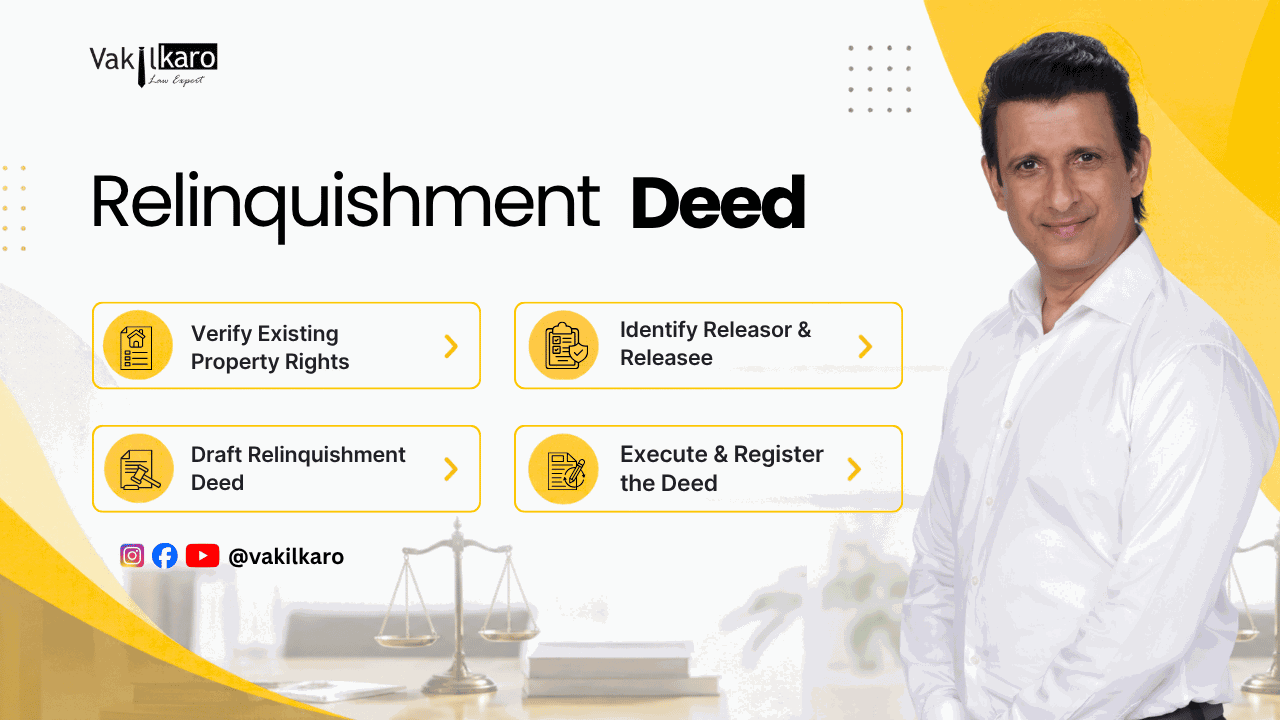
Who Can Execute a Relinquishment Deed?
A Relinquishment Deed is generally executed by a person who already holds a legal right, share or interest in the property.
The person giving up the share is commonly called the releasor, while the person receiving the released interest may be called the releasee.
It may be relevant between:
- Legal heirs
- Co-owners
- Joint property holders
- Family members who already have an interest in the property
- Other persons holding an existing share or right in the property
For inherited property, the ownership and succession position should be checked before execution. Where applicable, [the Hindu Succession Act, 1956](https://www.plrs.org.in/pdfs/Hindu Succession Act.pdf) may be relevant.
A family relationship alone does not create a right to execute a Relinquishment Deed. The person releasing the share should have an existing legal interest in the property.
Where a representative signs on behalf of a party, the authority under the Power of Attorney should also be reviewed.
Why is a Relinquishment Deed Important?
A Relinquishment Deed creates a formal record that a person has given up an existing right, share or interest in property.
It can help clearly record:
- The parties involved
- Existing ownership
- Property details
- Share being relinquished
- Person receiving the released share
- Consideration, if any
- Voluntary nature of the release
A properly executed and registered Relinquishment Deed can also become an important part of the property's title history.
It may be reviewed during future transactions such as a Sale Deed, mortgage or Property Registration.
Proper documentation can help reduce uncertainty regarding ownership after the relinquishment.
Which Laws May Apply to a Relinquishment Deed?
Different laws may apply depending on the property, state, ownership structure and nature of the transaction.
1. Registration Act, 1908
Section 17 of the Registration Act, 1908 covers specified instruments that create, assign, limit or extinguish rights in immovable property.
A Relinquishment Deed affecting such rights may therefore require registration. The applicable Property Registration requirements should be checked before execution.
2. Transfer of Property Act, 1882
The Transfer of Property Act, 1882 contains important principles relating to transfer of immovable property.
The actual legal effect of the transaction should be reviewed to determine whether a Relinquishment Deed, Gift Deed, Sale Deed or another document is appropriate.
3. Stamp Laws
Stamp duty is governed by applicable state laws and may vary based on the property value, relationship between the parties, share being relinquished, consideration and available concessions.
The current state stamp and registration requirements should be checked before execution.
4. Succession Laws
Where the property is inherited, the applicable succession law determines the rights of the legal heirs before any relinquishment takes place.
Where relevant, the Hindu Succession Act, 1956 may apply.
A person should relinquish only a share or interest that he or she legally holds.
Relinquishment Deed for Inherited Property
A Relinquishment Deed may be used where property passes to multiple legal heirs and one or more heirs wish to release their share in favour of another co-heir.
Before preparing the Relinquishment Deed, the inheritance and ownership position should be reviewed through available documents.
Important documents may include:
- Previous title deed
- Death certificate
- Will, where applicable
- Probate or court order, where applicable
- Legal heir or succession documents
- Mutation records
- Identity documents of the heirs
A Property Verification may help review how ownership passed from the deceased owner to the present legal heirs.
The deed should clearly state the share being relinquished and the co-heir in whose favour that share is being released.
Relinquishment Deed Between Co-Owners
A Relinquishment Deed may be used where property is jointly owned and one co-owner wishes to release an existing share or interest in favour of another co-owner.
Before execution, important checks may include:
- Current co-owners
- Ownership share of each party
- Source of ownership
- Property description
- Existing mortgages or encumbrances
- Share being relinquished
- Ownership position after relinquishment
The available title documents should be reviewed through Property Verification.
Where consideration is involved, the nature of the transaction should be reviewed carefully to determine whether a Relinquishment Deed, Sale Deed or another transfer document is more appropriate.
The deed should always reflect the actual ownership arrangement and transaction.
Documents Required for Relinquishment Deed
The documents required for a Relinquishment Deed may vary depending on the property, ownership history and applicable state procedure.
| Document | Purpose |
|---|---|
| Current Title Deed | Helps establish the present ownership of the property. |
| Previous Property Documents | Helps review the ownership history, where required. |
| Identity Proof and PAN of Parties | Used to verify the releasor and releasee and for applicable formalities. |
| Property Records | May include mutation, revenue, survey or municipal records. |
| Inheritance Documents | Relevant where the property has been inherited. |
| Ownership / Share Details | Helps identify the interest being relinquished. |
| Power of Attorney / Authorisation | Required where an authorised representative is acting. |
| Stamp Duty and Registration Proof | Confirms payment of applicable government charges. |
| Witness Identity Documents | Used for witness verification during execution or registration. |
Additional documents may be required where the property is mortgaged, disputed, leasehold, entity-owned or subject to special approvals.
Where the ownership position is unclear, Property Verification may be considered before preparing the deed.
Relinquishment Deed Process
The exact process may vary depending on the property, ownership structure and applicable state procedure.
Step 1: Verify Ownership and Property Records
Review the current title documents, ownership shares and available property records. Where the property is inherited, relevant succession documents should also be checked.
A Property Verification may help identify ownership gaps, mortgages or document inconsistencies.
Step 2: Confirm the Share Being Relinquished
Clearly identify the releasor's existing share or interest and the portion being released in favour of the releasee.
Step 3: Prepare the Relinquishment Deed
Draft the Relinquishment Deed according to the actual ownership arrangement.
The deed should clearly record:
- Details of the parties
- Property description
- Existing ownership
- Share being relinquished
- Consideration, if any
- Possession and relevant terms
- Witness details
Step 4: Check Stamp Duty and Registration Charges
Determine the applicable stamp duty and registration charges according to the relevant state rules. Rates may vary depending on the property, relationship between the parties and nature of the transaction.
Step 5: Execute the Deed
Complete the deed with the required signatures, witnesses and other execution formalities. Names, ownership shares and property details should be checked carefully before signing.
Step 6: Complete Registration
Where registration is required, present the deed before the concerned registration authority and complete the applicable Property Registration formalities. The Registration Act, 1908 and applicable state procedure should be followed.
Step 7: Preserve and Update Records
After registration, preserve the registered deed and payment receipts. Where applicable, mutation or other land, revenue or municipal records may also need to be updated.
What Should a Relinquishment Deed Contain?
A properly drafted Relinquishment Deed should clearly record the ownership position and terms of the release.
Important details may include:
- Details of Parties: Names, addresses and identification details of the releasor and releasee.
- Ownership Background: Details explaining how the parties acquired their rights in the property.
- Property Description: Address, plot or flat number, survey or Khasra number, area, boundaries and other relevant property details.
- Existing Share: The releasor's present right, share or interest in the property.
- Relinquished Share: The exact share or interest being released.
- Consideration: Details of consideration, if any.
- Possession: Relevant terms relating to possession of the property.
- Voluntary Declaration: Confirmation that the deed is being executed voluntarily.
- Rights After Relinquishment: The ownership position after the share is released.
- Witness Details: Names and details of witnesses required for execution or registration.
The property description and ownership details should match the available title and property records.
Registration of Relinquishment Deed
Where a Relinquishment Deed affects rights in immovable property, registration may be required under Section 17 of the Registration Act, 1908.
Registration is generally completed before the concerned Sub-Registrar or other authorised registration authority under the applicable state procedure.
The process may include:
- Preparation of the final deed
- Payment of applicable stamp duty
- Payment of registration charges
- Appointment booking, where required
- Identity and document verification
- Signatures and witness verification
- Photograph or biometric verification, where applicable
- Registration of the document
Online facilities may be available through the relevant NGDRS or state registration portal.
Since stamp duty, registration charges and procedures may vary by state, the applicable local requirements should be checked before execution and registration.
Stamp Duty on Relinquishment Deed
Stamp duty on a Relinquishment Deed is not uniform across India and may vary according to the applicable state law.
The amount may depend on factors such as:
- State and location of the property
- Property value
- Share being relinquished
- Relationship between the parties
- Consideration, if any
- Nature of ownership
- Available concessions
The applicable rate should be checked with the concerned state stamp and registration authority before execution.
The Indian Stamp Act, 1899_The_Indian_Stamp_Act,_1899.pdf) provides the general stamp-law framework, while states may prescribe separate rates, amendments or concessions.
Where available, the relevant NGDRS or state registration portal may also be checked for current transaction-related requirements.
Relinquishment Deed vs Gift Deed
A Relinquishment Deed and Gift Deed can both affect property rights, but they are used in different situations.
| Relinquishment Deed | Gift Deed |
|---|---|
| Generally used to release an existing share or interest in property. | Used to voluntarily transfer property without consideration. |
| Commonly relevant between co-owners or legal heirs having an existing interest. | May be used to transfer property to another person as a gift. |
| The releasor gives up an existing share or right in the property. | The donor transfers an existing property interest to the donee. |
| Stamp duty and registration requirements depend on the applicable state law and transaction. | A gift of immovable property generally requires a registered instrument and applicable stamp duty. |
The correct deed should be selected according to the actual ownership structure and nature of the transaction.
Where the intention is to make a voluntary gift rather than release an existing co-owned or inherited share, a Gift Deed may be more appropriate.
Relinquishment Deed vs Sale Deed
A Sale Deed generally records the transfer of property ownership for consideration, while a Relinquishment Deed commonly records the release of an existing co-owned or inherited share.
| Relinquishment Deed | Sale Deed |
|---|---|
| Releases an existing share or interest in property. | Transfers ownership from a seller to a buyer. |
| Commonly relevant between co-owners or legal heirs having an existing interest. | The buyer may have no previous interest in the property. |
| Consideration may or may not be involved depending on the arrangement. | A sale generally involves consideration. |
| Stamp duty and registration requirements depend on applicable state law. | Stamp duty and registration charges generally depend on property value and state rules. |
Where money is being paid for acquiring a property share, the actual nature of the transaction should be reviewed before choosing between a Relinquishment Deed and Sale Deed.
Relinquishment Deed vs Partition
A Relinquishment Deed and Partition deal with jointly held property, but their purpose is different.
| Relinquishment Deed | Partition |
|---|---|
| One person gives up an existing share or interest in property. | Jointly held property or ownership interests are divided among co-owners. |
| Commonly used where a co-owner or legal heir releases a share in favour of another existing interested person. | Commonly used where co-owners want separate and defined shares or portions. |
| The releasor's interest is reduced or extinguished. | Each party may receive a separate share or portion after division. |
| Suitable where the objective is release of an existing share. | Suitable where the objective is division of jointly owned property. |
The correct document should be selected according to the existing ownership and intended result.
Where ownership or title history is unclear, Property Verification may be considered before preparing a Relinquishment Deed or partition document.
Relinquishment Deed Through Power of Attorney
A Relinquishment Deed may be executed through an authorised representative where legally permitted.
Where a Power of Attorney is used, important checks may include:
- Identity of the principal and attorney
- Scope of authority granted
- Property details mentioned in the document
- Authority to execute the Relinquishment Deed
- Execution, authentication and registration requirements
- Whether the Power of Attorney remains valid and effective
The property ownership and the representative's authority should be reviewed separately.
A Power of Attorney should not automatically be treated as proof of ownership or as a document transferring property title.
Online Relinquishment Deed Registration
Several states provide online facilities for certain parts of the Relinquishment Deed registration process.
Depending on the state, online services may include:
- Deed entry
- Property details submission
- Stamp duty calculation
- Online payment
- Appointment booking
- Registration status tracking
The Government's NGDRS portal supports digital document-registration services across participating states and Union Territories.
However, the complete process may still require physical appearance, identity verification, signatures or biometric verification before the concerned registration authority.
The applicable state procedure should therefore be checked before execution and registration.
Common Relinquishment Deed Mistakes
Common mistakes that may lead to documentation or registration issues include:
- Executing the deed without confirming present ownership
- Incorrect details of the releasor, releasee or property
- Failing to clearly mention the share being relinquished
- Ignoring previous title documents or ownership history
- Not checking mortgages, encumbrances or pending interests
- Using a Relinquishment Deed where another transfer document is more appropriate
- Incorrectly assuming stamp duty or registration requirements
- Missing required signatures, witnesses or supporting documents
- Ignoring succession or co-ownership rights
- Using an invalid or insufficient Power of Attorney
- Treating mutation as complete proof of ownership
- Using a generic deed without reviewing the actual transaction
Proper Property Verification, deed drafting and Property Registration can help identify and avoid documentation issues before execution.
Relinquishment Deed Checklist
Before completing a Relinquishment Deed, check that:
- Present ownership and title documents are verified
- Releasor has an existing legal share or interest
- Releasee's existing interest is identified
- Property description and ownership details are correct
- Share being relinquished is clearly stated
- Inheritance documents are available, where applicable
- Mortgage or encumbrance status has been checked
- Consideration is correctly recorded, if any
- Stamp duty and registration requirements are confirmed
- Identity documents and witness details are complete
- Power of Attorney is reviewed, where applicable
- Final deed accurately reflects the actual transaction
The exact checklist may vary depending on the property, ownership history and applicable state procedure.
Benefits of a Proper Relinquishment Deed
A properly drafted and registered Relinquishment Deed can provide several practical benefits.
Clear Record of Released Rights
Clearly records the share, right or interest being relinquished.
Better Ownership Documentation
Helps maintain a clear record of ownership after a co-owner or legal heir releases a share.
Reduced Ownership Ambiguity
Clearly identifies the parties, property and interest being released, helping reduce future confusion.
Support for Future Property Transactions
A registered Relinquishment Deed may form an important part of the title documents reviewed during a future Sale Deed, mortgage or Property Registration.
Clearer Title History
Helps explain how ownership changed among co-owners or legal heirs.
Better Record Management
The registered deed can be maintained with title, mutation, revenue and Property Verification records for future reference.
Drafting Fees
Vakilkaro's professional fee for drafting this deed starts at ₹____ + GST. It covers ownership review, drafting and guidance on stamp duty and registration. Stamp duty and registration charges, as per the State, are payable separately.
Why Choose Vakilkaro for Relinquishment Deed?
A Relinquishment Deed requires careful review of ownership, the share being released and applicable stamp and registration requirements. Vakilkaro follows a structured process based on the property and nature of the transaction.
Key benefits include:
- Clear and step-by-step deed process
- Property-specific document checklist
- Review of ownership and title documents
- Review of releasor and releasee details
- Identification of the share being relinquished
- Review of inheritance documents, where applicable
- Guidance on selecting the appropriate property deed
- Review of property description and ownership details
- Guidance on state-specific stamp duty requirements
- Coordination of applicable registration formalities
- Review of Power of Attorney, where applicable
- Coordination with Property Verification
- Coordination with Property Registration
- Guidance on Gift Deed or Sale Deed, where relevant
- Clear and transparent communication
- Guidance on next documentation steps