
A Design Objection is raised when the Design Office finds an issue during examination of a design registration application. The applicant may need to submit clarification, supporting documents, permitted amendments or request a hearing. A timely and properly prepared reply can help the application move toward acceptance and registration.
What Is a Design Objection?
A Design Objection is an issue raised by the Design Office while examining an application for Design Registration in India. Design registration and examination are mainly governed by the Designs Act, 2000, the Designs Rules, 2001, applicable amendments and procedures issued by the Office of the Controller General of Patents, Designs and Trade Marks.
Under Section 5 of the Designs Act, the application is examined to check whether the design meets the required legal and procedural conditions. An objection may relate to novelty, originality, prior publication, similarity with an earlier design, representations, article name, classification, Statement of Novelty, disclaimer or other application requirements.
Receiving an objection does not mean that the application has been finally rejected. The applicant is generally given an opportunity to submit a written reply, clarification, supporting documents or permitted amendments within the applicable time limit.
If the objection is not resolved through the written response, a hearing may also be requested or scheduled before the Controller, depending on the case. The official Design Application Workflow explains the examination, objection, acceptance, registration and publication stages.
Design Objection vs Design Refusal
A Design Objection does not mean that the application has been rejected. It is an examination-stage issue that gives the applicant an opportunity to respond, clarify the objection or make permitted amendments.
A Design Refusal, on the other hand, is a decision not to register the design after considering the applicable requirements.
Design Application → Examination → Objection → Reply / Amendment → Hearing, if required → Acceptance or Refusal
Applicants should therefore treat an examination report as an opportunity to address the issues raised rather than as a final rejection.
Common Reasons for Design Objection
A Design Objection may be raised when the application does not fully meet the legal, procedural or representation requirements under the Designs Act, 2000 and applicable Designs Rules.
Common reasons include:
1. Design Is Not New or Original
An objection may arise if the examiner finds that the design is not sufficiently new or original compared with an earlier design. The applicant may need to explain the distinctive visual features of the applied design.
2. Prior Publication of the Design
A design may face an objection if it was publicly disclosed before the relevant filing or priority date. Prior disclosure may include websites, catalogues, advertisements, exhibitions, social media, marketplaces or earlier applications.
3. Similarity With an Earlier Design
The Design Office may cite an earlier design that appears visually similar. The reply may need to explain differences in shape, configuration, pattern, ornamentation, contours or overall appearance.
4. Improper Design Representation
Clear and consistent representations are important for Design Registration. An objection may be raised if drawings or photographs are unclear, incomplete, inconsistent or do not properly show the claimed design.
Depending on the article, representations may include perspective, front, rear, top, bottom and side views. Corrected representations may be required if the submitted views do not meet examination requirements.
5. Incorrect Classification of the Article
A design application must identify the appropriate class and article. An incorrect class or subclass may result in an objection requiring correction or clarification.
The article should be classified according to the applicable design classification system and its actual nature or use.
6. Incorrect or Unclear Article Name
The article to which the design is applied should be clearly identified. A vague, incorrect or overly broad article name may create an objection during examination.
The applicant may need to provide a clearer description or make a permitted amendment.
7. Statement of Novelty Issues
The Statement of Novelty should clearly identify the visual features for which novelty is claimed. An objection may arise if the statement is unclear, too broad, inconsistent with the representations or refers mainly to functional features.
Where permitted, the statement may need to be corrected or clarified.
8. Functional Features
Design registration mainly protects visual appearance rather than features determined solely by technical or functional requirements.
If the claimed feature is mainly functional, the Design Office may raise an objection. Technical inventions may require Patent Registration, depending on the nature of the innovation.
9. Subject Matter Outside Design Protection
A design application may face an objection where the claimed subject matter falls outside the proper scope of design protection.
A brand name or logo may require Trademark Registration, while original artistic work may be protected under Copyright Registration, depending on the case.
10. Disclaimer Requirement
The Design Office may require a disclaimer for certain words, letters, trademarks or other matter appearing in the representation where protection is not being claimed over those elements.
The disclaimer should be prepared according to the application and the specific objection raised.
Documents Required for Design Objection Reply
The documents required may vary depending on the objection raised in the examination report. Commonly required documents include:
| Document | Purpose |
|---|---|
| Design Application Copy | To review the details originally filed |
| Examination Report | To understand the objections raised |
| Filed Design Representations | To check drawings, photographs and views submitted |
| Statement of Novelty | To review the visual features claimed as new |
| Applicant Details | To verify applicant information |
| Power of Attorney / Authorisation | Required where an authorised representative is involved |
| Earlier or Cited Design Details | Useful for novelty or similarity-related objections |
| Supporting Evidence | To support novelty, originality or other claims, where required |
| Corrected Representations / Amendments | Required where permitted corrections are necessary |
| Written Objection Reply | A point-wise response to the objections raised |
Additional documents such as priority, ownership, assignment or entity documents may be required depending on the nature of the objection.
Design Objection Reply Process in India
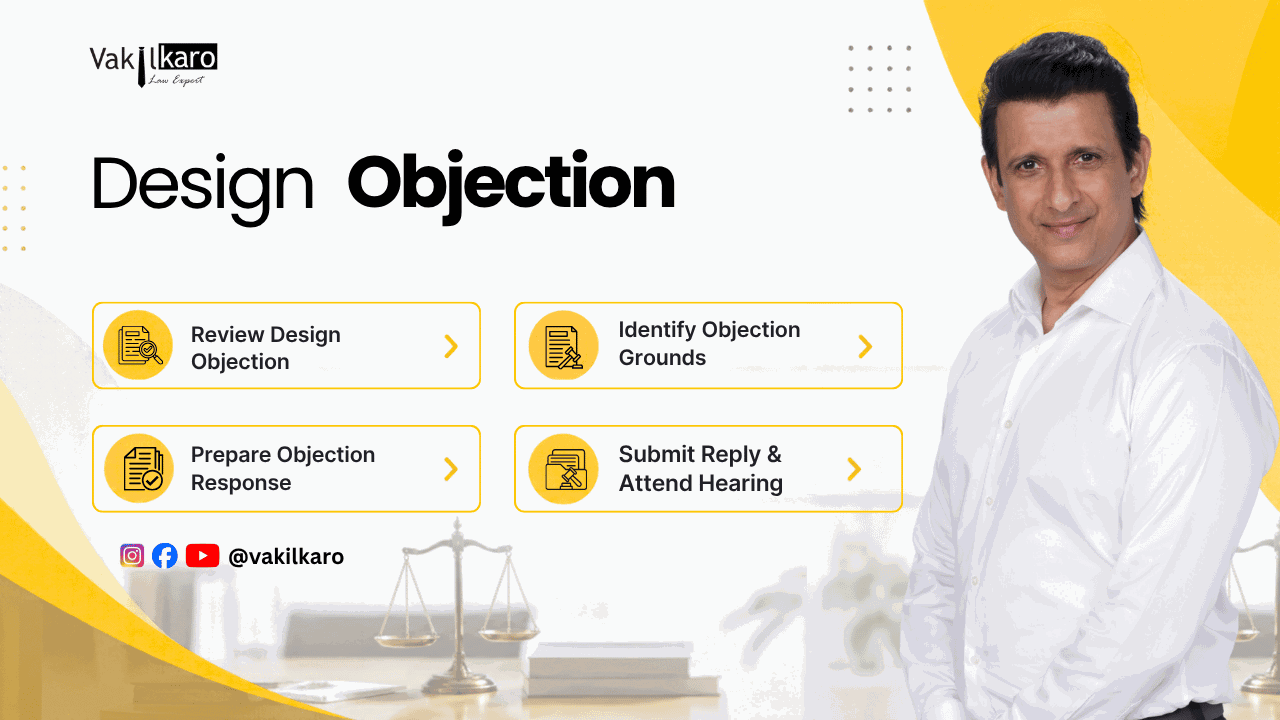
The Design Objection Reply process generally involves reviewing the examination report, preparing a point-wise response and completing any required corrections within the applicable timeline.
Step 1 – Review the Examination Report
The examination report should be reviewed carefully to understand each objection raised by the Design Office. Both formal and substantive issues should be identified before preparing the reply.
Step 2 – Check the Filed Application
The originally filed application should be reviewed, including Form 1, design representations, Statement of Novelty, article name, classification, priority details and applicant information.
This helps identify whether the objection requires clarification, supporting documents or a permitted amendment.
Step 3 – Review Earlier or Cited Designs
If the objection relates to novelty, originality or similarity, the earlier design cited by the examiner should be reviewed carefully.
The visual features of both designs may need to be compared to identify relevant differences. Earlier design records and application-related information may be checked through relevant IP India resources.
Step 4 – Prepare the Objection Reply
A point-wise reply should be prepared for every objection raised in the examination report.
Depending on the case, the response may include legal explanations, design comparisons, novelty clarification, supporting documents, revised representations, amendments or disclaimers.
Step 5 – Make Required Amendments
Where permitted, formal defects may be corrected through appropriate amendments.
These may relate to design representations, article description, classification, Statement of Novelty, disclaimer or supporting documents.
Step 6 – File the Response
The reply and supporting documents should be filed through the applicable official process within the prescribed timeline.
Copies of the final reply, amended documents, filing acknowledgement and official correspondence should be retained for record.
Step 7 – Monitor the Application
After filing the reply, the application should be monitored for further updates.
The Design Office may accept the response, request additional clarification, continue the objection or schedule a hearing before taking a final decision.
What Happens After Filing a Design Objection Reply?
After the reply is filed, the Design Office reviews the response, supporting documents and any permitted amendments. The application may then move forward in different ways depending on the issues raised and how they have been addressed.
Possible Outcomes
| Outcome | What It Means |
|---|---|
| Objection Resolved | The application may proceed toward acceptance and registration. |
| Further Clarification Required | The Design Office may ask for additional explanation, documents or corrections. |
| Hearing Scheduled | If the objection remains unresolved, the Controller may provide an opportunity for hearing. |
| Application Refused | If the requirements are not satisfied, the application may be refused in accordance with the applicable law. |
The final outcome depends on factors such as the nature of the objection, earlier cited designs, clarity of representations, amendments made, legal submissions and supporting documents.
Filing a reply gives the applicant an opportunity to address the objection, but it does not by itself guarantee registration.
Design Objection Hearing
A Design Objection Hearing may be required when the objections raised by the Design Office are not fully resolved through the written reply or when a hearing is requested under the applicable procedure.
Under Rule 18 of the Designs Rules, 2001, the Controller may provide an opportunity of hearing in appropriate cases.
During the hearing, the applicant or authorised representative may explain the design, address the pending objections and present relevant documents or submissions in support of registration.
The hearing may involve issues related to novelty, originality, prior publication, similarity with earlier designs, representations, classification, disclaimers or other registration requirements.
Before the hearing, the examination report, filed application, earlier cited designs, representations and supporting documents should be reviewed carefully. The arguments should focus specifically on the objections that are still pending.
After considering the submissions, the Controller may accept the application or refuse registration in accordance with the applicable law.
Deadline for Design Objection Reply
Under Rule 18 of the Designs Rules, 2001, the applicant generally needs to remove the objection or apply for a hearing within three months from official communication, subject to the overall period prescribed for completing the application and any permitted extension.
In eligible cases, an extension may be available through Form 18, subject to the applicable conditions and fee.
A timely response allows the applicant to correct formal defects, clarify novelty, submit revised representations or request a hearing where required. Delay may affect the continuation of the application, so the examination report should be reviewed as early as possible.
Design Objection vs Cancellation of a Registered Design
A Design Objection and cancellation of a registered design are different proceedings. A Design Objection arises during examination of a pending application, while cancellation relates to a design that has already been registered.
| Design Objection | Design Cancellation |
|---|---|
| Arises during examination of the application | Applies after the design has been registered |
| Raised by the Design Office during examination | A petition may be filed by any person interested |
| Concerns a pending design application | Challenges an existing design registration |
| Applicant responds to examination objections | Cancellation is considered on the grounds specified under Section 19 |
| May lead to acceptance, further examination, hearing or refusal | May result in the registration continuing or being cancelled |
Under Section 19 of the Designs Act, 2000, a person interested may seek cancellation of a registered design on specified grounds, such as prior registration, prior publication, lack of novelty or originality, or non-registrability.
A Design Objection should therefore be handled as an examination-stage issue, while Design Cancellation is a separate post-registration proceeding.
Design Objection vs Trademark Objection
A Design Objection and a Trademark Objection relate to different types of intellectual property protection.
| Basis | Design Objection | Trademark Objection |
|---|---|---|
| What It Relates To | Visual appearance of an article | Brand name, logo, word, symbol or other trademark |
| Main Focus | Shape, configuration, pattern, ornamentation and overall appearance | Distinctiveness, similarity with earlier marks and trademark registrability |
| Applicable Protection | Design Registration | Trademark Registration |
| Example | Unique shape or appearance of a bottle | Brand name or logo printed on the bottle |
| Nature of Objection | Concerns whether the design meets design registration requirements | Concerns whether the trademark meets trademark registration requirements |
| Response | Reply should address the design-related examination issues | Reply should address the objections raised in the trademark examination report |
For the same product, different intellectual-property rights may apply. For example, packaging artwork may involve Copyright Registration, while a new technical mechanism may require Patent Registration.
Businesses should therefore identify the appropriate form of protection for each element of their product.
Common Mistakes While Replying to a Design Objection
A Design Objection Reply should directly address the issues raised in the examination report. Some common mistakes can delay the application or create additional examination concerns.
1. Ignoring the Examination Report
The objection should not be left unanswered after filing the application. Each issue raised by the Design Office should be reviewed and addressed within the applicable time limit.
2. Filing a Generic Reply
A standard or general response may not resolve the actual objection. The reply should be prepared according to the specific examination report.
3. Not Comparing Cited Designs
Where an earlier design is cited, the applicant should review it carefully and explain the relevant visual differences between the cited design and the applied design.
4. Changing the Design Completely
A Design Objection Reply should not be used to replace the originally filed design with an entirely different design. Any amendment should remain within the limits permitted under the applicable rules.
5. Submitting Unclear or Inconsistent Representations
Unclear, incomplete or inconsistent drawings and photographs can create further objections. Revised representations, where permitted, should clearly show the claimed design.
6. Missing the Deadline
Delay in filing the reply or requesting a hearing may affect the continuation of the application. The applicable deadline should therefore be checked carefully.
7. Using an Incorrect Statement of Novelty
The Statement of Novelty should match the visual features shown in the representations. An unclear or inconsistent statement may create additional examination issues.
8. Ignoring Formal Requirements
Even where the design appears new or original, incomplete documents, incorrect classification, unclear article details or other procedural defects may delay the registration process.
Applicants should therefore review both the legal objections and the formal requirements before submitting the final reply.
Benefits of a Proper Design Objection Reply
A properly prepared response helps present the application clearly before the Design Office.
- Clear Response to Examiner: Each objection can be answered separately with relevant clarification instead of using general statements.
- Better Presentation of Novelty: Distinctive visual features of the design can be explained clearly, especially where an earlier design has been cited.
- Correction of Formal Defects: Permitted errors in representations, article details, classification or other documents can be corrected where required.
- Proper Supporting Documents: Relevant documents and evidence can be arranged according to the specific objections raised.
- Hearing Preparation: Unresolved objections can be identified and prepared for before a hearing, where required.
- Application Continuity: Timely action can help avoid unnecessary delay or loss of the application due to non-response.
Who May Need Design Objection Support?
Design Objection support may be useful for applicants who have received an examination objection on their design application, including:
- Manufacturers
- Product designers
- Startups and MSMEs
- Private Limited Companies and LLPs
- Individual designers and creators
- E-commerce and consumer brands
- Furniture, packaging and jewellery businesses
- Electronics and automotive companies
- Foreign applicants seeking design protection in India
Applicants may also require related intellectual-property services such as Design Registration, Trademark Registration, Copyright Registration or Patent Registration, depending on the nature of their product or business.
How to Reduce the Risk of a Design Objection
A Design Objection cannot always be avoided, but proper preparation before filing can reduce common examination issues.
Before filing a design application, applicants should:
- Conduct an appropriate design search
- Avoid public disclosure before filing, where possible
- Identify the correct article
- Select the appropriate class and subclass
- Prepare clear and consistent design representations
- Ensure all views show the same design properly
- Prepare an accurate Statement of Novelty
- Review ownership and applicant details
- Check priority claims, where applicable
- Remove unnecessary trademarks, words or other matter from representations where required
- Review the complete application before submission
Applicants can also refer to the official Design Filing Process to understand the filing and examination stages.
Careful preparation at the filing stage can help reduce avoidable objections and make the examination process smoother.
What Happens After the Objection Is Cleared?
Once the objections are resolved and the examination requirements are satisfied, the design application may proceed toward acceptance, registration and publication.
After registration:
- The design is entered in the Register of Designs
- A registration certificate may be issued
- Registration details are published through the applicable process
- The registered proprietor receives rights under the Designs Act
A registered design generally receives protection for 10 years, which may be extended for a further 5 years in accordance with the applicable law.
Design Objection Reply Fees
Vakilkaro's professional fee for Design Objection Reply is ₹2,499 + GST + Govt. charges. This covers review of the examination report, point-wise reply drafting, permitted amendments and filing within the Rule 18 time limit. Hearing support before the Controller can be added if required.
Why Choose Vakilkaro for Design Objection Reply?
Vakilkaro provides structured support for Design Objection matters, from reviewing the examination report and filed documents to preparing the response, managing permitted corrections and supporting the application through further proceedings.
- Review of the examination report and filed application
- Objection-wise analysis and response preparation
- Assessment of novelty and cited design issues
- Review of drawings, representations and Statement of Novelty
- Guidance on classification, article description and permitted amendments
- Preparation and organisation of supporting documents
- Filing support through the applicable process
- Follow-up on application status and further communication
- Hearing preparation, where required
- Online support for individuals, startups, MSMEs and companies across India
Applicants looking for broader intellectual-property protection can also explore Design Registration, Trademark Registration, Trademark Objection Reply, Copyright Registration and Patent Registration.