Copyright Registration is a legal process through which details of an original creative work and its ownership are officially registered with the Copyright Office under the Copyright Act, 1957. It provides documentary evidence of ownership and helps creators, authors, businesses, and organizations protect their intellectual property from unauthorized reproduction, distribution, adaptation, and commercial exploitation.
What is Copyright Registration?
Copyright Registration is the process of officially registering ownership details of an original creative work with the Copyright Office under the Copyright Act, 1957.
It provides creators and businesses legal rights over their original work and helps them control how their work is used, copied, published, distributed, or commercially used.
Copyright Registration is available for different types of creative works, including books, website content, software, mobile applications, music, photographs, videos, films, and educational materials.
Registration provides documentary evidence of ownership and helps protect the work from unauthorized use.
For example, copyright protection automatically applies to original software code or written content after creation. However, registration provides official proof of ownership that can support the creator’s rights in case of disputes.
Benefits of Copyright Registration
Copyright Registration helps creators and businesses protect their original work by providing legal proof of ownership. It helps establish rights over creative works and provides support if someone uses the work without permission.
Key benefits include:
1. Proves Ownership of Your Work
Copyright Registration creates an official record that shows who owns the original work. It helps support ownership claims in case of disputes.
2. Protects Your Work from Copying
Registration helps protect creative works from unauthorized copying, use, or distribution by others.
3. Protects Business Content and Assets
Businesses can protect valuable assets such as software, website content, designs, marketing materials, and digital products.
4. Helps in Licensing and Business Use
Registered copyright allows owners to license their work, enter agreements, and use their creations for commercial purposes.
5. Provides Legal Support in Case of Infringement
Copyright Registration provides supporting proof that can help owners protect their rights if someone misuses their work.
What Can Be Protected Through Copyright Registration?
Copyright Registration protects different types of original creative works created through the skill, effort, and creativity of the author or owner. Under the Copyright Act, 1957, eligible works can be registered with the Copyright Office, Government of India to establish legal ownership.
| Type of Work | Examples of Protected Works |
|---|---|
| Literary Works | Books, articles, blogs, website content, e-books, scripts, educational material, software source code |
| Software & Computer Programs | Software code, mobile applications, computer programs, software documentation, user manuals |
| Artistic Works | Paintings, drawings, photographs, graphic designs, illustrations, digital artwork |
| Musical Works | Musical compositions, songs, tunes, background scores |
| Sound Recordings | Audio recordings, podcasts, voice recordings, digital audio content |
| Films & Video Content | Movies, advertisements, documentaries, educational videos, digital videos |
| Website & Digital Content | Website content, images, graphics, online courses, training materials |
Who Can Apply for Copyright Registration?
Copyright Registration can be applied by individuals, businesses, and organizations that own original creative works. The applicant depends on the nature of the work and ownership rights.
Copyright Registration is suitable for:
- Individual Creators: Authors, writers, artists, photographers, musicians, software developers, and content creators can register their original works.
- Companies and Businesses: Businesses can protect creative assets such as software, applications, website content, marketing materials, product manuals, and training documents.
- Startups and Entrepreneurs: Startups can register copyright for digital platforms, software solutions, mobile applications, creative designs, and original content.
- Organizations and Institutions: Educational institutions, research organizations, and other entities can protect publications, educational materials, training resources, and awareness content.
Documents Required for Copyright Registration
The documents required for Copyright Registration depend on the type of work and ownership details. Providing complete and accurate documents helps ensure smooth filing and reduces delays during the examination process.
| Document Category | Required Documents |
|---|---|
| Applicant Details | Name, address, nationality, contact details, and ownership details of the applicant. For companies/organizations: entity details and authorized signatory information. |
| Copyright Application Form | Duly filled Form XIV along with required statements and prescribed details of the work. (IP India) |
| Copy of Original Work | Copy of the work being registered, depending on category such as manuscript, artwork, software details, audio file, or video content. (Copyright Office of India) |
| Identity & Address Proof | PAN Card, Aadhaar Card, Passport, or other government-issued identity documents (as applicable). |
| Ownership Proof / NOC | If the applicant is not the original author, documents such as Assignment Agreement, License Agreement, Employment Agreement, or NOC from the author may be required. (Copyright Office of India) |
| Software Registration Documents | Software description and required source code details as prescribed for computer programme registration. (IP India) |
| Artistic Work Documents | Copy of artwork and additional documents such as Trademark Office certificate may be required where artistic work is used or capable of being used for goods/services. (IP India) |
| Music / Sound Recording Documents | Audio files, composition details, and agreements/NOC from relevant copyright holders (where applicable). (Copyright Office of India) |
| Authorization Documents | Power of Attorney or authorization letter if the application is filed through an advocate or authorized representative. (Copyright Office of India) |
Additional Note:
The exact document requirement depends on the nature of work, applicant status, and ownership structure. For example, a creator filing for their own literary work may require fewer documents compared to a company registering software, music, or content acquired from another person.
Eligibility Requirements for Copyright Registration
Before applying for Copyright Registration, the work should meet certain basic requirements related to originality, ownership, and proper documentation.
Copyright Registration requires:
- Original Work: The work should be created through the author’s own skill, effort, and creativity. Copied or substantially similar works may not qualify for protection.
- Clear Ownership: The applicant should be the original creator or have valid legal rights over the work. Proper ownership records help avoid future disputes.
- Fixed Form of Work: The creative work should be available in a recorded or documented form, such as written content, software code, audio recordings, videos, artwork, or digital files.
- Correct Application Details: The application should include accurate information about the author, owner, type of work, and creation details.
Copyright Registration Process in India
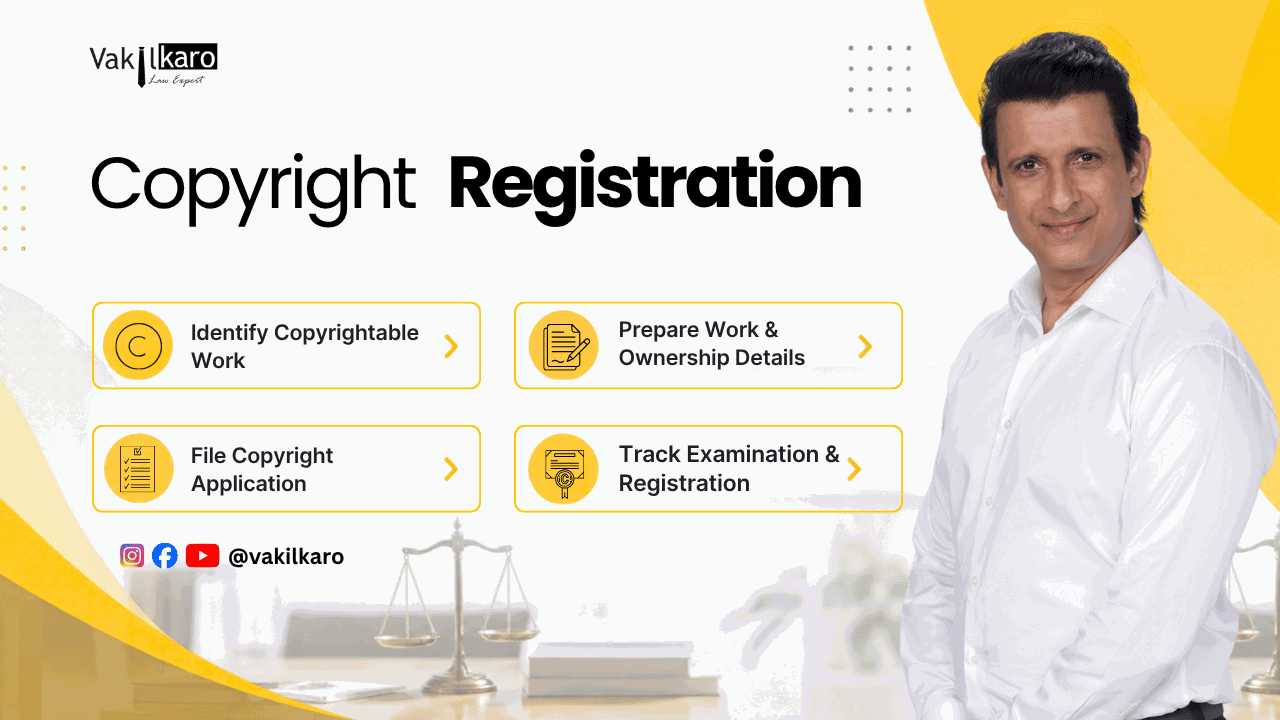
Copyright Registration Process in India involves identifying the work category, preparing documents, filing the application, examination, and receiving the registration certificate.
The process includes the following steps:
Step 1: Identify the Category of Work
The applicant needs to select the correct category of the creative work before filing the application. Common categories include literary works, software, artistic works, musical works, sound recordings, and cinematograph films.
Step 2: Prepare Documents and Work Details
The applicant needs to prepare required information and documents, including applicant details, author details, ownership information, description of work, copy of the original work, and supporting documents (if required).
Step 3: Create Account on Copyright Portal
The applicant needs to create an account on the official Copyright Registration Portal for submitting the application online.
Step 4: File Copyright Application Online
The application is submitted with work details, ownership information, required documents, and applicable government fees. After successful submission, a Diary Number is generated for application tracking.
Step 5: Examination and Objection Process
The Copyright Office examines the submitted application and documents. If any clarification or objection is raised, the applicant may need to submit a Copyright Objection Reply with supporting documents. A hearing may also be required in certain cases.
Step 6: Issue of Copyright Registration Certificate
After successful examination and completion of formalities, the Copyright Office issues the Copyright Registration Certificate containing details of the registered work, applicant, author, and registration number.
The certificate serves as official evidence of copyright ownership.
What Happens If Copyright Application Receives an Objection?
During the examination process, the Copyright Office may raise objections if any clarification, correction, or additional information is required regarding the application.
Common reasons for objections include:
- Incomplete or incorrect application details
- Ownership-related issues
- Missing supporting documents
- Need for clarification regarding the submitted work
The applicant needs to submit a proper Copyright Objection Reply explaining the issues and providing required documents. In certain cases, a hearing before the Registrar may also be required.
After reviewing the reply and supporting documents, the Copyright Office may accept the application and proceed with registration.
For detailed information about objection handling, applicants can refer to Copyright Objection process.
Copyright Registration Timeline
The time required for Copyright Registration depends on the type of work, accuracy of application details, completeness of documents, and whether any objection or discrepancy is raised during examination.
After filing the application, a mandatory waiting period is provided for objections. If there are no objections and the application is complete, it proceeds for examination and further processing by the Copyright Office. Copyright Office of India
The registration process may take several months depending on:
- Type and complexity of work
- Accuracy of application details
- Completeness of submitted documents
- Objections or clarifications required
- Examination process
Applicants can help avoid unnecessary delays by:
- Providing correct information
- Submitting complete documents
- Selecting the correct category of work
- Responding to official queries or objections on time
Copyright Registration Fees in India
The government fee for Copyright Registration depends on the category of work being registered. The fee is prescribed by the Copyright Office, Government of India, and varies according to the type of work. Applicants can verify the latest fee details from the official Copyright Office of India portal before filing the application.
Common Copyright Registration fee categories include:
- Literary, Dramatic, Musical, or Artistic Work: ₹500 per work
- Artistic Work used in relation to goods or services: ₹2,000 per work
- Sound Recording: ₹2,000 per work
- Cinematograph Film: ₹5,000 per work
The final cost of Copyright Registration may include professional service charges depending on factors such as:
- Type of work
- Documentation requirements
- Ownership details
- Additional legal requirements
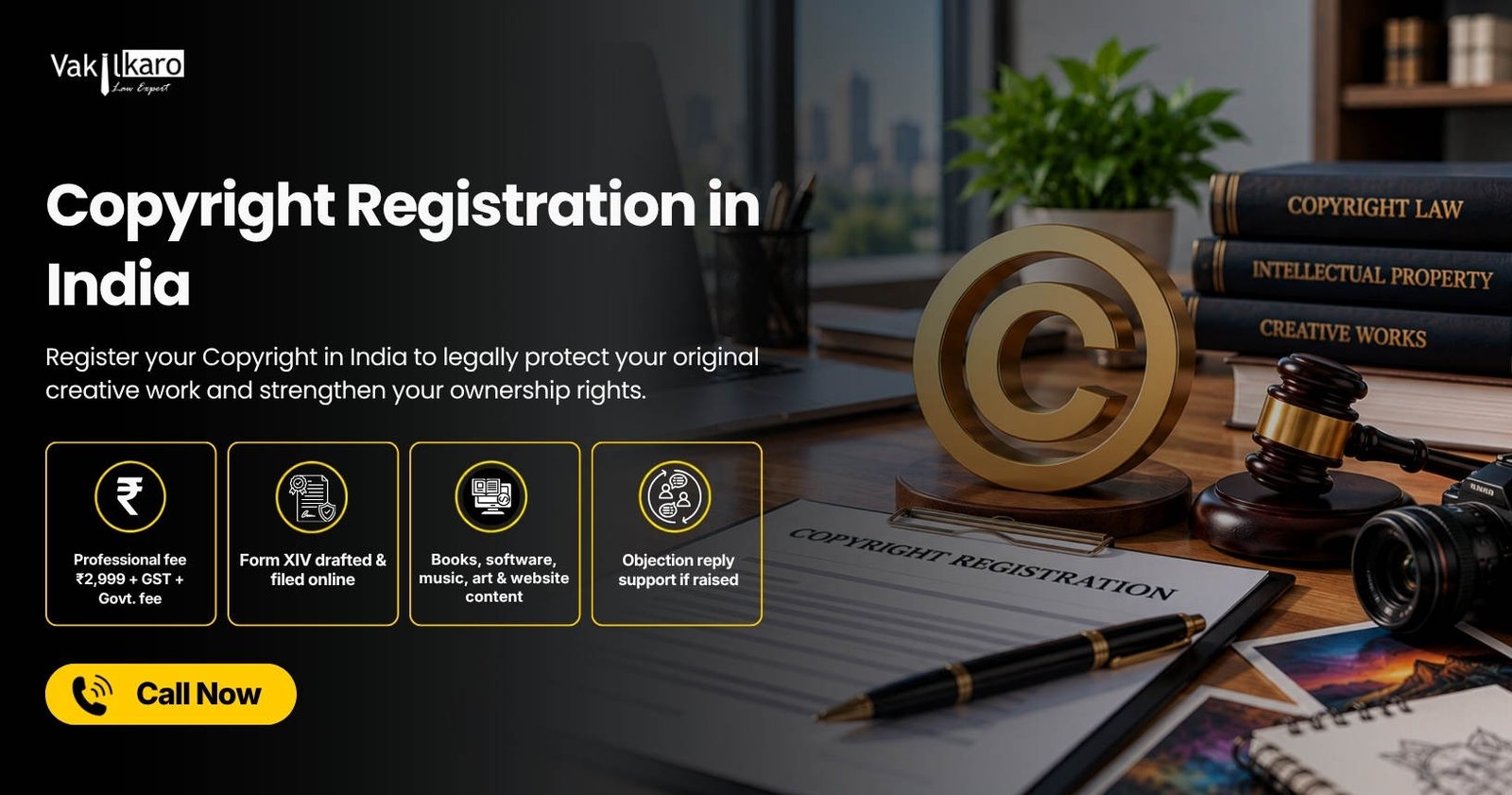
Vakilkaro's professional fee for Copyright Registration is ₹2,999 + GST + Govt. charges per work. This covers Form XIV drafting, document preparation, online filing and tracking until the Diary Number and examination stage.
Different copyright services, such as new registration, Copyright Objection Reply, copyright assignment, or ownership-related changes, may have separate charges depending on the requirements.
Copyright Registration Validity and Duration
The validity of copyright protection depends on the type of work and applicable provisions under the Copyright Act, 1957.
For literary, dramatic, musical, and artistic works, copyright protection generally continues for the lifetime of the author and extends for 60 years after the author’s death.
Different duration rules apply to certain categories of works, such as:
- Cinematograph films
- Sound recordings
- Government works
- Anonymous or pseudonymous works
For these categories, copyright protection is generally calculated from the year of publication as prescribed under the Copyright Act, 1957.
Therefore, the validity period of copyright depends on the nature of the work, ownership details, and applicable legal provisions.
Copyright Infringement in India
Copyright infringement occurs when someone uses, copies, distributes, or reproduces a copyrighted work without permission from the owner.
Under the Copyright Act, 1957, copyright owners have legal rights over the use of their original works, including reproduction, distribution, and communication of the work.
Common Examples of Copyright Infringement
Copyright infringement occurs when a copyrighted work is copied, used, distributed, or reproduced without permission from the owner.
Common examples include:
- Website Content: Copying blogs, articles, product descriptions, educational materials, or other original website content without authorization.
- Software and Applications: Copying source code, using software without permission, or distributing software without authorization.
- Images and Creative Designs: Using photographs, graphics, illustrations, or digital artwork without proper permission from the copyright owner.
- Video and Audio Content: Unauthorized use of videos, music, podcasts, films, or other digital content protected under copyright law.
Legal Remedies for Copyright Infringement
If copyrighted work is used without permission, the owner may take legal action under applicable copyright laws.
Possible remedies include:
- Injunction: To stop unauthorized use of the work
- Damages or Compensation: For losses caused due to infringement
- Removal of Infringing Content: To remove unauthorized copies from platforms
Copyright Registration vs Trademark Registration
Copyright and Trademark both provide legal protection, but they protect different types of rights. Copyright protects original creative works, while Trademark protects brand identity and business recognition.
| Basis | Copyright Registration | Trademark Registration |
|---|---|---|
| Protection | Protects original creative works | Protects brand identity and business marks |
| Protected Assets | Books, software, website content, music, photographs, artwork, videos | Brand name, logo, tagline, symbol, product identity |
| Main Purpose | Protects creative expression and original content | Protects business identity and prevents misuse of brand elements |
| Governing Law | Copyright Act, 1957 | Trade Marks Act, 1999 |
| Registration Authority | Copyright Office, Government of India | Trademark Registry, Government of India |
| Examples | Software code, articles, books, music compositions, designs | Company name, brand logo, product name, tagline |
| Protection Period | Generally lifetime of author + 60 years for many works (subject to category) | 10 years and renewable indefinitely |
Copyright Registration vs Design Registration
Copyright Registration protects creative works, while Design Registration protects the visual appearance of products.
| Basis | Copyright Registration | Design Registration |
|---|---|---|
| Protection | Original creative works | Product design and appearance |
| Protected Assets | Books, software, music, artwork, website content | Shape, pattern, configuration and ornamentation of products |
| Governing Law | Copyright Act, 1957 | Designs Act, 2000 |
| Registration Authority | Copyright Office | Design Office |
| Example | Software code, photographs, articles | Product shape, packaging design |
| Protection Period | Depends on type of work | 10 years, extendable up to 15 years |
Copyright Registration vs Patent Registration
Copyright Registration protects creative expression, whereas Patent Registration protects inventions and technical innovations.
| Basis | Copyright Registration | Patent Registration |
|---|---|---|
| Protection | Creative works | New inventions |
| Protected Assets | Software, books, music, artwork, digital content | Products, processes and technical solutions |
| Governing Law | Copyright Act, 1957 | Patents Act, 1970 |
| Registration Authority | Copyright Office | Indian Patent Office |
| Example | Software code, written content | New technology or device |
| Protection Period | Depends on work category | 20 years from filing date |
Common Mistakes During Copyright Registration
Applicants may face delays or complications during the Copyright Registration process due to incorrect information, incomplete documents, or improper filing details.
Common mistakes include:
- Selecting the Wrong Work Category: Filing the application under an incorrect category may affect the registration process. The work should be classified correctly based on its nature.
- Incorrect Ownership Details: Applicant, author, and ownership information should be accurate. Incorrect details may create ownership disputes in the future.
- Submitting Incomplete Documents: Missing or incorrect documents can delay application processing. All required documents should be properly reviewed before filing.
- Lack of Ownership Agreements: Businesses should maintain proper agreements with employees, freelancers, and agencies to clearly establish copyright ownership rights.
- Ignoring Digital Assets: Businesses should consider protecting valuable digital assets such as software, website content, digital products, and marketing materials through appropriate copyright protection.
Why Choose Vakilkaro for Copyright Registration?
Vakilkaro provides copyright registration services for creators, businesses, and organizations to protect their original creative works. With proper documentation, filing support, and legal understanding, Vakilkaro helps clients complete the copyright registration process smoothly.
Why Businesses Choose Vakilkaro:
- Complete guidance for Copyright Registration process
- Support for literary, software, artistic, music, website, and digital works.
- Assistance with document preparation and application filing
- Review of ownership details and required information
- Support for copyright objection reply and registration-related queries
- Guidance on copyright assignment and licensing requirements
- Transparent information about documents, procedures, and application status
- Structured process support from filing to final registration