
A Limited Liability Partnership is a separate legal entity registered under the LLP Act, 2008 that gives partners operational flexibility with limited liability. LLP registration is completed online through the MCA portal, followed by execution and filing of the LLP Agreement.
What Is a Limited Liability Partnership?
A Limited Liability Partnership is a body corporate created under the Limited Liability Partnership Act, 2008 with a legal identity separate from its partners. It can acquire property, open bank accounts, enter contracts, employ people and initiate or defend legal proceedings in its own name.
- Separate legal identity – the LLP exists independently from its partners.
- Limited liability – a partner’s ordinary financial exposure is generally linked to the agreed contribution, subject to the law and exceptions such as fraud or the partner’s own wrongful act.
- Perpetual succession – the LLP continues despite changes in partners.
- Contractual flexibility – internal rights and duties can be structured through the LLP Agreement.
- No statutory minimum contribution – the partners can decide a commercially suitable contribution structure.
- Suitable for professional and service businesses – consultants, agencies, technology teams, trading businesses and professional practices often evaluate LLPs where an equity-investor structure is not the immediate priority.

When Is LLP Registration a Good Choice?
An LLP can suit two or more persons who want a formally registered, partner-managed business rather than a shareholding and board-driven company. It is commonly considered by consultants, agencies, family businesses, technology and professional service firms, and growing SMEs seeking defined ownership with limited liability.
- Choose an LLP when the partners want flexibility to decide profit sharing and management rights through contract.
- Consider an LLP when personal liability protection is important but a private limited company’s equity structure is not yet required.
- Consider a Private Limited Company instead where the business plans to issue shares, create an ESOP pool or raise institutional equity investment.
- Consider a Partnership Firm only after understanding that it does not provide the same separate legal personality and liability framework as an LLP.
The right structure should be selected based on funding plans, taxation, operational control, compliance capacity, industry requirements and long-term ownership strategy—not only on initial registration cost.

Legal Requirements for LLP Registration
Before filing the incorporation application, the proposed structure should satisfy the basic legal and documentation conditions.
Minimum Partners and Designated Partners
An LLP must have at least two partners. It must also have at least two designated partners who are individuals. At least one designated partner must be resident in India as defined under the LLP Act. Under the current statutory definition, resident status for this purpose is linked to staying in India for at least 120 days during the financial year.
Partners can be individuals or eligible body corporates. Where a body corporate participates, an individual nominee may act as its designated partner subject to law. Designated partners carry statutory filing and compliance responsibility and should not be treated as nominal appointees.
Digital Signature Certificate
LLP incorporation is completed electronically on the MCA V3 portal. Proposed designated partners who sign the forms require valid Digital Signature Certificates (DSCs). The DSC must be properly associated with the relevant MCA user profile before filing.
DIN or DPIN
Designated partners require an identification number under the applicable MCA framework. Where permitted, the identification number for proposed designated partners can be applied for through the incorporation process. Existing DIN/DPIN details must be valid and consistent with the person’s KYC data.
Registered Office in India
Every LLP must maintain a registered office address in India for receiving statutory communication. The premises may be owned, rented or otherwise lawfully occupied, subject to proper documentary support. Typical office proofs include:
- Recent utility bill for the premises.
- Rent or lease agreement where the property is rented.
- No Objection Certificate from the owner where required.
- Ownership or occupancy proof in the name of the relevant owner or occupier.
Address documents should be current, readable and consistent. Mismatched house numbers, outdated utility bills or incomplete owner consent are common causes of resubmission.
Documents Required for LLP Registration
Preparing the document set correctly can prevent avoidable delay. The checklist changes for foreign partners, body corporates or conversions, but a standard Indian incorporation commonly requires the following.
For Individual Partners / Designated Partners
- PAN card.
- Aadhaar card or other acceptable identity proof.
- Address proof such as bank statement, utility bill, voter ID, driving licence or passport, as applicable.
- Recent photograph.
- Email address and mobile number.
- Digital Signature Certificate for the persons signing the MCA forms.
- Consent to act as designated partner in the prescribed form.
For the Registered Office
- Utility bill for the premises, generally kept recent for filing purposes.
- Rent / lease agreement if rented.
- Owner’s NOC where applicable.
- Ownership proof if the premises is owned.
Where a Body Corporate Is a Partner
Additional corporate documents may be required, such as certificate of incorporation, constitutional documents, authorization / board resolution, nominee details and identity documents of the authorized person. Foreign documents may require notarisation, apostille or consular authentication depending on the country and document type.
Vakilkaro reviews the document set before filing so that names, addresses, dates and identification details remain consistent across DSC records, MCA forms and supporting documents.
Choosing and Reserving the LLP Name
The LLP name must satisfy MCA naming rules and should not conflict with an existing company, LLP or protected trademark Registration. A weak name strategy can delay an otherwise complete filing.
A proposed name should be distinctive, relevant to the business and free from prohibited or restricted expressions unless prior approval is available. Before submission, conduct a basic MCA name check and a trademark availability review for important brand words. The name should end with “Limited Liability Partnership” or “LLP”.
Name reservation can be handled through the MCA’s LLP name reservation service or as part of the applicable incorporation workflow. Where a name is separately approved, the incorporation application must be filed within the validity period shown by MCA.
- Avoid names that are only minor spelling variations of an existing entity.
- Avoid using regulated words such as banking, insurance, stock exchange, mutual fund or other sector-specific expressions without checking approval requirements.
- Do not assume MCA name approval equals trademark ownership. Business-name approval and trademark rights are separate issues.
Step-by-Step LLP Registration Process
The current LLP incorporation process is completed online through the Ministry of Corporate Affairs. A well-prepared application normally moves through the following stages.
Structure the Partnership
Finalise the proposed partners, designated partners, contribution, profit-sharing ratio, business activity, registered office and management arrangement. Decide early how major decisions will be approved and what happens if a partner exits.
Obtain and Associate DSCs
Obtain valid DSCs for the proposed signatories and complete MCA profile / DSC association as required. Incorrect association can block the filing even where the documents are otherwise complete.
Conduct Name and Trademark Checks
Shortlist suitable names, search the MCA database, review similar LLP/company names and consider a trademark search for the core brand expression. Submit the preferred name through the appropriate MCA route.
Prepare FiLLiP and Linked Information
The incorporation application is filed through [Form FiLLiP](https://www.mca.gov.in/content/dam/mca-aem-forms/instructionkits/Instruction Kit_Form FiLLiP.pdf) on MCA V3. The filing captures the proposed LLP name, registered office, business activities, contribution, partner and designated partner details and other incorporation information. The process also includes the prescribed consent and linked information required by the portal.
Attach Supporting Documents and Professional Certification
Partner information, registered-office evidence, consents and authorizations are attached. The filing is digitally signed and, where required, certified by an eligible practising professional.
MCA / Registrar Review
The Registrar examines the filing. If clarification or correction is required, a resubmission may be issued. A properly prepared response should correct the specific defect without creating inconsistencies elsewhere in the application.
Certificate of Incorporation and LLPIN
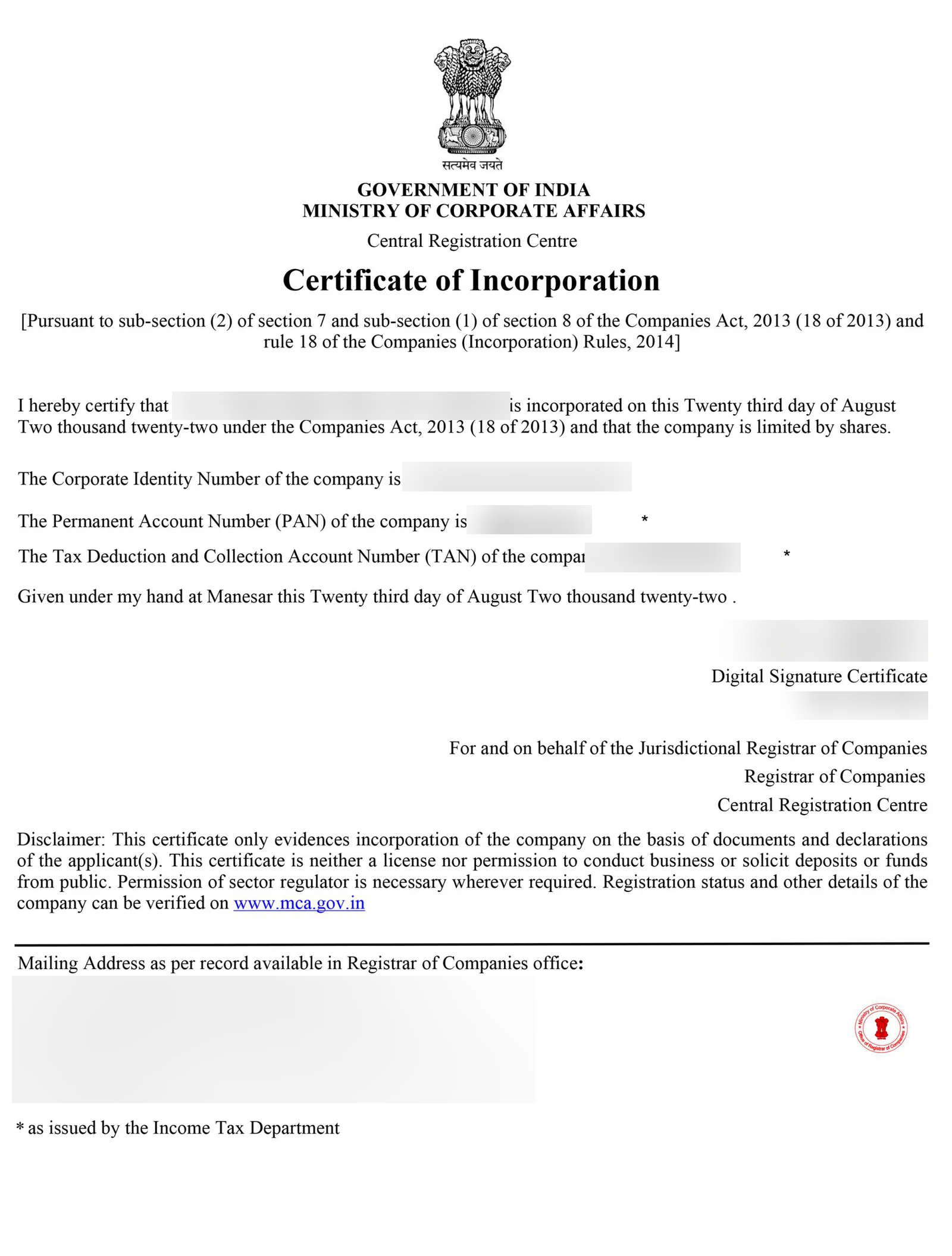
Once approved, the LLP is incorporated and receives its Certificate of Incorporation and Limited Liability Partnership Identification Number (LLPIN). The LLP legally exists from the date stated in the certificate.
Execute and File the LLP Agreement
After incorporation, the partners should execute a properly drafted LLP Agreement and file the required information in [LLP Form 3](https://www.mca.gov.in/content/dam/mca-aem-forms/instructionkits/Instruction Kit_LLP_Form_No_3.pdf). Under the current framework, the initial agreement information is generally required within 30 days of incorporation. Stamp duty depends on the applicable state law and contribution structure.
What Should the LLP Agreement Cover?
A generic two-page agreement can create problems later. The LLP Agreement should reflect how the partners actually intend to run the business. Important clauses usually include:
- Capital / contribution of each partner and the form of contribution.
- Profit and loss sharing ratio.
- Management authority and day-to-day decision rights.
- Matters requiring unanimous or special approval.
- Banking authority and signing limits.
- Drawings, remuneration, interest and reimbursement arrangements subject to law and tax treatment.
- Duties, non-compete, confidentiality and conflict-of-interest obligations.
- Admission of new partners.
- Retirement, resignation, death, incapacity or expulsion provisions.
- Valuation and settlement mechanism when a partner exits.
- Ownership of intellectual property and client relationships.
- Indemnity and liability allocation.
- Dispute resolution and arbitration mechanism.
- Dissolution and winding-up process.
The agreement should not simply copy a template. It should be aligned with the business model, contribution, partner roles and future growth plan.
Contribution, Ownership and Profit Sharing
An LLP does not issue shares like a private limited company. Partner economics are recorded through agreed contribution and the LLP Agreement. Contribution can be monetary or, subject to law and documentation, may include other forms of contribution. The partners can agree on profit sharing separately from the simple amount of cash introduced, provided the structure is clearly recorded and legally compliant.
Where one partner contributes money and another contributes expertise or business development, the agreement should clearly define the resulting rights, profit share and exit value.
LLP Registration Cost and Timeline
LLP registration cost depends on the number of partners, contribution, DSCs, name-reservation route, state stamp duty, professional drafting and any additional body-corporate or foreign-partner documentation.
A straightforward Indian LLP with complete documents may often be incorporated within approximately 7–10 working days, but the timeline can vary because of name approval, MCA processing, DSC readiness, document corrections or resubmission. Foreign documents and regulated business objects can take longer.
Vakilkaro provides a scope-based quote so the client can distinguish government fees, stamp duty, DSC costs and professional service charges rather than treating every component as a single unexplained amount.
PAN, TAN, Bank Account and Other Registrations After Incorporation
After receiving the incorporation certificate, the LLP should move promptly into operational setup.
- Verify PAN / TAN issuance and the tax profile of the LLP.
- Open the LLP’s current bank account using the incorporation documents and executed LLP Agreement.
- Bring partner contribution into the LLP through properly recorded banking channels.
- Apply for GST Registration where the statutory threshold or compulsory-registration category applies, or where voluntary registration is commercially appropriate.
- Consider Udyam / MSME registration where eligible.
- Obtain sector-specific licences such as FSSAI, import-export, professional tax, shops and establishment or other approvals depending on activity and location.
- Put bookkeeping, invoicing, expense approvals and tax deduction procedures in place from the beginning.
Operating through personal bank accounts after incorporation creates avoidable accounting and legal confusion. Business receipts and expenses should move through the LLP’s own banking and accounting system.
Ongoing LLP Compliance After Registration
An LLP may have a lighter governance structure than a company in several areas, but it is not a “no-compliance” entity. Annual and event-based filings remain important.
Form 11 – Annual Return
Every LLP is generally required to file its annual return in Form 11 within the statutory timeline after the close of the financial year, including LLPs with low or no business activity unless an exception applies. The commonly applicable due date is 30 May for a financial year ending 31 March, subject to official extensions.
Form 8 – Statement of Account and Solvency
The LLP must prepare its accounts and file the prescribed Statement of Account and Solvency. For a normal financial year, Form 8 is generally due within the statutory period after the end of six months of the financial year, commonly resulting in a 30 October due date, subject to extension or rule changes.
Income Tax Return
An LLP is required to file its income tax return in the applicable form and comply with tax audit, TDS and other Income-tax requirements wherever applicable. Tax treatment should be reviewed based on the current Finance Act and the LLP’s actual transactions.
Audit of Accounts
Under the LLP Rules, audit exemption is generally available where turnover does not exceed the prescribed threshold and contribution does not exceed the prescribed threshold. The commonly referenced thresholds are ₹40 lakh of turnover and ₹25 lakh of contribution, but the position should be confirmed for the relevant financial year and any later notification.
Event-Based Filings
Changes in partners, designated partners, contribution, LLP Agreement, registered office or name may require MCA filings within prescribed timelines. Delayed reporting can create additional fees and inconsistencies in MCA master data.
LLP vs Partnership Firm vs Private Limited Company
Choosing between these structures should be based on business goals rather than popularity.
For a foreign body corporate, apostilled constitutional documents
LLP: Separate legal entity, limited liability, partner-driven management, contractual flexibility and no share capital structure. Suitable where partners want operational flexibility and do not immediately need equity fundraising.
Partnership Firm: Simpler traditional structure but without the same corporate personality and liability protection available to an LLP. State-level registration practices also vary.
Private Limited Company: Separate legal entity with share-based ownership, directors, corporate governance and a structure generally preferred for angel, venture capital and private equity funding. Compliance is more formal, but the structure is better suited to scalable equity ownership.
Vakilkaro can help founders compare LLP Registration , Partnership Firm Registration, One Person Company Registration and Private Limited Company Registration before the filing begins so the structure matches the business plan.
Foreign or NRI Partner in an LLP
An LLP may involve foreign individuals or foreign body corporates subject to the LLP Act, FEMA/FDI policy, sectoral conditions and documentation requirements. Overseas documents may require notarisation, apostille or consular authentication. The proposed activity should be checked against current FDI rules, particularly for regulated sectors, and cross-border contribution or reporting should be handled with professional FEMA and tax guidance.
Common LLP Registration Mistakes to Avoid
- Selecting a name without checking similar MCA entities or trademarks.
- Using inconsistent spelling of names or addresses across PAN, Aadhaar, DSC and MCA forms.
- Filing with an old or incomplete utility bill for the registered office.
- Treating a designated partner as a nominal role without understanding compliance responsibility.
- Keeping the LLP Agreement too generic and silent on exits, deadlocks or authority limits.
- Missing the Form 3 timeline after incorporation.
- Failing to record partner contribution through the LLP’s books and bank account.
- Assuming an LLP has no annual filings because it had no revenue.
- Delaying changes in partner, address or agreement until annual filing time.
- Using an LLP where the real business plan requires equity investors and share-based incentives.
Post-Registration Checklist
After incorporation, complete a structured handover rather than stopping at the certificate.
- Save the Certificate of Incorporation, LLPIN and MCA challans.
- Execute and stamp the LLP Agreement correctly.
- File [Form 3](https://www.mca.gov.in/content/dam/mca-aem-forms/instructionkits/Instruction Kit_LLP_Form_No_3.pdf) within the applicable statutory period.
- Open the LLP bank account and bring in agreed contribution.
- Set up bookkeeping and invoice formats.
- Check GST, Udyam and sector-specific registrations.
- Maintain partner and contribution records.
- Set reminders for Form 11, Form 8 and income-tax filings.
- Record every future change in partners, address, contribution or agreement promptly.
A clean post-incorporation file simplifies banking, due diligence, tax filings and future restructuring.
Why Choose Vakilkaro for LLP Registration?
Vakilkaro supports LLP registration as a complete business-setup workflow rather than only an MCA form upload. The process begins with structure review and continues through incorporation and post-registration guidance.
- Structure guidance – understand whether LLP, partnership, OPC or private limited company better fits your business plan.
- Name review – basic checks for entity-name conflicts and practical trademark risk before submission.
- Document verification – partner KYC, registered-office proofs, DSC data and authorizations reviewed for consistency.
- MCA filing support – preparation and coordination of the FiLLiP incorporation filing and required linked information.
- LLP Agreement support – drafting aligned with contribution, profit sharing, management authority, exits and dispute resolution.
- Form 3 filing assistance – help with timely filing of LLP Agreement information after incorporation.
- Post-registration support – guidance for bank account, GST, tax filing and annual LLP compliance.
- Pan-India digital process – documentation and coordination can be handled online for clients across India.
Vakilkaro is designed to help founders move from “we want to start an LLP” to a documented, registered and compliance-ready business structure with fewer avoidable gaps.
Start Your LLP Registration with Vakilkaro
Ready to register your Limited Liability Partnership in India? Share the proposed business activity, partner details, preferred names, contribution plan and registered-office information with Vakilkaro. Our team can coordinate the documentation, name process, DSC requirements, MCA incorporation filing, LLP Agreement and post-registration checklist in one organised workflow.
- Register your LLP with a structure that is clear from day one.
- Avoid preventable resubmissions caused by inconsistent documents.
- Build the LLP Agreement around the actual roles and economics of the partners.
- Keep post-registration filings and compliance on track.
Contact Vakilkaro to begin your LLP Registration and get professional assistance for incorporation, agreement drafting and ongoing compliance support.