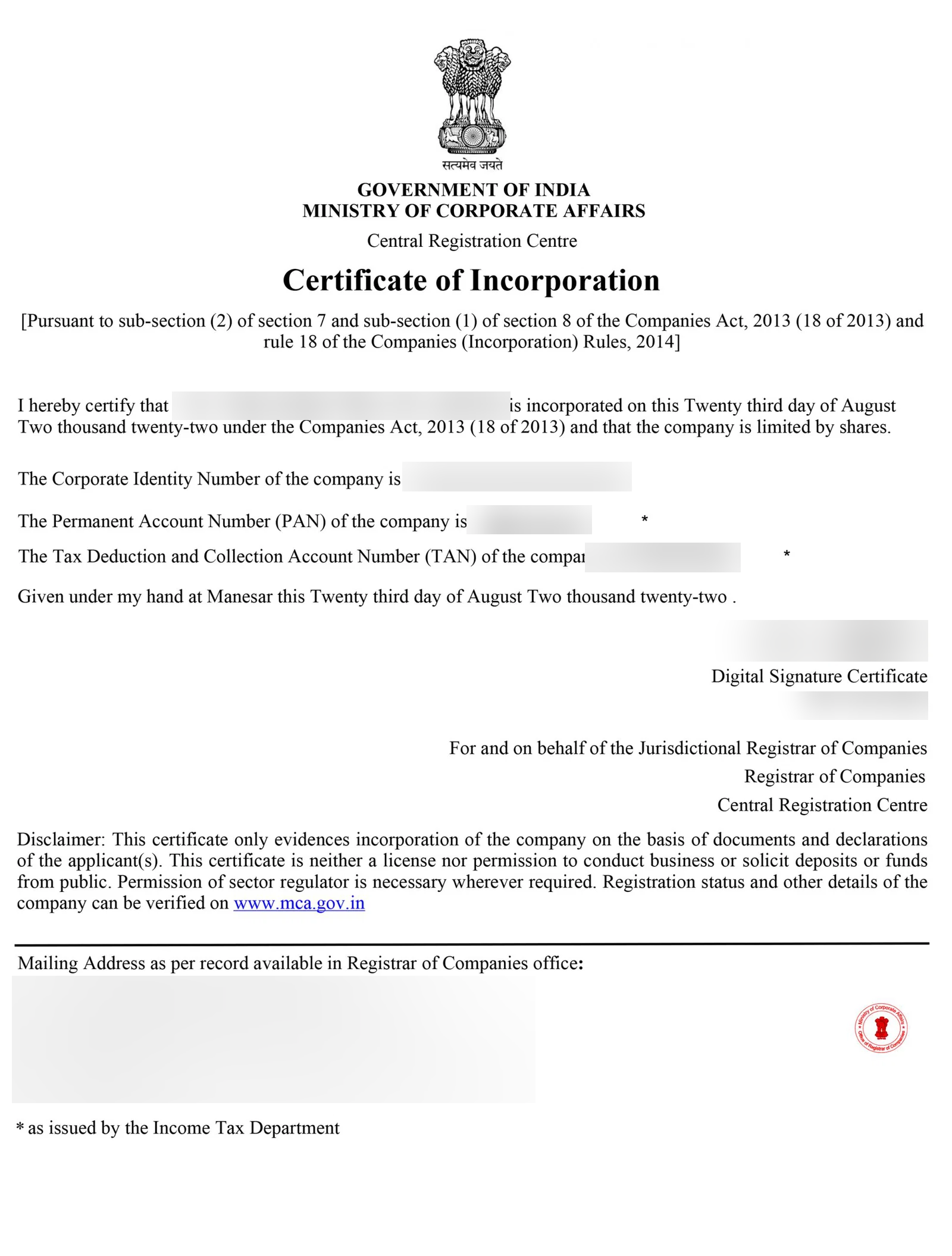
A Section 8 Company is a non-profit entity registered under the Companies Act, 2013 for charitable or public-benefit activities. Its profits must be used for its objectives and cannot be distributed as dividends to members.
Section 8 NGO Registration Under the Companies Act, 2013
Section 8 NGO Registration means incorporating a non-profit company under Section 8 of the Companies Act, 2013. It is suitable for organisations formed to promote charitable or public-benefit objectives such as education, research, social welfare, sports, environment, religion, art or similar causes. A fresh Section 8 Company is incorporated through the Ministry of Corporate Affairs (MCA) incorporation system, generally using SPICe+ and linked forms. The company can earn income or generate a surplus, but that income must be applied toward its stated objects rather than distributed as dividend to members. Section 8 incorporation does not by itself grant income-tax exemption, donor deduction approval, FCRA permission or government-grant eligibility; those approvals must be evaluated separately after incorporation.
Section 8 Company Registration - At a Glance
| Particular | Practical Position |
|---|---|
| Governing law | Companies Act, 2013 and applicable incorporation rules |
| Primary purpose | Charitable / non-profit / public-benefit objects |
| Minimum setup - private form | Generally 2 members and 2 directors |
| Minimum setup - public form | Generally 7 members and 3 directors |
| Minimum paid-up capital | No statutory minimum paid-up capital prescribed |
| Profit distribution | Dividend to members is prohibited; income is applied to objects |
| Name ending | “Private Limited” or “Limited” is omitted after Section 8 licence |
| Fresh incorporation route | SPICe+ and applicable linked incorporation forms |
| Indicative timeline | Often around 7-15 working days after complete documents, subject to MCA processing |
| Post-registration | Banking, accounting, tax registration/approval, DARPAN, CSR/FCRA readiness as applicable |

What Is a Section 8 Company?
A Section 8 Company is a company created for recognised charitable or public-benefit purposes. Section 8 of the Companies Act allows a qualifying organisation to be registered as a limited company without using “Private Limited” or “Limited” in its name, provided its constitutional documents commit the organisation to approved objects, application of income toward those objects, and prohibition on dividend distribution. This makes it different from a normal commercial company even though it remains a corporate legal entity.
The structure is commonly chosen by founders who want an NGO to have a board-led governance model, a clear legal identity, continuity independent of individual founders and formal records with the Registrar of Companies. For organisations planning institutional grants, corporate partnerships, large-scale programmes or a professional management team, this corporate structure can provide greater organisational discipline than an informal charitable initiative.
Objects Permitted for Section 8 NGO Registration
The Companies Act recognises a broad range of non-profit objects. A Section 8 Company may be formed for objects including:
- Promotion of education, skill development, literacy and learning.
- Social welfare, poverty relief, community development and public-benefit programmes.
- Promotion of commerce, industry development, entrepreneurship or professional advancement where the organisation is genuinely non-profit.
- Science, research, innovation and knowledge development.
- Art, culture, heritage and creative development.
- Sports and related public-benefit activities.
- Protection of environment, sustainability and conservation.
- Religion, charity and other legally recognised public-benefit objects.
The object clause is one of the most important parts of the incorporation. It should be specific enough to explain the proposed activities, but broad enough to support the organisation’s legitimate long-term programmes. Poorly drafted objects can create name-approval queries, incorporation resubmissions and future difficulties while applying for tax or grant-related approvals.
Who Can Register a Section 8 Company?
Indian individuals, eligible entities and, subject to the applicable legal and documentation framework, foreign individuals or bodies may participate as subscribers or members. The exact documentation changes when a subscriber or proposed director is a foreign national, non-resident or body corporate, so notarisation, apostille or consularisation requirements should be reviewed before filing.
For a private-form Section 8 Company, a practical starting structure is generally at least two members and two directors. A public-form company generally requires at least seven members and three directors. The proposed board should be selected carefully because directors remain responsible for corporate governance, statutory filings, financial oversight and ensuring that the organisation operates consistently with its Section 8 objects.
Key Requirements Before Filing
Clear charitable objects: Decide the core social or public-benefit purpose and the programmes the organisation expects to carry out.
Suitable proposed name: The name should be unique, aligned with the objects and compliant with MCA name rules. Section 8 names commonly use words such as Foundation, Forum, Association, Federation or Council, depending on the nature of the organisation.
Directors and subscribers: Finalise the initial members/subscribers and proposed directors, and verify their KYC and contact details.
Registered office: Keep appropriate proof of the proposed registered office, including ownership/occupancy documents and owner consent where required.
Digital signatures: The incorporation is electronic, so valid DSCs are required for persons who must digitally sign the incorporation forms.
MOA and AOA planning: The Memorandum should clearly state the Section 8 objects and non-profit restrictions; the Articles should support suitable governance and decision-making.
Documents Required for Section 8 NGO Registration
The exact checklist depends on the subscriber/director profile and the registered office. A typical incorporation file includes the following:
- PAN and Aadhaar / acceptable identity proof of Indian subscribers and directors.
- Recent address proof and contact details of proposed directors and subscribers.
- Passport and overseas address proof for foreign nationals, with notarisation/apostille/consularisation where legally required.
- Registered office proof such as ownership document, lease/rent arrangement or other acceptable occupancy evidence.
- Recent utility bill for the registered office and owner NOC where applicable.
- Proposed company names and a short note explaining the significance of the preferred name, where useful.
- Detailed proposed objects and activity description.
- Digital Signature Certificates for signatories as required.
- MOA and AOA / linked electronic constitutional documents in the prescribed Section 8 format, as applicable.
- Declarations, consents and linked incorporation information required through the MCA filing system.
Step-by-Step Section 8 Company Registration Process
- Define the NGO model and objects: Decide what the organisation will actually do, who its beneficiaries are, how programmes will be funded and whether a Section 8 Company is more suitable than a Trust or Society. The object clause should reflect the real operating plan.
- Finalise name options: Prepare legally suitable and distinguishable names aligned with the proposed objects. A name that is too generic, resembles an existing company or trademark, or does not indicate a Section 8 character may face objections.
- Arrange DSC and director/subscriber details: Collect KYC records, contact details, declarations and digital signatures. DIN allotment for eligible proposed directors may be handled through the incorporation workflow as applicable.
- Prepare MOA and AOA: Draft the constitutional documents carefully. The MOA should contain appropriate non-profit objects and restrictions. The AOA should support board management, membership rules, meetings and internal governance.
- File SPICe+ and linked forms: For a fresh Section 8 Company, incorporation and the Section 8 licensing process are handled through the MCA incorporation framework using SPICe+ and applicable linked forms. The filing includes company, director, subscriber, office, capital/guarantee and constitutional information as applicable.
- Respond to MCA/CRC queries, if any: The Central Registration Centre may ask for clarification, revised object wording, a different name or additional documents. A precise resubmission should address every remark rather than merely re-uploading the same documents.
- Receive incorporation documents: Once approved, the Registrar issues the incorporation outcome and company identification details. PAN/TAN integration is generally part of the incorporation ecosystem, subject to the applicable filing system.
- Complete post-incorporation setup: Open the organisation’s bank account, establish books of accounts and internal controls, approve initial governance matters and evaluate tax registration/approval, NGO DARPAN, CSR, FCRA and other requirements relevant to the proposed funding model.
How Much Does Section 8 NGO Registration Cost?
There is no single fixed cost that applies to every Section 8 Company. The total depends on the state, proposed capital or guarantee structure, number and profile of subscribers/directors, stamp duty, DSC requirements, professional drafting, and whether additional documentation or resubmission work is required. Government and stamp-duty components should therefore be calculated from the actual filing details rather than advertised as a universal package price.
Vakilkaro can provide a case-specific fee estimate after reviewing the proposed name, state of registered office, subscriber/director profile and capital structure. This avoids misleading “all-inclusive” quotes that later exclude stamp duty, DSC, foreign-document certification or post-incorporation work.
How Long Does Section 8 Company Registration Take?
A properly prepared application may often be completed in approximately 7-15 working days after complete documents are available, but this is only an indicative service timeline and not a statutory guarantee. Name availability, MCA workload, document quality, object-clause drafting and resubmission requirements can increase the time. Founders planning grant applications, project launches or banking should therefore keep a reasonable buffer rather than committing to a funding deadline before incorporation is approved.
Benefits of Registering an NGO as a Section 8 Company
- Separate legal identity: the organisation exists independently from its individual members and directors.
- Limited liability: liability of members is generally limited according to the company’s constitution and structure.
- Perpetual succession: the organisation can continue despite changes in directors or members.
- Structured governance: board decisions, statutory records and filings create an organised compliance framework.
- Institutional credibility: a corporate non-profit structure is often easier for banks, institutional donors and corporate counterparties to understand and review.
- No minimum paid-up capital prescribed: the organisation can be incorporated without a statutory minimum paid-up capital requirement, though adequate funding should still be planned for real operations.
- Clear non-profit discipline: surplus is applied to the objects and dividends cannot be distributed to members.
- Scalability: suitable for NGOs that expect multi-state programmes, employees, professional management, grants or long-term partnerships.
Important Restrictions and Compliance Principles
Section 8 status is not a shortcut to operate a commercial business without normal restrictions. The company must remain aligned with its approved objects and the conditions of its Section 8 licence. Income can be earned, fees may be charged for legitimate programmes and a surplus may arise, but the economic benefit cannot be distributed to members as dividend. Related-party payments, salaries, reimbursements and service arrangements should be commercially reasonable, properly approved and supported by records.
Material changes to the constitutional documents, conversion to another company form, use of funds, and other regulated actions may require approvals or specific procedures under company law. Because the Section 8 licence depends on continued compliance with its charitable objects and restrictions, governance should be treated as an ongoing obligation rather than a one-time registration formality.
Section 8 Company vs Trust vs Society
| Factor | Section 8 Company | Trust | Society |
|---|---|---|---|
| Primary law | Companies Act, 2013 | State trust law / general trust framework | Societies Registration Act / state law |
| Governance | Board of Directors + members | Trustees | Governing body / members |
| Legal structure | Corporate legal entity | Trust structure | Membership association |
| Public filings | ROC-based corporate filings | Varies by state and law | Varies by state and law |
| Best suited for | Professionally governed, scalable NGOs | Asset/endowment or trustee-led charities | Membership/community associations |
| Tax exemption | Separate approval required | Separate approval required | Separate approval required |
| Foreign contribution | FCRA registration/prior permission if applicable | Same principle | Same principle |
There is no universally “best” NGO structure. The right choice depends on the founders’ governance preference, state footprint, long-term funding plan, member structure and compliance capacity. Vakilkaro can help compare these structures before incorporation so the organisation does not have to restructure later.
Post-Registration Approvals and Registrations
Incorporation creates the legal entity, but it does not automatically provide every tax, grant or funding approval. After incorporation, evaluate the following based on the NGO’s activity and funding model:
- Income-tax registration / donation approval: Section 8 incorporation itself does not automatically exempt income or make donations tax-deductible. For fresh applications after 1 April 2026, the current Income-tax Act, 2025 framework applies; provisional and regular approvals use the current prescribed forms depending on whether activities have commenced and the organisation’s status. The traditional search terms “12A/12AB and 80G” remain useful for users, but the filing should follow the current law and portal requirements.
- Vakilkaro 12A and 80G Registration resource: Use this for service navigation, while the application strategy should be checked against the current Income-tax portal and law at the time of filing.
- NGO DARPAN Registration: Registration on the Government NGO DARPAN platform may be important for organisations seeking certain government interactions, schemes or grants. It is separate from MCA incorporation. See the official NGO DARPAN portal for the current government process.
- FCRA Registration: A Section 8 Company cannot receive foreign contribution merely because it is incorporated. FCRA registration or prior permission must be obtained where the Foreign Contribution (Regulation) Act applies, and dedicated banking/compliance conditions must be followed. Check the official FCRA portal before accepting regulated foreign contribution.
- CSR implementation readiness: Section 8 Companies that intend to act as implementing agencies for corporate CSR should evaluate the eligibility conditions under the Companies (CSR Policy) Rules, including tax approvals, track record where applicable and CSR-1 registration requirements.
- Trademark Registration: If the NGO is building a distinctive name, logo, programme brand or campaign identity, trademark protection can help secure that identity.
Annual Compliance After Section 8 Incorporation
A Section 8 Company remains a company under the Companies Act and must maintain corporate and financial compliance. A strong compliance system generally includes proper books of accounts, statutory registers, board and member meeting records, financial statements, audit where applicable, annual ROC filings, income-tax compliance and timely reporting under any special approvals held by the organisation. For a detailed Vakilkaro resource, Annual Compliance for Section 8 Company.
Founders should create a compliance calendar immediately after incorporation. The most common governance problems arise not because the NGO lacks a social mission, but because records are incomplete, bank transactions are not properly supported, board approvals are missing, donor restrictions are not tracked, or statutory filings are treated as year-end tasks. Continuous recordkeeping improves audit readiness and donor confidence.
Common Mistakes to Avoid
- Using vague or overly commercial objects that do not clearly establish the non-profit purpose.
- Selecting a name without checking MCA availability or possible trademark conflicts.
- Assuming Section 8 registration automatically gives tax exemption or donor deduction benefits.
- Using personal bank accounts for NGO receipts or expenses after incorporation.
- Accepting foreign contribution without first evaluating FCRA requirements.
- Promising CSR eligibility immediately after incorporation without checking the applicable implementing-agency conditions.
- Paying founders, directors or related parties without transparent approval, documentation and reasonable commercial basis.
- Ignoring annual ROC, accounting, audit or income-tax compliance after the certificate is issued.
Who Should Choose a Section 8 Company?
A Section 8 Company may be a strong choice where the founders want a professionally governed, long-term organisation rather than an informal charitable group. It is particularly suitable for education foundations, research organisations, skill-development institutions, social-impact platforms, environmental organisations, sports-development bodies, industry or professional associations operating on a non-profit basis, charitable healthcare initiatives and NGOs that expect institutional partnerships or multi-state programmes.
It may be less suitable where the founders want a simple local structure with minimal corporate formalities and no expectation of institutional scale. The decision should be made after comparing governance, state-level requirements, tax strategy, donor expectations and ongoing compliance capacity.
Why Choose Vakilkaro for Section 8 NGO Registration?
Vakilkaro supports founders from the planning stage through incorporation and post-registration compliance. Our approach focuses on legally workable objects, clean documentation and a practical governance setup rather than treating registration as a form-filling exercise.
- Pre-registration structure consultation and Section 8 vs Trust/Society guidance.
- Name planning and MCA name-application support.
- DSC and director/subscriber documentation assistance.
- Drafting support for MOA, AOA and Section 8 object clauses.
- SPICe+ incorporation and linked-form filing support.
- MCA resubmission / clarification handling where required.
- Post-incorporation guidance for banking and governance setup.
- Tax registration/approval guidance under the current Income-tax framework.
- NGO DARPAN, CSR readiness and FCRA advisory where applicable.
- Ongoing annual compliance support for Section 8 Companies.