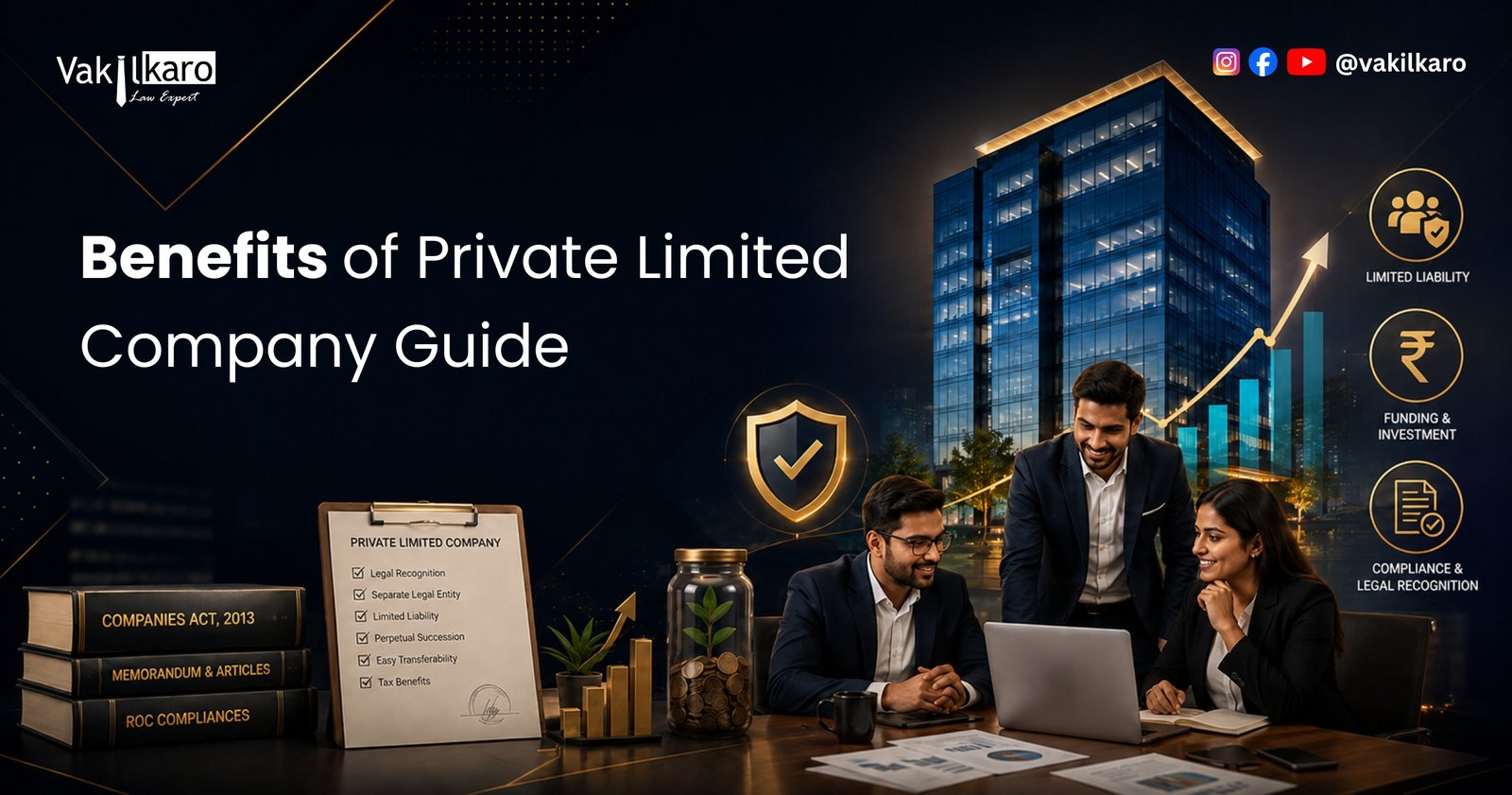
A Private Limited Company is widely regarded as one of the most suitable business structures for entrepreneurs planning long-term growth. It provides a separate legal identity, limited liability protection, perpetual succession, structured ownership through shares and improved credibility before investors, banks and government authorities. It also creates a strong legal framework for fundraising, corporate governance, business expansion and long-term succession planning under the Companies Act, 2013.
Many founders ask "Should I register a Private Limited Company because everyone else is doing it?" The better question is: "Will my business need structured ownership, external investment, limited liability and long-term scalability?" If the answer is Yes, a Private Limited Company generally provides the strongest legal foundation among the commonly used business structures in India.
Many entrepreneurs continue signing contracts and purchasing assets in their personal names even after incorporation. Doing so reduces one of the principal advantages of forming a Private Limited Company. A Private Limited Company generally protects shareholders from unlimited personal liability.
Many founders register trademarks in their personal names before incorporation. Where the business intends to build long-term enterprise value, intellectual property is generally more effective when owned by the company itself. Businesses expanding across multiple states frequently benefit from the corporate identity created by a Private Limited Company.
Many founders evaluate incorporation only based on their current business size. A better approach is to evaluate where the business is expected to be in the next five years. The legal structure should support future growth rather than only current operations.
| Benefit | Business Advantage |
|---|---|
| Separate Legal Entity | Independent corporate identity |
| Limited Liability | Protects shareholders' personal assets |
| Perpetual Succession | Business continues despite ownership changes |
| Better Credibility | Improves trust among banks, investors and clients |
| Investment Ready | Suitable for angel and venture capital funding |
| Ownership Through Shares | Flexible ownership and succession planning |
| Corporate Governance | Structured decision-making framework |
| Brand Value | Supports long-term business reputation |
| National Expansion | Suitable for multi-state operations |
| International Opportunities | Better framework for overseas expansion and foreign investment |
Key Highlights
- Separate Legal Entity
- Limited Liability Protection
- Preferred Structure for Startups
- Investment Friendly
- Better Business Credibility
- Strong Corporate Governance
- Easy Ownership Transfer Through Shares
- Long-Term Business Continuity
- Suitable for Business Expansion
- Supports Future Fundraising
Introduction
Every successful business eventually reaches a stage where informal management practices are no longer sufficient. As customers increase, employees join the organisation, external funding becomes necessary and compliance responsibilities grow, founders often realise that the legal structure chosen at the beginning significantly affects the future of the business.
Many entrepreneurs initially operate as sole proprietors because incorporation appears unnecessary during the early stages. However, once the business begins expanding, challenges relating to ownership, personal liability, banking, investment and succession frequently arise. These challenges often make the transition to a Private Limited Company an important strategic decision.
Unlike unincorporated business structures, a Private Limited Company creates a distinct legal entity that exists independently of its owners. This allows the business to own property, enter contracts, employ staff, protect intellectual property and raise investment without depending upon the personal legal identity of the founders.
The benefits of incorporation therefore extend beyond compliance. They influence the company's ability to attract investors, secure institutional finance, recruit talented employees, establish corporate governance and build long-term enterprise value.
Understanding these advantages helps founders determine whether incorporation aligns with their business objectives before investing time and resources into company registration.
Common Myths About a Private Limited Company
Many entrepreneurs make decisions based on advice from friends, social media or outdated information instead of understanding the legal framework. These misconceptions often delay incorporation or result in selecting an unsuitable business structure.
The following are some of the most common myths surrounding Private Limited Companies.
Myth 1 – A Private Limited Company is Only for Large Businesses
Reality:
A Private Limited Company is suitable for businesses of all sizes. Many successful startups begin as Private Limited Companies because they intend to raise investment and scale their operations.
Myth 2 – Company Registration Automatically Protects the Brand
Reality:
Company incorporation establishes the legal identity of the company. Trademark Registration protects the business name, logo and brand identity. Both are separate legal processes.
Myth 3 – A Private Limited Company Cannot Be Started from Home
Reality:
A residential address may generally be used as the registered office, subject to applicable legal requirements and supporting documentation.
Myth 4 – Incorporation Eliminates All Personal Liability
Reality:
Limited liability protects shareholders from ordinary business liabilities. However, directors may still be personally liable in situations involving fraud, wrongful conduct or statutory non-compliance.
Myth 5 – A Private Limited Company Pays Less Tax in Every Situation
Reality:
Taxation depends upon the applicable tax regime, business income and prevailing tax laws. The choice of business structure should not be based solely on tax considerations.
Myth 6 – A Private Limited Company Does Not Require Annual Compliance
Reality:
Every incorporated company remains subject to statutory compliance under the Companies Act and other applicable laws.
Myth 7 – Incorporation Means Immediate Startup India Benefits
Reality:
Startup India Recognition is a separate process administered by DPIIT and is subject to prescribed eligibility conditions.
Myth 8 – Only Technology Companies Should Incorporate
Reality:
Manufacturing businesses, healthcare organisations, exporters, consultants, professional firms and many other industries also benefit from incorporation.
Myth 9 – Every Company Needs New DINs for Every Director Appointment
Reality:
A Director Identification Number is generally allotted once and continues throughout the director's corporate career.
Myth 10 – Company Registration is the Final Step
Reality:
Incorporation marks the beginning of:
- Corporate Governance
- Compliance
- Banking
- Taxation
- Intellectual Property Planning
- Business Growth
Vakilkaro Expert Insights
Insight 1
Founders should select a business structure based on their future business vision, not only their present turnover.
Insight 2
The strongest businesses generally invest in legal structuring before raising external funding.
Insight 3
Corporate governance should begin immediately after incorporation rather than during the first investment round.
Insight 4
A well-structured Private Limited Company often commands greater confidence among investors, lenders and institutional customers than an informal business structure.
Insight 5
Legal compliance should be viewed as a business asset rather than an administrative burden.
Consistent compliance strengthens enterprise value over time.
Real Business Case Studies
Case Study 1 – Startup Funding
Industry
Technology Startup
Background
Two founders incorporated a Private Limited Company before launching their SaaS platform.
Challenge
Within twelve months, an angel investor expressed interest in funding the business.
Outcome
Because the company already had:
- Clear Shareholding
- Constitutional Documents
- Corporate Records
the investment process proceeded efficiently.
Learning
Early incorporation significantly improves investment readiness.
Case Study 2 – Manufacturing Expansion
Industry
Packaging Manufacturing
Background
A family-owned business initially operated as a proprietorship.
Challenge
Large corporate buyers required vendor registration and formal corporate documentation.
Outcome
After incorporation, the business successfully expanded into institutional supply contracts.
Learning
Corporate credibility often influences commercial opportunities.
Case Study 3 – Brand Protection
Industry
Consumer Products
Background
A company completed incorporation but delayed trademark registration.
Challenge
Another business obtained trademark rights over a similar brand.
Outcome
The founders had to redesign branding and marketing material.
Learning
Company incorporation and trademark registration should be planned together.
Why Choose a Private Limited Company?
A Private Limited Company is generally selected by entrepreneurs who intend to build an organisation capable of long-term growth rather than operating as an individual business.
This structure is particularly suitable where the founder expects:
- Business Expansion
- Multiple Shareholders
- External Investment
- Corporate Banking
- Government Contracts
- Intellectual Property Ownership
- Succession Planning
- Employee Stock Option Plans (ESOP)
- Venture Capital Funding
- National or International Operations
Unlike a proprietorship, where the business and owner remain legally inseparable, a Private Limited Company establishes an independent corporate identity capable of continuing its existence irrespective of changes in ownership or management.
For this reason, the majority of high-growth startups, technology companies, manufacturing businesses and professionally managed organisations prefer incorporation as a Private Limited Company.
When Should You Choose a Private Limited Company?
A Private Limited Company is generally appropriate when the business intends to:
- Raise external investment.
- Operate with multiple founders.
- Build a scalable organisation.
- Protect personal assets.
- Establish a long-term brand.
- Expand nationally.
- Introduce ESOPs.
- Improve corporate governance.
- Prepare for acquisitions or strategic partnerships.
If these objectives align with the founder's vision, incorporation often provides a strong legal foundation.
When Should You Not Choose a Private Limited Company?
A Private Limited Company may not always be the most suitable choice.
Alternative structures may be more practical where:
- Business is extremely small.
- Operations remain local with no expansion plans.
- External investment is unlikely.
- The founder prefers minimal compliance.
- Only one individual intends to operate the business with limited future growth.
Selecting the appropriate structure should always depend upon commercial objectives rather than popularity.
Vakilkaro Recommendation
The question should not be:
"Which structure is cheapest?"
The better question is:
"Which structure will support my business over the next five to ten years?"
Founder Decision Framework
Before selecting a Private Limited Company, every entrepreneur should evaluate the following questions.
Business Vision
- Will the business expand nationally?
- Is long-term scalability expected?
Investment
- Will investors participate?
- Is external funding likely?
Ownership
- Will multiple founders or shareholders be involved?
- Will ownership change over time?
Governance
- Is structured decision-making required?
- Will the business employ senior management?
Brand
- Is long-term brand building important?
- Will intellectual property become valuable?
Compliance
- Can the business maintain annual statutory compliance?
If the answer to most of these questions is Yes, a Private Limited Company generally provides the most suitable legal framework.
Final Business Decision
A Private Limited Company is not simply a registration.
It is a long-term corporate structure designed for businesses intending to:
- Grow.
- Raise investment.
- Build enterprise value.
- Create sustainable governance.
- Expand into larger markets.
Choosing this structure should therefore be viewed as a strategic business decision rather than merely a legal requirement.
15 Major Benefits of a Private Limited Company
The decision to incorporate a Private Limited Company should be based on long-term business objectives rather than short-term registration convenience. The benefits of this structure extend far beyond legal compliance. They influence fundraising capability, risk management, business credibility, ownership flexibility and corporate governance throughout the company's lifecycle.
The following benefits explain why Private Limited Companies have become the preferred legal structure for startups, high-growth businesses and professionally managed organisations.
1. Separate Legal Entity
One of the most important advantages of a Private Limited Company is that it becomes a separate legal entity immediately after incorporation.
The company exists independently of its shareholders and directors.
This means the company can:
- Own movable and immovable property.
- Open bank accounts.
- Enter commercial contracts.
- Acquire intellectual property.
- Employ staff.
- Borrow money.
- Sue and be sued in its own name.
The business therefore acquires its own legal identity distinct from the individuals who established it.
Practical Example
A startup purchases office equipment, registers a trademark and signs agreements with enterprise customers.
All these assets belong to the company—not the individual founders.
Even if one founder exits later, ownership of these assets remains with the company.
2. Limited Liability Protection
Shareholders are ordinarily liable only to the extent of the unpaid amount on their subscribed shares.
This separation between personal assets and business liabilities encourages entrepreneurship and allows founders to undertake commercial risks more confidently.
Although directors may still be liable in cases involving fraud, wrongful conduct or statutory violations, ordinary commercial liabilities generally remain with the company.
Business Advantage
Limited liability helps founders:
- Expand operations.
- Hire employees.
- Enter larger contracts.
- Raise institutional finance.
- Build long-term businesses.
without exposing personal wealth to routine business risks.
3. Perpetual Succession
Unlike sole proprietorships and traditional partnerships, the legal existence of a Private Limited Company continues irrespective of changes in ownership.
The company generally continues despite:
- Death of Shareholders.
- Resignation of Directors.
- Retirement of Founders.
- Transfer of Shares.
- Admission of New Investors.
This continuity provides stability for long-term business planning.
4. Better Business Credibility
Banks, investors, multinational corporations and government departments generally place greater confidence in incorporated businesses because they operate within a recognised legal framework.
A Private Limited Company often improves credibility during:
- Vendor Registration
- Government Tenders
- Institutional Finance
- Corporate Procurement
- Strategic Partnerships
This credibility frequently opens commercial opportunities that may not be available to informal business structures.
5. Easier Access to Investment
One of the strongest reasons founders choose a Private Limited Company is its suitability for raising external investment.
The company may raise capital through:
- Equity Shares
- Rights Issues
- Preference Shares
- Angel Investment
- Venture Capital
- Strategic Investment
Professional investors generally prefer investing through incorporated companies because ownership is represented through shares and supported by structured corporate governance.
Vakilkaro Recommendation
Businesses planning to raise investment within the next three to five years should evaluate incorporation at an early stage rather than restructuring later.
6. Ownership Through Shares
Ownership in a Private Limited Company is represented through shares.
This structure simplifies:
- Admission of New Shareholders.
- Founder Exit.
- Succession Planning.
- ESOP Implementation.
- Family Business Planning.
Compared with informal business structures, ownership transfer becomes significantly more organised.
7. Strong Corporate Governance
Corporate governance improves business discipline.
The Private Limited Company structure establishes:
- Board of Directors.
- Shareholder Meetings.
- Board Resolutions.
- Statutory Registers.
- Annual Compliance.
Although this increases compliance responsibilities, it also improves organisational stability and accountability.
8. Better Banking Opportunities
Financial institutions generally prefer lending to properly incorporated businesses.
A Private Limited Company can more effectively apply for:
- Working Capital
- Cash Credit
- Term Loans
- Equipment Finance
- Business Banking Facilities
The availability of organised corporate records frequently improves credit assessment.
9. Startup India Compatibility
Innovative Private Limited Companies may become eligible to apply for Startup India Recognition, subject to the applicable eligibility conditions prescribed by DPIIT.
Potential advantages may include:
- Recognition within the startup ecosystem.
- Access to government initiatives.
- Intellectual property support.
- Participation in startup-focused programmes.
Startup India Recognition is a separate process and should not be confused with company incorporation.
10. Better Brand Protection Strategy
Although incorporation itself does not protect a brand, the Private Limited Company structure provides a stronger framework for intellectual property ownership.
The company may own:
- Trademarks.
- Copyrights.
- Patents.
- Industrial Designs.
- Domain Names.
This is particularly important during investment and acquisitions.
11. Easier National Expansion
Expansion often becomes easier for:
- Vendor Registrations.
- Branch Offices.
- Institutional Contracts.
- Multi-State Operations.
12. Foreign Investment Readiness
Where foreign investment becomes relevant, a Private Limited Company provides a recognised corporate structure capable of receiving investment subject to applicable FEMA, RBI and sector-specific regulations.
This makes the structure suitable for startups planning international growth.
13. Better Business Continuity
Business continuity does not depend upon one individual.
Changes in ownership, management or investment generally do not interrupt the legal existence of the company.
This improves long-term sustainability.
14. Higher Enterprise Value
Businesses with:
- Organised Corporate Governance
- Proper Compliance
- Intellectual Property
- Financial Records
often command stronger valuations during investment, mergers and acquisitions.
The legal structure therefore contributes indirectly to enterprise value.
15. Long-Term Scalability
Perhaps the greatest benefit of a Private Limited Company is scalability.
The structure supports growth from:
- Single Founder Startup
- to
- National Company
- to
- Investor-backed Enterprise
without requiring a fundamental change in legal identity.
This makes it one of the most future-ready business structures available under Indian corporate law.
Founder Decision Summary
A Private Limited Company is generally appropriate where the founder intends to:
- Build a scalable business.
- Raise external investment.
- Protect personal assets.
- Create long-term brand value.
- Expand nationally.
- Introduce co-founders or investors.
- Build structured corporate governance.
- Prepare for institutional finance.
Vakilkaro Recommendation
The true value of a Private Limited Company lies not in obtaining a Certificate of Incorporation but in establishing a legal foundation capable of supporting growth over the next decade.
Entrepreneurs should therefore choose incorporation not because it is popular, but because it aligns with their long-term commercial vision.
Benefits of a Private Limited Company at Different Business Stages
The advantages of a Private Limited Company become more apparent as a business grows. A founder at the idea stage may value limited liability, while an investor-backed startup may focus on governance and equity structuring. Therefore, the benefits of incorporation should be evaluated according to the stage of the business rather than as a single checklist.
Understanding how the company structure supports different stages of growth helps founders make better long-term decisions.
Stage 1 – Idea & Validation Stage
During the early stage, entrepreneurs are validating business ideas, building prototypes and acquiring initial customers.
At this stage, a Private Limited Company provides:
- Separate legal identity.
- Professional business image.
- Better trust with vendors and clients.
- Protection of personal assets.
- Foundation for future expansion.
Although some founders may initially operate through a proprietorship, businesses expecting rapid growth often benefit from incorporating at an early stage.
Stage 2 – Startup & Launch Stage
Once the business begins commercial operations, the legal structure starts influencing day-to-day activities.
Benefits include:
- Opening a company bank account.
- Entering contracts in the company's name.
- Hiring employees.
- Applying for GST Registration (where applicable).
- Startup India planning.
- Trademark ownership in the company's name.
- Better accounting structure.
At this stage, incorporation improves operational discipline and business credibility.
Stage 3 – Growth Stage
As revenue and operations expand, additional governance becomes important.
A Private Limited Company supports:
- Appointment of additional directors.
- Expansion into multiple cities or states.
- Corporate banking.
- Institutional finance.
- Vendor registrations.
- Long-term customer contracts.
- Structured compliance.
Businesses that intend to scale generally benefit from this organised corporate framework.
Stage 4 – Investment Stage
When businesses begin discussions with angel investors, venture capital funds or strategic investors, the legal structure becomes even more significant.
A Private Limited Company supports:
- Equity investment.
- Share allotment.
- Shareholder agreements.
- Board governance.
- ESOP implementation.
- Corporate due diligence.
Professional investors generally expect a structured corporate entity before making equity investments.
Stage 5 – Enterprise Stage
Established businesses planning national or international expansion benefit from:
- Corporate restructuring.
- Foreign investment readiness.
- Acquisition opportunities.
- Strong governance.
- Succession planning.
- Higher enterprise valuation.
The Private Limited Company structure continues to support business growth without requiring a fundamental change in legal identity.
Industry-wise Benefits of a Private Limited Company
Different industries derive different advantages from incorporation.
Technology Startups
Technology companies often require:
- Angel Investment
- Venture Capital
- ESOP
- Intellectual Property Protection
- Rapid Scaling
A Private Limited Company supports these requirements more effectively than informal business structures.
Manufacturing Businesses
Manufacturers benefit through:
- Corporate Vendor Registration
- Working Capital Finance
- Industrial Contracts
- Government Procurement
- Expansion into Multiple States
Healthcare Businesses
Healthcare companies often require:
- Regulatory Compliance
- Corporate Governance
- Investment
- Professional Credibility
Incorporation strengthens confidence among hospitals, institutions and investors.
Export & Import Businesses
Businesses engaged in international trade benefit from:
- Corporate Banking
- Import Export Code (IEC)
- International Contracts
- Foreign Customers
- Global Business Credibility
D2C & E-commerce Brands
Consumer brands benefit through:
- Trademark Ownership
- Investor Readiness
- Marketplace Credibility
- Business Expansion
- Corporate Partnerships
Professional Service Firms
Consulting firms, software companies and agencies benefit from:
- Better Client Confidence
- Organised Contracts
- Employee Hiring
- Corporate Tax Planning
- Long-Term Brand Building
Frequently asked questions
Is a Private Limited Company suitable for startups?+
Yes. It is widely preferred by startups planning growth, investment and long-term expansion.
Can one person own a Private Limited Company?+
A Private Limited Company generally requires at least two shareholders. Entrepreneurs seeking a single-owner structure may evaluate an OPC where eligible.
Can investors invest in a Private Limited Company?+
Yes. Equity investment is one of the principal advantages of this structure.
Is annual compliance mandatory?+
Yes. Companies are generally required to comply with applicable statutory requirements throughout their existence.
Can the company own intellectual property?+
Yes. A Private Limited Company may own trademarks, patents, copyrights, designs and domain names.
Is incorporation enough for legal compliance?+
No. Incorporation should be followed by applicable post-incorporation registrations, statutory compliance and corporate governance.
Can a Private Limited Company receive foreign investment?+
Yes. Subject to applicable FEMA provisions, RBI regulations and sector-specific rules.
Is incorporation suitable for family businesses?+
Yes. Many family businesses incorporate to improve succession planning, governance and long-term continuity.
Can ownership change without closing the company?+
Yes. Shares may generally be transferred in accordance with the Articles of Association and applicable law.
Can Vakilkaro help throughout the company lifecycle?+
Yes. Vakilkaro provides assistance from incorporation through compliance, taxation, intellectual property and long-term corporate advisory.
Why Choose Vakilkaro?+
Vakilkaro supports entrepreneurs beyond company registration. Our services include: Business Structure Advisory Company Registration Startup India Guidance Trademark Registration Annual Compliance Corporate Governance Advisory Investment Readiness Legal Documentation Business Expansion Support Our objective is to help founders build sustainable, legally compliant and investment-ready businesses rather than simply completing registration formalities.