A Public Limited Company requires at least 7 members and 3 directors, including one resident director. It is registered online through the MCA SPICe+ process using DSC, MOA and AOA. There is no minimum paid-up capital requirement, and stock exchange listing requires separate SEBI compliance.
What is a Public Limited Company?
A Public Limited Company is a corporate entity formed for a lawful purpose under the Companies Act, 2013. It is legally separate from its shareholders and directors. This separation allows the company to own property, enter contracts, hire employees, borrow money, maintain bank accounts and sue or be sued in its own name. The shareholders ordinarily have limited liability up to the amount unpaid on the shares held by them, subject to exceptions created by law, guarantees, fraud or other specific circumstances.
The public-company structure is generally used where promoters expect a larger ownership base, formal board decision-making, institutional funding or future access to capital markets. Compared with a private company, it offers broader ownership flexibility but also brings a higher compliance burden and more structured governance.
The name ordinarily ends with “Limited”. Promoters should select this structure because it fits the ownership, funding and governance strategy, not merely because it appears larger. For a small founder group, a private company may remain simpler.
Who Should Consider Public Limited Company Registration?
A Public Limited Company is worth considering where the business has a clear scale-up plan and the promoters are prepared for formal governance, periodic disclosures, board processes and shareholder documentation. It may be suitable for:
- Established businesses preparing for large-scale expansion across multiple states or business verticals.
- Promoter groups that expect a wider shareholder base and want a formal share-based ownership structure.
- Companies planning to bring in institutional, strategic or multiple rounds of investors over time.
- Family-owned or closely held businesses that are moving toward professional management and stronger board processes.
- Enterprises that may eventually evaluate an IPO or stock-exchange listing, while understanding that incorporation as a public company alone does not create listing eligibility.
- Businesses participating in large tenders, banking relationships or corporate procurement where an organised corporate structure can support credibility and due diligence.
If the business has only a small founder group and does not need a broad ownership structure, Private Limited Company Registration may be operationally simpler. A solo founder may instead evaluate a One Person Company (OPC) Registration. The correct structure should be selected after considering ownership, fundraising, governance, compliance capacity and long-term business plans.

Basic Eligibility and Legal Requirements
Before filing the incorporation application, promoters should confirm that the proposed company can satisfy the foundational requirements. The following table gives a practical overview.
| Requirement | Practical Position |
|---|---|
| Minimum members/subscribers | At least 7 persons are required to form a public company. |
| Minimum directors | At least 3 directors are required. |
| Resident director | At least 1 director must meet the statutory India-residency requirement applicable under the Act. |
| Minimum paid-up capital | No general statutory minimum paid-up capital is prescribed merely for incorporation; capital should be planned according to the business model and filing requirements. |
| Company name | The proposed name must be available, legally permissible and ordinarily end with “Limited”. |
| Registered office | A valid registered office in India is required, with address evidence and owner consent/NOC where applicable. |
| Digital filing | Digital Signature Certificates are required for signing the relevant electronic incorporation documents. |
| Business objects | The MOA must clearly describe lawful main objects and supporting objects appropriate to the intended activities. |
Benefits of a Public Limited Company
Separate Legal Identity
The company exists separately from shareholders and directors, so it can own assets, sign contracts, borrow and conduct legal proceedings in its own name.
Limited Liability
Shareholders are ordinarily liable only to the unpaid amount on their shares, subject to statutory exceptions, guarantees and fraud-related circumstances.
Structured Ownership Through Shares
Share-based ownership makes promoter and investor holdings easier to document and adjust through lawful allotments or transfers.
Long-Term Capital Raising Potential
The structure is suited to businesses expecting larger capital needs. Any public offer, IPO or listing still requires separate securities-law compliance.
Perpetual Succession
The company continues despite changes in shareholders, directors or promoters, supporting succession, financing and long-term contracts.
Governance and Institutional Credibility
Board procedures, statutory records and audited reporting create formal governance that can improve lender, investor and enterprise-customer due diligence.
Transferability and Investor Planning
Shares are generally more transferable than in a private company, subject to law, the Articles, securities rules and dematerialisation requirements.
Step-by-Step Public Limited Company Registration Process
Public company incorporation is completed electronically, but the quality of the filing depends heavily on planning before submission. A practical process is set out below.
Step 1 – Finalise the Business Structure and Promoter Plan
Confirm the business activities, at least seven subscribers, at least three directors, promoter holdings, capital structure and registered office. Identify any NRI, foreign or body-corporate participant early because additional documentation may apply.
Step 2 – Select and Check the Proposed Company Name
Choose a distinctive name that does not conflict with existing companies or trademarks. Avoid regulated expressions without approvals, and ordinarily use the suffix “Limited”.
Step 3 – Obtain Digital Signature Certificates
The filing is electronic, so relevant signatories need valid DSCs before the incorporation forms can be submitted.
Step 4 – Reserve the Name Through SPICe+ Part A
Submit the proposed name through SPICe+ Part A with a business description consistent with the intended objects and supporting documents.
Step 5 – Draft the MOA and AOA
Draft the MOA for the company’s objects, liability and capital, and the AOA for internal governance, meetings, voting and share-related rules. The documents should match the actual business plan.
Step 6 – Prepare SPICe+ Part B and Linked Incorporation Forms
Complete SPICe+ Part B with company, subscriber, director, office and capital details. Linked filings commonly include e-MOA/e-AOA, INC-9 where applicable and AGILE-PRO-S.
Step 7 – Attach the Supporting Documents
Attach clear, consistent identity, address, office, NOC, consent and corporate-subscriber documents. Names, dates and share subscriptions should match across all filings.
Step 8 – Pay Government Filing Fees and Stamp Duty
Pay MCA fees and state-specific stamp duty based on the authorised capital, registered-office state and applicable filing rules.
Step 9 – ROC Examination and Resubmission, if Any
The ROC/CPC may approve the filing or issue a resubmission. Any response should correct defects without creating new inconsistencies.
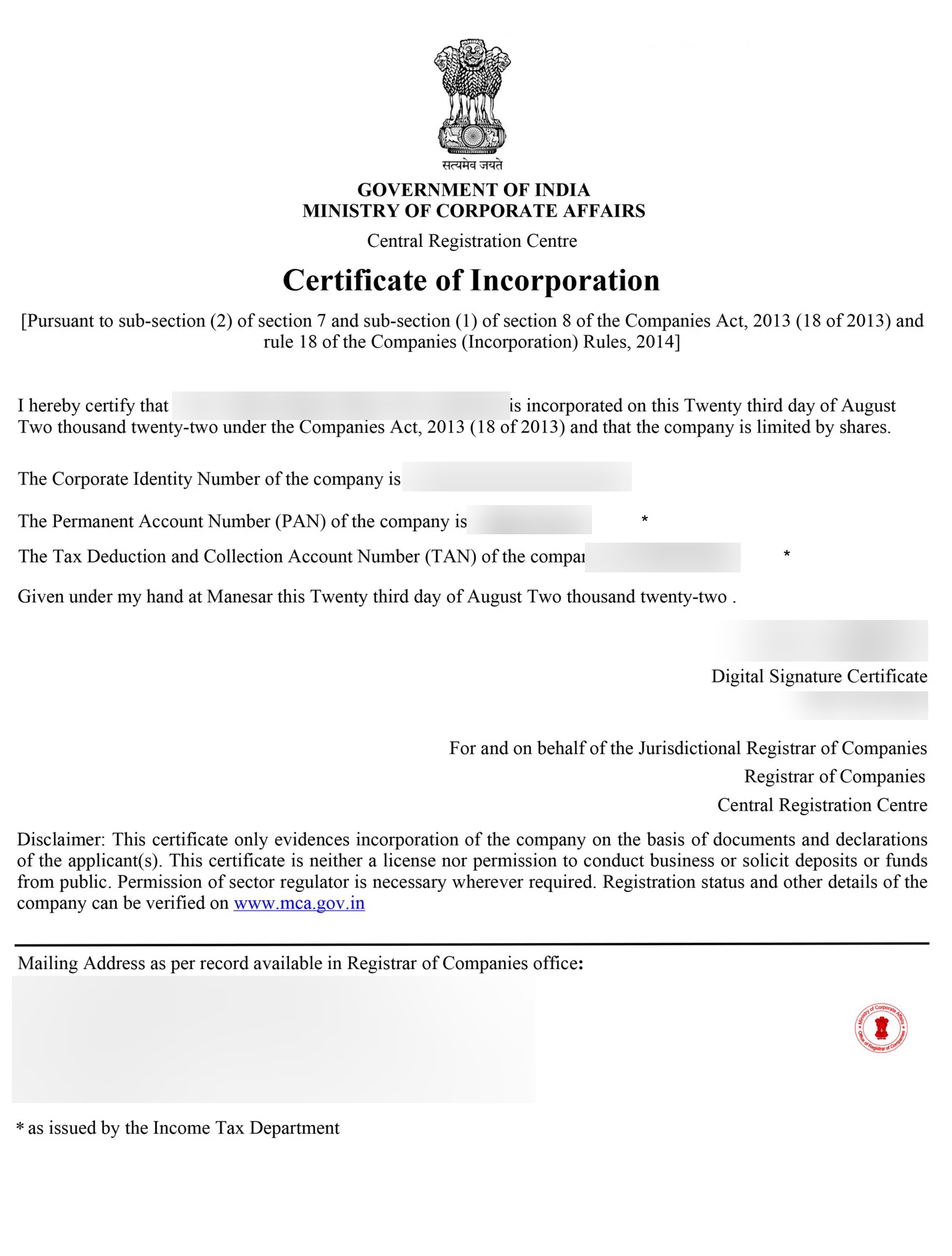
Step 10 – Certificate of Incorporation, CIN, PAN and TAN
On approval, the company receives the Certificate of Incorporation and CIN; PAN and TAN are integrated with incorporation. Post-incorporation actions should begin immediately.
For portal-level incorporation guidance, promoters can refer to the official Ministry of Corporate Affairs (MCA) website and the MCA SPICe+ incorporation FAQs.
Documents Required for Public Limited Company Registration
The exact document set changes according to the nationality of subscribers/directors, ownership pattern, registered-office arrangement and whether a body corporate is participating. A standard Indian promoter case commonly requires the following categories.
For Proposed Directors and Individual Subscribers
- PAN and Aadhaar or other valid identity documents, as applicable.
- Recent address proof showing the individual’s current residential address.
- Passport-size photograph and active email/mobile details for verification and filings.
- Director consent and declarations in the prescribed manner.
- DIN details where already available; new DIN allotment may be integrated with incorporation subject to the applicable form framework.
- Passport and notarised/apostilled documents where a foreign national or non-resident case requires overseas authentication.
For the Registered Office
- Ownership document, rent agreement or other evidence supporting the right to use the premises.
- No-objection certificate from the owner where the premises are not owned by the company/promoters.
- Recent utility bill or other prescribed address evidence for the premises.
- Complete address, PIN code, police-station/jurisdiction information and contact details as required by the filing.
Company and Incorporation Documents
- Proposed company name and alternative name options.
- Main business objects and supporting activities for MOA drafting.
- Share-capital and subscription plan showing how many shares each subscriber will take.
- MOA and AOA in the applicable electronic or attachment format.
- INC-9/declarations and other linked forms where applicable.
- Board resolution, incorporation certificate and authorised-representative documents where a body corporate subscribes to shares.
- Regulatory approval, trademark-owner consent or other NOC where the proposed name or business sector requires it.
Share Capital, Shareholding and Governance Planning
There is no general minimum paid-up capital merely for incorporation, but capital still requires planning. Authorised capital sets the initial issue ceiling, while subscribed and paid-up capital should match business, banking, licensing and investor needs.
Vakilkaro also provides support for Authorized Capital Increase when a company needs additional headroom for future allotments. For promoter or investor relationships, a well-drafted Shareholders Agreement can document commercial rights in addition to the company’s constitutional documents, subject to legal enforceability and consistency with the Articles.
Governance should be planned from the beginning: Board composition, signing authority, reserved matters, shareholder approvals and conflict handling. Certain public companies also face threshold-based requirements for independent directors, committees, secretarial audit or other governance measures.
Public Limited Company vs Listed Company
A Public Limited Company is not automatically listed. It may remain an unlisted public company. Listing is a separate regulatory process involving securities-law eligibility, disclosures, exchange approvals and continuing compliance.
Where a company later seeks listing or issues listed securities, it must evaluate the applicable framework of the Securities and Exchange Board of India (SEBI) and the recognised stock exchange. A public company should therefore be marketed as “listed” only after the appropriate listing process has actually been completed.
Unlisted public companies should also review applicable dematerialisation requirements before issues, transfers and other securities actions.
For assistance with securities record readiness, Vakilkaro offers Demat of Shares support for applicable company cases.
Timeline and Cost of Public Limited Company Registration
There is no guaranteed incorporation timeline. Processing depends on DSC readiness, name approval, document quality, MCA workload and whether the filing is sent for resubmission. Promoters can reduce avoidable delay by finalising subscriber details, director documents, office proof, capital figures, business objects and digital signatures before submission. Where overseas documents, regulated words or corporate subscribers are involved, additional preparation time should be kept in the project plan. A complete, consistent filing generally moves faster than a file prepared in stages.
Cost generally includes DSCs, MCA filing fees, state stamp duty, professional fees and any notarisation, apostille or special approval costs. The government component may change with authorised capital and the state of the registered office. Promoters should also budget for post-incorporation actions instead of comparing only the incorporation quote. A good quotation should clearly separate statutory charges from professional fees and state whether later services such as INC-20A, auditor filing, annual compliance, GST or demat support are included or charged separately.
Post-Incorporation Compliances You Should Plan From Day One
The Certificate of Incorporation creates the company, but post-incorporation compliance starts immediately. A practical checklist includes:
- Open and activate the company bank account: Complete bank KYC, deposit subscription money in the manner required and preserve the banking evidence.
- Declaration for commencement of business: A company incorporated with share capital and covered by Section 10A should complete the commencement declaration within the statutory period after satisfying the subscription-money condition.
- First Board meeting: The Board should hold its first meeting within the statutory timeline and approve essential matters such as banking, records, authorised signatories and initial governance actions.
- First statutory auditor: For a non-government company, the first auditor is generally to be appointed by the Board within 30 days of registration, subject to the Companies Act.
- Share certificates and statutory registers: Issue share certificates within the legally applicable period and maintain the register of members, directors/KMP interests and other prescribed records.
- Books of account and tax setup: Establish accounting controls, invoicing, TDS, payroll and tax processes. Obtain GST registration where legally required or commercially appropriate.
- Annual corporate filings: Prepare audited financial statements, annual return and other MCA filings in the applicable forms and timelines. Public-company annual return requirements are generally more extensive than simplified forms available to OPCs and small companies.
- Event-based filings: Changes in directors, share capital, registered office, allotments, charges and other corporate events may trigger separate board/shareholder approvals and MCA filings.
- Governance thresholds: As the company grows, review applicability of independent directors, woman director, committees, internal audit, secretarial audit and other threshold-based requirements.
- Listed-company compliance if listing occurs: After listing, the company enters a separate layer of SEBI, stock-exchange and disclosure compliance beyond ordinary Companies Act requirements.
Vakilkaro provides dedicated support for Commencement (INC-20A) filings. Businesses that meet the relevant GST criteria can also use GST Registration support, while brand owners can separately secure their corporate name/logo through Trademark Registration. Official tax registration and return information is available through the GST Portal and Income Tax e-Filing portal.
Common Mistakes to Avoid
- Choosing “public limited” without assessing the higher governance and compliance burden.
- Using a proposed name that conflicts with an existing company or trademark.
- Keeping the MOA objects too narrow for the real business plan or so generic that regulatory questions arise.
- Submitting inconsistent names, addresses, dates or share numbers across SPICe+, MOA, AOA and declarations.
- Treating authorised capital, subscribed capital and paid-up capital as the same concept.
- Assuming that incorporation automatically permits a public issue or stock-exchange listing.
- Ignoring foreign-subscriber authentication or sector-specific approvals until after the filing is prepared.
- Failing to collect subscription money and complete post-incorporation actions on time.
- Operating without a board calendar, statutory registers or clear approval authority.
- Copying documents from another company instead of drafting around the proposed company’s ownership and business model.
Why Choose Vakilkaro for Public Limited Company Registration?
Public company registration should create an internally consistent incorporation file and a workable compliance plan. Vakilkaro supports promoters from structure selection through post-incorporation setup, with attention to shareholder details, director eligibility, capital planning, office documents, MOA/AOA drafting and MCA filings. The objective is to reduce preventable resubmissions and give management a clear compliance roadmap after incorporation.
- Structure review for promoters, subscribers, directors, capital and registered office.
- Name planning with business-activity and trademark-risk checks.
- Drafting support for MOA and AOA aligned to the intended business.
- Preparation and filing of SPICe+ and applicable linked incorporation forms.
- Document checklist for Indian, NRI, foreign and body-corporate participants, as applicable.
- Coordination for DSC, DIN-related incorporation requirements and statutory declarations.
- Clear separation of government charges, stamp duty and professional service fees.
- Support for resubmission queries and document corrections where required.
- Post-incorporation guidance for bank account, subscription money, commencement filing, auditor and statutory records.
- Ongoing support for MCA, tax, share-capital, demat and corporate compliance services.