Sole Proprietorship Registration formalises a one-person business through required registrations such as GST, Udyam and local licences. The proprietor has full control but also bears unlimited personal liability for business debts.
The setup involves selecting a business name and obtaining the registrations that actually apply to your activity — GST where required, Udyam (MSME) registration, a Shops and Establishment licence, and a current bank account in the business name. There is no incorporation, but the right registrations are what give the business credibility and let it operate normally.
Sole Proprietorship Registration
A sole proprietorship is a business owned by one person, who is personally responsible for its profits, losses and liabilities. There is no single registration certificate; required registrations may include GST, Udyam, Shops & Establishment or other licences, depending on the business.
Who Should Choose a Sole Proprietorship?
- Freelancers, consultants and professionals starting independently with limited operational risk.
- Small traders, shopkeepers, local service providers and home-based businesses with one owner.
- Entrepreneurs testing a business idea before moving to an incorporated structure.
- Businesses where the owner wants complete control and does not need outside equity investment.
- Small operations where simple administration is more important than limited liability or perpetual succession.
A proprietorship may be less suitable where the business will borrow heavily, take substantial contractual risk, add co-founders, raise equity, issue employee ownership, work with investors or require a structure that continues independently of the owner.
Core Legal Features of a Sole Proprietorship
- One owner: the business cannot have two proprietors. Adding another owner requires a different structure.
- No separate legal entity: the proprietor and the business are not legally independent in the way a company or LLP is.
- Unlimited liability: business debts and claims can expose the proprietor’s personal assets, subject to applicable law.
- No minimum capital: there is no statutory minimum capital requirement merely to operate as a proprietorship.
- No MCA incorporation: a proprietorship is not incorporated through the Ministry of Corporate Affairs.
- Owner’s PAN is normally used: the proprietorship does not ordinarily receive a separate PAN merely because a trade name is used.
- Business name is not automatically protected: brand protection should be considered separately through trademark registration.

Registrations and Licences a Proprietorship May Need
The exact checklist should be prepared after reviewing the activity and location. The following are common registrations, but not every proprietorship needs every item.
| Registration / Approval | When it may be relevant | Practical point |
|---|---|---|
| Udyam (MSME) | For eligible micro, small or medium enterprises. | Government Udyam registration is free and paperless; the proprietor’s Aadhaar is used for a proprietorship. |
| GST | Where registration is mandatory under GST law or voluntarily chosen. | Applicability depends on turnover, supply pattern and compulsory-registration provisions. |
| Shops & Establishment | For establishments covered by the relevant state law. | Rules, forms, fees and renewal requirements vary by state/UT. |
| Local trade licence | Where the municipal/local authority requires permission for the premises or activity. | Requirement depends on city, activity and local rules. |
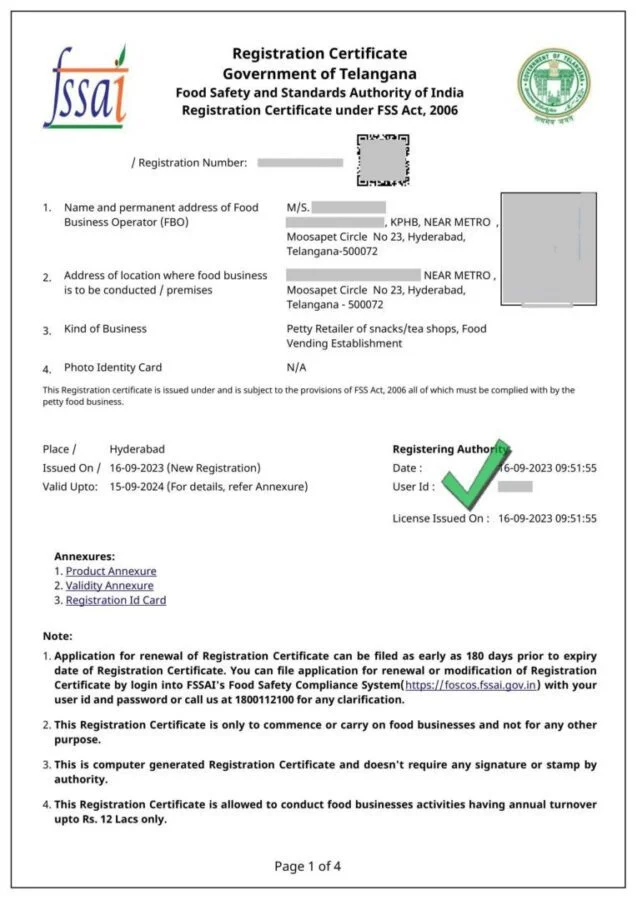
| FSSAI | For food businesses. | The correct registration/licence category depends on the Food Business Operator’s eligibility on FoSCoS. |
| IEC | For import/export activities where IEC is required. | IEC is handled through DGFT, subject to the applicable exemptions and rules. |
| Professional Tax / Labour | Where the state or workforce profile triggers registration. | State law and employee thresholds must be checked. |
| Trademark | For protecting the business name/logo. | A trade name used by a proprietorship is not automatically reserved or protected. |
- Udyam Registration Portal — official Government of India portal for MSME registration.
- GST Portal — official portal for GST registration and compliance.
- FoSCoS — official FSSAI system for food registration/licensing.
- DGFT — official portal for Import Export Code and foreign trade services.
Basic Eligibility and Requirements
There is no incorporation eligibility test similar to a company because a proprietorship is simply a business carried on by an individual. However, the proprietor must be legally capable of carrying on the proposed activity and must satisfy the requirements of the specific registrations or licences being applied for.
- A single individual proprietor with valid identity and tax records.
- A genuine business address supported by acceptable possession or occupancy documents.
- A clearly identified business activity and trade name.
- Required tax, local and sectoral registrations based on actual applicability.
- Banking and payment arrangements that clearly separate business receipts from personal spending as far as practical.
Documents Commonly Required
- PAN card of the proprietor.
- Aadhaar card or other accepted identity/address proof, depending on the application.
- Recent photograph, mobile number and email ID of the proprietor.
- Business address proof such as utility bill, ownership document or rent/lease agreement, as applicable.
- No Objection Certificate from the premises owner where required.
- Nature of business, trade name, commencement details and goods/services information.
- Bank details or cancelled cheque when required by the relevant authority or for post-registration setup.
- Activity-specific documents for FSSAI, IEC, municipal or other sectoral registrations.
The document list can vary significantly by state and by registration. Documents should be internally consistent—especially the legal name, trade name and business address—to reduce clarification notices and delays.
Step-by-Step Sole Proprietorship Setup Process
Step 1 — Decide the business activity and trade name
Choose a simple, distinctive business name and define exactly what the business will do. Before investing in signage, packaging or advertising, check whether the proposed brand conflicts with existing rights.
Step 2 — Check which registrations actually apply
Review turnover, state, customer type, supply pattern, employees, premises and sector. This determines whether GST, Udyam, Shops and Establishment, local trade permission, FSSAI, IEC or another approval is needed.
Step 3 — Prepare identity and premises documents
Keep the proprietor’s identity documents and consistent proof of business address ready. If the premises are rented, obtain the rent/lease document and owner consent where required.
Step 4 — Complete priority registrations
Apply for the registrations that create the documentary identity needed for operations and banking. Where Udyam is appropriate, the government portal provides a free, paperless route. GST Registration should be taken only after a proper applicability check.
Step 5 — Obtain local or sector-specific licences
Food businesses, import/export businesses and locally regulated establishments may require additional permissions before starting or expanding the activity.
Step 6 — Open a current account in the business name
After collecting sufficient evidence of the proprietary concern, approach the bank with proprietor KYC and business/activity documents. RBI KYC rules generally contemplate two business/activity documents, with limited discretion for one document plus verification.
Step 7 — Set up invoicing, bookkeeping and tax compliance
Create a clean invoice format, record expenses and receipts, track tax obligations and preserve supporting documents. Good records make GST, income-tax filing, loans and future conversion much easier.
Step 8 — Protect the brand and plan for growth
If the business name matters commercially, protect it through trademark filing. Review the structure again when liability, funding, employees or scale increase.
How Long Does Sole Proprietorship Registration Take?
There is no single statutory processing time because there is no single proprietorship registration. A simple setup may be completed quickly when only basic registrations are needed, while GST, local establishment registration, FSSAI, IEC, municipal approval or a bank’s KYC review can extend the timeline. The most reliable approach is to run compatible applications in parallel and avoid promising a fixed completion date before the activity and state have been checked.
- Udyam registration is designed as an online, paperless registration process.
- GST timing depends on document verification and whether the officer seeks clarification or physical verification.
- State and municipal licence timelines vary by location.
- Bank current-account opening depends on the bank’s KYC verification and business/activity evidence.
Sole Proprietorship Registration Cost
The cost is usually lower than forming a company or LLP, but there is no universal package that applies to every proprietor. Government charges depend on the licences actually required. Udyam registration itself is free on the official Government of India portal. GST registration does not carry a government application fee, while state, municipal and sectoral licences may have their own fees. Professional charges for eligibility review, documentation, filing, query handling or ongoing compliance are separate.
Opening a Current Account for a Proprietorship
A dedicated current account helps keep business receipts and payments separate from personal transactions and is often requested by customers, payment gateways and lenders. Since there is no incorporation certificate, the bank must verify both the proprietor and the existence/activity of the proprietary concern.
Under RBI KYC guidance, regulated entities generally obtain customer due diligence for the proprietor and business/activity evidence in the name of the proprietary firm. Common evidence can include Udyam registration, GST registration, Shops and Establishment licence, tax returns, IEC, professional licence or qualifying utility bills. In certain cases, the bank may accept one business/activity document with additional verification. The exact account-opening checklist therefore remains bank-specific.
- Keep trade name spelling identical across all registrations.
- Use the same business address across supporting documents unless there is a documented reason for a difference.
- Carry proprietor KYC plus the business/activity documents required by the bank.
- Avoid creating multiple inconsistent registrations just to satisfy banking; use only genuine and applicable records.
Tax and Ongoing Compliance
Business income of a sole proprietorship is generally reported in the proprietor’s own income-tax return. Depending on the facts and eligibility, an individual with business/professional income may use ITR-3 or, where the prescribed conditions are satisfied, ITR-4 under the presumptive scheme. The Income Tax Department publishes current return applicability guidance for individuals with business or professional income.
- Income-tax return filing and advance-tax obligations, where applicable.
- GST returns and invoice compliance after GST registration, where applicable.
- TDS/TAN compliance when the proprietor becomes liable to deduct tax.
- Maintenance of books, invoices, bank records and supporting documents as required by tax law and business needs.
- Renewal or updating of local and sector-specific licences where the relevant law requires it.
For ongoing support, review Vakilkaro’s Proprietorship Compliance service.
For day-to-day accounting records, Vakilkaro also provides Bookkeeping support.
Benefits of a Sole Proprietorship
- Easy to start: no company incorporation, shareholders or board structure is required.
- Complete control: the proprietor can make decisions without partner or shareholder approvals.
- Lower administrative burden: there are no MCA annual filings merely because the business is a proprietorship.
- Flexible operations: suitable for many small trading, consulting, service and professional activities.
- Simple profit ownership: after taxes and obligations, the business profit belongs to the proprietor.
- Straightforward exit: the proprietor can discontinue the business after properly settling liabilities and closing/cancelling the applicable registrations.
Limitations You Should Understand Before Starting
- Unlimited personal liability can expose the proprietor’s personal assets to business claims or debts.
- No separate legal identity means the business is closely dependent on the owner.
- No perpetual succession: continuity can be affected by the death or incapacity of the proprietor.
- Equity investment is difficult because there are no shares to issue to investors.
- Adding a co-owner requires migration to a partnership, LLP or company structure.
- Some large customers, tenders, lenders or regulated activities may prefer or require an incorporated entity.
- The trade name is not protected simply because GST, Udyam or a local licence has been obtained.
Brand Protection for a Proprietorship
A proprietorship can use a trade name, but business registrations do not by themselves grant exclusive ownership of that name. If the brand is commercially important, consider a search and Trademark Registration in the proprietor’s name. The official IP India trademark filing process explains the filing workflow and documentation.
Sole Proprietorship vs Other Business Structures
| Point | Sole Proprietorship | OPC | LLP |
|---|---|---|---|
| Owners | 1 proprietor | 1 member | Minimum 2 partners |
| Legal identity | Not separate from owner | Separate company | Separate LLP |
| Liability | Unlimited | Generally limited | Generally limited |
| MCA incorporation | No | Yes | Yes |
| Equity investment | Not share-based | Limited by single-member structure | Not share-capital based |
| Compliance | Relatively light | Corporate compliance | LLP compliance |
A solo founder who wants limited liability can compare One Person Company (OPC) Registration.
• Businesses with two or more owners can explore Limited Liability Partnership (LLP) Registration or Partnership Firm Registration.
When Should You Move from a Proprietorship to an Incorporated Structure?
- When business liabilities, loans or contractual exposure become significant.
- When a co-founder, investor or employee equity plan is introduced.
- When large enterprise customers require an incorporated vendor.
- When the business needs continuity independent of the owner.
- When the tax, funding or governance benefits of an OPC, LLP or company become more valuable than simplicity.
If DPIIT recognition is important, note that a proprietorship itself is not an eligible Startup India entity. Review Startup India Registration before choosing the structure.
Common Mistakes to Avoid
- Assuming that every proprietorship must buy the same registration package.
- Believing that a GST, Udyam or local certificate creates a separate legal entity.
- Applying for GST without checking whether it is mandatory or commercially useful.
- Using different spellings of the business name or address across applications.
- Ignoring local licences because Udyam or GST has already been obtained.
- Operating a food business without the correct FSSAI registration/licence category.
- Using a valuable business name without trademark protection.
- Mixing personal and business funds so heavily that accounting and tax records become difficult to explain.
- Continuing as a proprietorship even after liability and funding needs clearly justify a different structure.
Why Choose Vakilkaro for Sole Proprietorship Registration?
- Applicability-first approach: we identify the registrations your specific business actually needs.
- Document review before filing to reduce avoidable discrepancies and government queries.
- Support for GST, Udyam, Shops and Establishment, FSSAI, IEC, trade licences and related registrations, as applicable.
- Business-name and trademark support to help protect the brand you are building.
- Current-account documentation planning so the business has a usable compliance trail for banking.
- Ongoing tax, bookkeeping and proprietorship compliance support after setup.
- Structure review when the business grows and needs to move to OPC, LLP, partnership or company form.
- Transparent scope and professional coordination through qualified legal, tax and compliance professionals.