Indian Subsidiary Company Registration is the process of incorporating an Indian company owned or controlled by a foreign parent company. It is usually registered as a Private Limited Company under the Companies Act, 2013, with required directors, foreign investment compliance, FEMA rules, and post-incorporation filings.
Build a Compliant Indian Presence for Your Foreign Business
An Indian subsidiary is suitable where a foreign business wants a long-term commercial presence rather than a limited representative office. The Indian company receives its own CIN, registered office, board, bank account, books of account and statutory filing responsibilities. It can undertake the activities stated in its constitutional documents, subject to licensing and foreign-investment restrictions. Company incorporation is administered through the Ministry of Corporate Affairs.
For many foreign groups, a private limited company is preferred because it offers separate legal identity, limited liability, flexible shareholding and a familiar governance structure. The incorporation is electronic, but foreign ownership adds extra work around legalisation of overseas documents, beneficial ownership, banking and RBI reporting. For the standard Indian private company framework, see Vakilkaro Private Limited Company Registration.

What Is an Indian Subsidiary Company?
A company is a subsidiary where the holding company controls the composition of its Board or exercises or controls more than one-half of the total voting power, directly or with its subsidiaries. A foreign parent may therefore establish a majority-owned or wholly owned Indian subsidiary, subject to Companies Act member requirements and the applicable FDI framework. The governing corporate framework is the Companies Act, 2013.
The Indian subsidiary is a separate Indian legal entity. It signs contracts, employs staff, maintains accounts and pays taxes in its own name. The foreign parent’s exposure is generally connected with its investment and contractual commitments, although guarantees, indemnities or inter-company arrangements can create additional obligations.

Basic Requirements for Indian Subsidiary Registration
- At least two members/shareholders for a private limited company. The foreign parent may be a shareholder, with the second member structured lawfully.
- At least two individual directors, including at least one director who satisfies the statutory stay-in-India requirement.
- A registered office address in India with acceptable address proof and owner/NOC documents where applicable.
- No general minimum paid-up capital for an ordinary private company, unless a sector, licence or business requirement prescribes one.
- The business activity and investor profile must fit the applicable FDI sectoral cap, entry route and conditions.
- Ownership and ultimate beneficial ownership should be mapped before filing because approval or disclosure requirements may depend on the investor chain.
FDI Route, Sectoral Cap and Foreign Ownership Check
Foreign shareholding is governed by the FDI policy, FEMA and the Foreign Exchange Management (Non-Debt Instruments) Rules, as amended. Many sectors permit 100% foreign investment under the automatic route, but some have lower caps, mixed routes, regulatory conditions or prohibitions. The intended business activity must therefore be checked before the shareholding is finalised. Check the current DPIIT Foreign Direct Investment Policy before structuring the investment.
| FDI issue | Practical meaning |
|---|---|
| Automatic route | Prior Central Government approval is generally not required within the permitted cap and conditions, but FEMA, pricing and reporting rules still apply. |
| Government route | Prior approval is required where the sector, ownership profile or applicable policy places the investment under the Government route. |
| Sectoral conditions | Regulated sectors may have caps, licensing conditions or regulator approvals in addition to company incorporation. |
| Investor profile | Land-border and beneficial-ownership situations require a current FDI/FEMA approval check before investment is structured. |
| Prohibited activity | Incorporation cannot be used to undertake an activity in which foreign investment is prohibited. |
Choose the Subsidiary Structure Before Filing
Before filing, decide whether the Indian entity will be wholly owned, majority-owned or a joint venture. The shareholding ratio affects control, governance, future funding, downstream investment and exit planning. Where multiple investors are involved, governance rights may also be documented through tailored Articles and a shareholders’ agreement.
- Wholly owned subsidiary: appropriate where the foreign parent wants full economic control, subject to the FDI and member structure rules.
- Majority-owned/JV subsidiary: useful where an Indian or other strategic partner will hold a minority or negotiated stake.
Company Name and Foreign Parent Brand
Choose a distinctive company name and confirm the right to use the foreign parent’s group name or trademark. Supporting consent, board authorisation or trademark evidence may be required where the Indian company adopts the parent brand. Name approval should ideally be settled before documents are apostilled so avoidable repeat legalisation can be prevented.
For brand protection in India, consider Vakilkaro Trademark Registration.
Documents Required for Indian Subsidiary Registration
A. Foreign Parent Company
- Foreign parent Certificate of Incorporation/registration.
- Charter, Memorandum/Articles, bylaws or equivalent constitutional documents.
- Registered office/address proof of the foreign corporate subscriber.
- Board resolution approving the Indian investment and authorising the signatory.
- Ownership/control and beneficial ownership details required for the filing.
- Name/trademark consent if the group brand is used.
B. Directors and Individual Subscribers
- Passport and recent residential address proof of foreign directors/subscribers.
- PAN/Aadhaar for Indian persons where applicable.
- Digital Signature Certificate for required MCA signatories.
- Email/mobile and particulars needed for director/MCA KYC processes.
- Consent to act and incorporation declarations.
C. Indian Office and Business Details
- Registered office utility bill plus ownership/lease/rent proof and NOC where required.
- Business objects describing the actual Indian activities.
- Authorised/subscribed capital and shareholding details.
- Government or sector approval, if required before investment/incorporation.
Apostille, Notarisation and Consularisation
MCA acceptance of foreign documents depends on proper authentication. The method varies by country: documents may require notarisation, apostille under the Hague Convention, or authentication through the Indian diplomatic/consular channel. Identity proof, foreign company records, board authorisations and subscriber documents executed outside India should therefore be legalised correctly before filing. Non-English documents may also require certified translation. See the MCA SPICe+ and linked-filings FAQs for the attestation approach.
Step-by-Step Indian Subsidiary Registration Process
1. Review business activity and FDI route — Confirm the sectoral cap, automatic/government route, investor restrictions and any sector regulator approval before funds or final ownership commitments.
2. Finalise structure and directors — Freeze the foreign parent/subscriber structure, resident director, other directors, capital, state of registered office and governance plan.
3. Reserve the company name — File name reservation and keep parent consent or trademark support ready where the group name is proposed.
4. Arrange DSC and director particulars — Obtain Digital Signature Certificates for required signatories and prepare DIN/director information for incorporation.
5. Legalise foreign documents — Prepare the parent resolution, corporate documents and KYC in the correct format and complete notarisation/apostille/consularisation.
6. File SPICe+ and linked forms — Submit the incorporation filing with company structure, subscribers, directors, registered office, objects, capital and linked registrations.
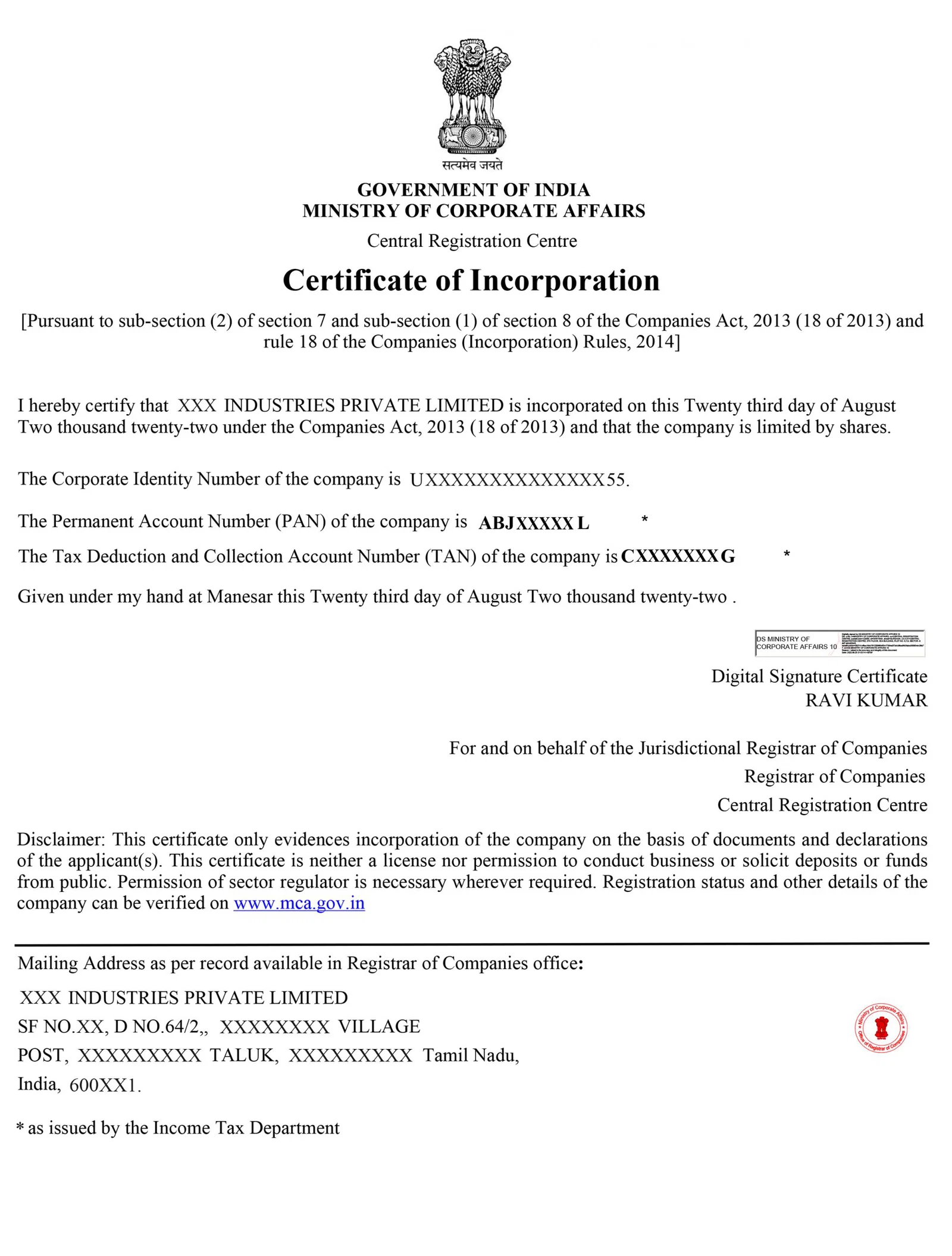
7. Obtain Certificate of Incorporation — Respond to any ROC resubmission. On approval, the company receives the Certificate of Incorporation and CIN with PAN/TAN integration.
8. Open bank account and receive subscription — Complete bank KYC with an Authorised Dealer bank and receive foreign subscription money through permitted banking channels.
9. Complete shares and corporate records — Complete subscription/allotment, share certificates, board records, statutory registers and beneficial ownership records as applicable.
10. Complete FEMA and commencement filings — File foreign investment reporting and the applicable commencement/post-incorporation filings within statutory timelines.
Foreign Subscription Money, Share Issue and FC-GPR
Foreign subscription money should be received through permitted banking channels and match the investor named in the corporate records. Equity instruments are generally required to be issued within 60 days from receipt of consideration; otherwise the applicable refund timeline must be followed. Where the issue is FDI, Form FC-GPR is generally filed within 30 days from the date of issue through RBI FIRMS, with supporting documents and Authorised Dealer bank review. Reporting is made through the RBI FIRMS Portal; the reporting framework is reflected in the RBI foreign-investment notification.
Commencement of Business and Immediate Actions
A company with share capital must also complete commencement-of-business requirements. Subscribers should pay the value of the shares agreed to be taken, and the prescribed declaration must be filed within the applicable period before commencing business or borrowing. The first board meeting, first auditor, share certificates, books and statutory registers should also be completed on time.
Post-Incorporation Compliance
- MCA annual financial statements and annual return filings, statutory audit and proper books/registers.
- Income-tax return, TDS/withholding and other tax obligations.
- Transfer-pricing documentation and Form 3CEB where qualifying international related-party transactions arise.
- GST registration/returns where mandatory or commercially required.
- FEMA/RBI reporting including FC-GPR, relevant FC-TRS filings and annual FLA return where applicable.
- Significant Beneficial Owner/beneficial-interest filings where the ownership chain triggers them.
- Employment, payroll and sector licences according to the business activity and employee base.
Tax and Inter-Company Transactions
An Indian subsidiary is taxed in India as an Indian company under the applicable tax regime. Payments to the foreign parent—such as royalty, technical fees, management charges, interest or dividends—may involve withholding tax, transfer pricing, treaty and FEMA rules. Inter-company arrangements should therefore be supported by agreements, pricing rationale and tax review before recurring cross-border payments begin. Tax filings are made through the Income Tax e-Filing Portal.
GST and Operating Registrations
GST registration depends on the nature of supplies, turnover and compulsory-registration provisions, not simply on foreign ownership. An operating subsidiary may still require GST early for invoicing, input-tax credit and B2B onboarding. Import/export activities may also require an Importer Exporter Code and customs registrations. See Vakilkaro GST Registration or the official GST Portal.
Startup India Recognition
A foreign-owned Indian private limited company can review Startup India/DPIIT recognition if it meets the current entity, age, turnover, innovation and formation conditions. See Vakilkaro Startup India Registration and the official Startup India Portal.
Timeline for Registration
A straightforward foreign-owned incorporation can often be completed in roughly 10–20 working days after complete and correctly legalised documents are available. Apostille/consularisation, name objections, government-route approval, sector licensing, bank KYC or ROC resubmission can extend the timeline. Freezing the name, objects, shareholding and directors before overseas legalisation is the best way to reduce avoidable delay.
Indian Subsidiary Registration Cost
Cost depends on authorised capital, state stamp duty, DSCs, professional work, overseas notarisation/apostille/consularisation, translations, valuation, sector approvals and FEMA reporting. A proper quote should separate government/stamp duty, foreign document legalisation, incorporation work and post-incorporation regulatory support rather than present one fixed price for every foreign subsidiary.
| Cost component | Main driver |
|---|---|
| MCA/stamp duty | Authorised capital and registered-office state. |
| Foreign documents | Notary, apostille/consularisation, translation and courier. |
| Professional work | Structure complexity, objects, subscriber/director documents and resubmission. |
| FDI/FEMA | Route, valuation/pricing, bank KYC and RBI reporting. |
| Sector approvals | Business activity and regulator-specific requirements. |
Indian Subsidiary vs Branch or Liaison Presence
A foreign group should choose the form of Indian presence according to the activities it actually wants to conduct. An incorporated subsidiary is normally preferred where the business will sell, employ, contract and operate locally. Branch and liaison structures are different regulatory concepts and may have narrower permitted activities or separate approval requirements. The comparison below is only a planning guide; the correct structure depends on the proposed activity and the rules in force.
| Point | Indian subsidiary | Branch/Liaison style presence |
|---|---|---|
| Legal form | Separate Indian company incorporated under the Companies Act. | Extension/office of the foreign entity rather than a separate Indian company. |
| Commercial activity | Can undertake permitted business stated in its objects, subject to licences and FDI rules. | Permitted scope depends on the type of office and applicable foreign-exchange rules. |
| Ownership | Shares are held by the foreign parent and/or other members. | No Indian share capital structure in the same manner as a subsidiary. |
| Compliance | MCA, tax, FEMA and sector compliance as an Indian company. | Office-specific RBI/FEMA, tax and other compliance may apply. |
Shareholding, Beneficial Ownership and Control
The legal shareholder shown in the Indian company records may be only one layer of the ownership chain. For foreign corporate investors, the company should identify the entities and individuals that ultimately own or control the investment and keep supporting ownership information ready. Companies Act beneficial-interest and Significant Beneficial Owner provisions may require declarations or filings where the statutory tests are met. The ownership analysis also matters for FDI approval questions, bank KYC and ongoing changes in the foreign parent group. A later share transfer, restructuring or change in ultimate ownership should therefore be reviewed before it is implemented, not only after the transaction is completed.
Banking and First-Year Compliance Planning
Bank onboarding can be as important as incorporation for a foreign-owned company. The bank may ask for the foreign parent's KYC, ownership chart, board resolution, incorporation documents, business model and expected transaction profile before accepting or processing investment funds. Keep the remittance evidence and bank advice with the share-allotment file. During the first financial year, maintain a compliance calendar covering board meetings, statutory registers, auditor matters, tax/TDS, GST if applicable, RBI/FEMA returns and MCA annual filings. Good first-year records make later due diligence, audit, fundraising and dividend or cross-border payment processes significantly easier.
Common Mistakes to Avoid
1. Assuming every sector permits 100% foreign ownership automatically.
2. Apostilling documents before the name, shareholding and signatory are final.
3. Parent resolution does not clearly approve the Indian investment or signatory.
4. Ignoring beneficial ownership or approval issues until after funds are remitted.
5. Receiving money with remitter details that do not match the investment records.
6. Missing share-issue, FC-GPR or commencement timelines.
7. Treating the Certificate of Incorporation as the end of the compliance process.
8. Treating the Certificate of Incorporation as the end of the compliance process.
Why Choose Vakilkaro?
Indian subsidiary registration requires coordination across company law, foreign investment, banking, tax and overseas document legalisation. Vakilkaro organises these steps as one structured engagement so the foreign parent can move from incorporation to investment and compliant operations without managing each filing separately.
- Pre-incorporation FDI route and shareholding review.
- Country-specific foreign parent/director document checklist.
- Apostille/notarisation/consularisation guidance before signing.
- Name reservation, objects, SPICe+ and linked MCA filings.
- Resident-director and foreign-director document coordination.
- Post-incorporation share, commencement and FEMA reporting support.
- GST, trademark, Startup India and ongoing compliance assistance where relevant.
Start Your Indian Subsidiary Registration
Planning to establish an Indian subsidiary? Share the parent-company country, proposed Indian activity, expected foreign shareholding and preferred registered-office state with Vakilkaro. We can map the document set, FDI route and post-registration actions before overseas legalisation begins. Contact Vakilkaro to begin with a document and FDI-route review.