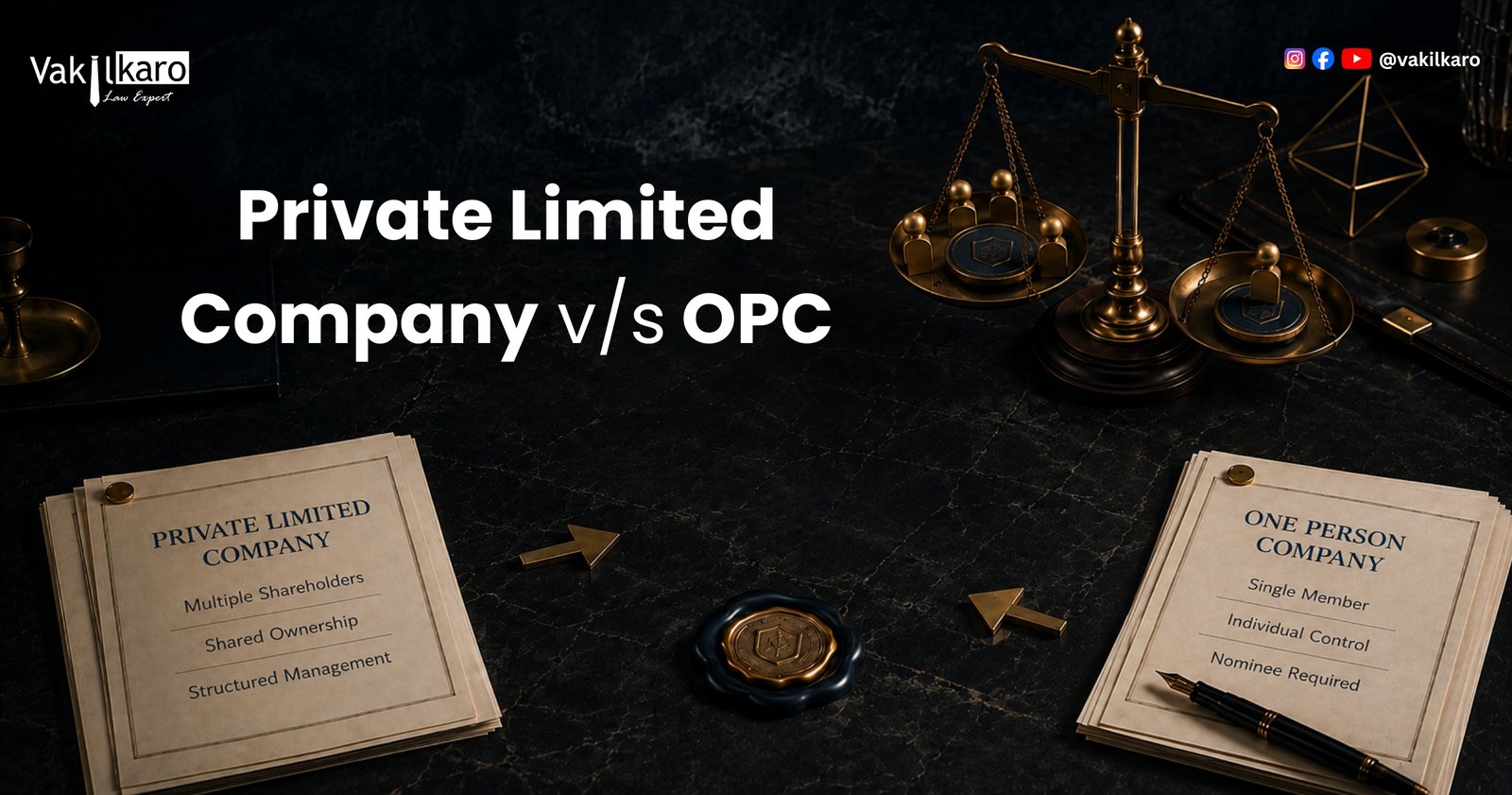
Both a Private Limited Company and a One Person Company (OPC) are recognised as separate legal entities under the Companies Act, 2013 and provide limited liability protection. The primary difference lies in ownership and future scalability. An OPC is designed for a single entrepreneur who wishes to own and manage the business independently, whereas a Private Limited Company is generally more suitable for businesses planning external investment, multiple shareholders, co-founders and long-term expansion. The appropriate structure depends on the founder's business objectives rather than simply the number of owners.
The most common mistake founders make is selecting an OPC simply because they are currently the only owner. The better question is: "Will I remain the only owner for the next five years?" If the answer is No, and the business plans to onboard co-founders, investors or employees through equity participation, a Private Limited Company may provide a more suitable long-term legal framework.
Current ownership should not be the only deciding factor. Future ownership plans are often more important than present ownership.
If the founder expects institutional investment in the future, beginning with a Private Limited Company may reduce the need for structural changes later.
The industry alone should never determine the legal structure. Two founders operating in the same industry may require completely different legal structures depending upon:
Comparison Summary Table
| Parameter | Private Limited Company | One Person Company (OPC) |
|---|---|---|
| Governing Law | Companies Act, 2013 | Companies Act, 2013 |
| Separate Legal Entity | ✔ | ✔ |
| Minimum Owners | Two Shareholders | One Shareholder |
| Liability | Limited | Limited |
| Ownership | Shareholders | Single Shareholder |
| Management | Directors | Director(s) as permitted under law |
| Equity Investment | Excellent | Limited in comparison |
| Venture Capital | Commonly Preferred | Generally Less Preferred |
| Governance | Structured | Comparatively Simpler |
| Best Suited For | Growth-Oriented Businesses | Solo Entrepreneurs |
Key Highlights
- Both Structures Provide Limited Liability
- Both Have Separate Legal Identity
- OPC is Designed for Single Founders
- Private Limited Company Supports Equity Funding
- Private Limited Company is Better Suited for Multiple Shareholders
- OPC Offers Complete Initial Ownership
- Governance Structures Differ
- Funding Opportunities Differ
- Scalability Should Influence the Decision
- Long-Term Vision Matters More Than Initial Convenience
Introduction
Entrepreneurs often believe that the legal structure should be selected according to the current size of the business. In reality, the better approach is to choose a structure that supports the future direction of the company.
For example, a solo software developer may initially be the only owner but may later invite co-founders, employees with ESOPs or external investors. On the other hand, a professional consultant may intend to remain the sole owner throughout the life of the business.
These two founders require different legal structures despite both starting alone.
This is why the comparison between a Private Limited Company and an OPC is not simply about the number of shareholders. It is about:
- Future Ownership
- Business Growth
- Investment Plans
- Corporate Governance
- Scalability
- Business Vision
Understanding these factors helps founders avoid unnecessary restructuring later.
What is a Private Limited Company?
A Private Limited Company is a company incorporated under the Companies Act, 2013 with ownership represented through shares.
It is commonly chosen by businesses that intend to:
- Raise Angel Investment
- Raise Venture Capital
- Add Co-founders
- Build Enterprise Value
- Expand Nationally or Internationally
- Introduce ESOPs
The company operates through a structured governance framework involving shareholders and directors.
Typical features include:
- Separate Legal Entity
- Limited Liability
- Share-Based Ownership
- Perpetual Succession
- Corporate Governance
- Investment Readiness
What is a One Person Company (OPC)?
A One Person Company (OPC) is a form of company incorporated under the Companies Act, 2013 that allows a single entrepreneur to operate through a corporate structure.
An OPC combines:
- Separate Legal Entity
- Limited Liability
- Corporate Identity
with the convenience of single ownership.
It is commonly selected by:
- Solo Entrepreneurs
- Freelancers Building a Company
- Independent Consultants
- Small Business Owners
- Individual Professionals
who wish to enjoy the benefits of incorporation without introducing additional shareholders at the initial stage.
An OPC also requires compliance with the applicable provisions of the Companies Act and should not be viewed as a substitute for long-term investment planning where multiple shareholders are expected.
Detailed Comparison: Private Limited Company vs One Person Company (OPC)
Both a Private Limited Company and a One Person Company (OPC) are incorporated under the Companies Act, 2013 and provide limited liability along with a separate legal identity. However, they differ significantly in ownership structure, scalability, governance, fundraising capability and long-term business flexibility.
The following comparison explains these differences from the perspective of entrepreneurs planning different types of businesses.
1. Governing Law
| Private Limited Company | One Person Company (OPC) |
|---|---|
| Companies Act, 2013 | Companies Act, 2013 |
Both structures are governed by the same legislation.
However, separate provisions apply to OPCs because they are designed specifically for single entrepreneurs.
2. Separate Legal Entity
| Private Limited Company | OPC |
|---|---|
| ✔ Separate Legal Entity | ✔ Separate Legal Entity |
Both structures exist independently of their owners.
This enables them to:
- Own assets
- Enter contracts
- Sue or be sued
- Continue irrespective of changes affecting the owner, subject to applicable law
3. Ownership
| Private Limited Company | OPC |
|---|---|
| Multiple Shareholders | Single Shareholder |
This is the most significant distinction.
A Private Limited Company is designed for businesses involving multiple owners or future shareholders.
An OPC is designed for a single entrepreneur who wishes to own the company independently.
4. Management Structure
| Private Limited Company | OPC |
|---|---|
| Managed by Directors | Managed according to the Companies Act applicable to OPCs |
Private Limited Companies generally separate ownership and management.
In an OPC, the sole member often plays an active management role.
5. Liability
| Private Limited Company | OPC |
|---|---|
| Limited Liability | Limited Liability |
Both structures generally protect personal assets from ordinary business liabilities, subject to the applicable legal framework.
6. Compliance Framework
| Private Limited Company | OPC |
|---|---|
| More structured corporate compliance | Comparatively simpler corporate compliance |
Companies generally maintain:
- Board Governance
- Shareholder Governance
- Corporate Records
- Statutory Registers
An OPC also remains subject to statutory compliance but is designed with comparatively simplified governance for single ownership.
Vakilkaro Recommendation
Founders should never choose an OPC solely because compliance appears simpler.
The structure should support the long-term business strategy.
7. Taxation Framework
Both structures remain subject to the applicable taxation laws.
Taxation depends upon:
- Applicable Tax Provisions
- Nature of Business
- Regulatory Framework
rather than merely the type of company.
Therefore, founders should avoid selecting either structure solely on perceived tax advantages.
8. Funding Capability
| Private Limited Company | OPC |
|---|---|
| Excellent | Limited in comparison |
A Private Limited Company generally provides greater flexibility for:
- Angel Investment
- Venture Capital
- Strategic Investment
- Equity Funding
An OPC is designed primarily for single ownership and is generally less suitable for businesses expecting multiple equity investors.
9. Angel Investment
| Private Limited Company | OPC |
|---|---|
| Commonly Preferred | Limited Practical Use |
Angel investors typically prefer businesses where equity participation and future shareholding expansion are easier to structure.
10. Venture Capital
| Private Limited Company | OPC |
|---|---|
| Strongly Preferred | Generally Less Preferred |
Venture Capital investors usually expect:
- Multiple Shareholders
- ESOP Capability
- Structured Governance
- Equity Flexibility
Private Limited Companies generally provide a more suitable framework.
11. Employee Stock Option Plans (ESOP)
| Private Limited Company | OPC |
|---|---|
| Suitable | Limited Practical Application |
Fast-growing startups often use ESOPs to attract and retain employees.
Private Limited Companies generally provide a more practical framework for equity-based employee incentive programmes.
12. Ownership Transfer
| Private Limited Company | OPC |
|---|---|
| Share Transfer Framework | Ownership changes often require broader structural consideration |
Companies provide greater flexibility for introducing additional shareholders.
OPCs are designed around single ownership.
13. Nominee Requirement
| Private Limited Company | OPC |
|---|---|
| No statutory nominee requirement for ownership | Nominee concept applicable under the OPC framework |
The nominee mechanism is one of the distinguishing features of an OPC.
14. Perpetual Succession
| Private Limited Company | OPC |
|---|---|
| ✔ Available | ✔ Available |
Both structures possess continuity as separate legal entities under the applicable legal framework.
15. Corporate Governance
| Private Limited Company | OPC |
|---|---|
| Structured Governance | Comparatively Simpler Governance |
Businesses expecting:
- Investors
- Independent Directors
- Professional Management
often prefer the structured governance framework available to Private Limited Companies.
16. Banking & Institutional Finance
Both structures may establish corporate banking relationships.
However, businesses planning larger institutional funding often benefit from the governance and ownership flexibility available in a Private Limited Company.
17. Startup India Suitability
Both eligible structures may evaluate Startup India Recognition.
However, startups planning rapid scaling and institutional investment often prefer the Private Limited Company structure.
18. MSME Registration
Eligible businesses under both structures may evaluate MSME (Udyam) Registration independently.
The availability of MSME Registration is not determined solely by whether the business is a Private Limited Company or an OPC.
19. International Expansion
Businesses planning:
- Foreign Investment
- International Partnerships
- Global Expansion
often prefer a Private Limited Company because of its greater flexibility for ownership restructuring and institutional investment.
Comparison Summary
| Parameter | Private Limited Company | OPC |
|---|---|---|
| Separate Legal Entity | ✔ | ✔ |
| Limited Liability | ✔ | ✔ |
| Multiple Owners | ✔ | ✘ |
| Equity Funding | Excellent | Limited |
| Venture Capital | Preferred | Less Preferred |
| ESOP | Suitable | Limited |
| Governance | Structured | Simpler |
| Scalability | High | Moderate |
| Startup Suitability | Excellent | Suitable for Solo Founders |
| Best For | Growth-Oriented Businesses | Single Entrepreneur Businesses |
Vakilkaro Recommendation
Choose a Private Limited Company if your long-term objective includes:
- Multiple Shareholders
- Angel Investment
- Venture Capital
- ESOP
- National Expansion
- Enterprise Building
Choose an OPC if you:
- Are the only founder.
- Prefer complete ownership.
- Do not currently require equity investment.
- Want to begin with a corporate structure while operating independently.
The correct choice should always reflect where the business is going—not only where it is today.
Which Structure is Better for Different Businesses?
Solo Entrepreneur
Recommended Structure
- One Person Company (OPC)
If you:
- Want complete ownership.
- Do not currently require partners.
- Want a corporate identity.
- Prefer to manage the business independently.
an OPC is often a practical starting point.
However, founders expecting rapid expansion should also evaluate a Private Limited Company before incorporating.
Technology Startup
Recommended Structure
- Private Limited Company
Technology startups commonly require:
- Angel Investment
- Venture Capital
- ESOP
- Multiple Founders
- Enterprise Scaling
A Private Limited Company generally provides the governance and ownership flexibility expected by institutional investors.
SaaS Company
Recommended Structure
- Private Limited Company
Software businesses often require:
- International Expansion
- Investor Participation
- Intellectual Property Ownership
- Equity-Based Hiring
Private Limited Companies are generally better suited for these objectives.
D2C Brand
Recommended Structure
- Private Limited Company
Consumer brands typically focus on:
- Trademark Protection
- National Expansion
- Marketplace Growth
- Investor Funding
As the business scales, structured ownership becomes increasingly important.
Manufacturing Business
Recommended Structure
- Private Limited Company
Manufacturing businesses planning:
- Bank Finance
- Institutional Customers
- Export Operations
- Multiple Plants
generally benefit from the governance structure of a company.
Very small owner-managed manufacturing businesses may initially evaluate an OPC if expansion is not an immediate objective.
Consultants
Recommended Structure
- OPC
Independent consultants who:
- Work alone.
- Do not expect investors.
- Prefer complete ownership.
often find an OPC appropriate during the early stages.
Where additional partners or large-scale expansion become likely, founders may later evaluate a Private Limited Company.
Marketing Agencies
Recommended Structure
Depends on Growth Vision
If the agency intends to remain founder-driven:
→ OPC may be suitable.
If the agency plans:
- Multiple Founders
- Equity Investment
- ESOP
- National Expansion
→ Private Limited Company generally provides greater flexibility.
Export Business
Recommended Structure
- Private Limited Company
Businesses planning:
- IEC Registration
- International Buyers
- Overseas Expansion
- Institutional Banking
often benefit from the corporate governance associated with a Private Limited Company.
- Ownership Plans
- Funding Goals
- Growth Strategy
- Long-Term Vision
Which Business Structure is Better?
One of the most common questions asked by entrepreneurs is:
"Should I register an OPC or a Private Limited Company?"
The answer depends entirely on the type of business you intend to build.
An entrepreneur planning to remain the sole owner of a consultancy has very different requirements from a founder building a technology startup with plans to raise venture capital.
Instead of asking:
"Which structure is better?"
Founders should ask:
"Which structure supports my business over the next five to ten years?"
The legal structure should support future growth—not merely today's ownership.
Founder Decision Framework
Before selecting a legal structure, founders should evaluate the following questions.
Ownership
- Will I remain the only owner?
- Will co-founders join later?
- Will investors receive equity?
If ownership is expected to expand, a Private Limited Company generally provides greater flexibility.
Funding
- Will Angel Investors participate?
- Will Venture Capital be required?
- Will ESOP be introduced?
If Yes, a Private Limited Company is generally more suitable.
Governance
- Will professional management be introduced?
- Will Board Governance become important?
- Will institutional investors participate?
If Yes, structured corporate governance becomes valuable.
Business Growth
- Will the business scale nationally?
- Will international expansion occur?
- Will multiple teams be created?
If Yes, founders should evaluate whether a Private Limited Company better supports those objectives.
Founder Preference
- Do you prefer complete ownership?
- Do you intend to operate independently?
- Is external investment unlikely?
If Yes, an OPC may be a practical starting structure.
Business Growth Matrix
| Business Stage | Recommended Structure |
|---|---|
| Solo Entrepreneur | OPC |
| Early Startup with One Founder | OPC or Private Limited (depending on growth plans) |
| Startup Seeking Investment | Private Limited Company |
| Technology Business | Private Limited Company |
| Manufacturing Expansion | Private Limited Company |
| Export Business | Private Limited Company |
| Independent Consultant | OPC |
Founder Decision Tree
Single Founder?
│
Yes
│
Need External Investment Soon?
│
Yes ─────────► Private Limited Company
│
No
│
Need Complete Ownership?
│
Yes ─────────► OPC
│
No
│
Planning National / International Expansion?
│
Yes ─────────► Private Limited Company
│
No ─────────► OPC
Decision Matrix
| Business Goal | Recommended Structure |
|---|---|
| Solo Founder Business | OPC |
| Angel Investment | Private Limited Company |
| Venture Capital | Private Limited Company |
| ESOP | Private Limited Company |
| Complete Ownership | OPC |
| Startup Growth | Private Limited Company |
| Independent Consultancy | OPC |
| National Expansion | Private Limited Company |
| Enterprise Building | Private Limited Company |
| Long-Term Investment Readiness | Private Limited Company |
Vakilkaro Recommendation
Choose an OPC if you:
- Want to start independently.
- Prefer complete ownership.
- Do not currently require investors.
- Want the benefits of a company while operating alone.
Choose a Private Limited Company if you:
- Expect co-founders.
- Plan to raise investment.
- Want to issue ESOPs.
- Intend to scale nationally or internationally.
- Aim to build long-term enterprise value.
The right structure is the one that supports your future business vision, not simply your present ownership structure.
Common Myths About Private Limited Company and OPC
Many first-time entrepreneurs compare a Private Limited Company and an OPC based only on the number of owners. However, the real differences relate to long-term business strategy, scalability, investment readiness and governance.
The following misconceptions often result in founders selecting a structure that no longer suits their business after a few years.
Myth 1 – OPC is Always Better Because It Has Only One Owner
Reality:
An OPC is designed for entrepreneurs who intend to operate independently.
However, founders expecting:
- Co-founders
- Angel Investors
- Venture Capital
- ESOP
- Rapid Expansion
often find a Private Limited Company more suitable.
The choice should depend on future business plans rather than present ownership.
Myth 2 – Private Limited Companies Are Only for Large Businesses
Reality:
Many startups incorporate as Private Limited Companies from the beginning because they intend to:
- Raise Investment
- Build Scalable Products
- Protect Intellectual Property
- Create Enterprise Value
Business size alone should not determine the legal structure.
Myth 3 – OPC Cannot Become a Large Business
Reality:
An OPC can successfully operate and grow.
However, businesses planning significant expansion or multiple shareholders may eventually evaluate structural changes where permitted under the applicable legal framework.
Myth 4 – Private Limited Company Has Too Much Compliance
Reality:
A Private Limited Company generally has a more structured compliance framework than an OPC.
However, this governance structure is often one of the reasons why investors and institutional stakeholders prefer companies for scalable businesses.
Myth 5 – Investors Can Easily Invest in an OPC
Reality:
Professional equity investors generally prefer businesses with share-based ownership structures capable of accommodating future investment rounds.
Private Limited Companies are commonly structured with this objective in mind.
Myth 6 – One Founder Should Always Choose an OPC
Reality:
A founder planning to remain the sole owner may find an OPC appropriate.
However, if the founder expects:
- Investment
- Additional Shareholders
- ESOP
- Enterprise Scaling
a Private Limited Company may provide a stronger long-term framework.
Myth 7 – Company Registration Automatically Makes the Business Investment Ready
Reality:
Investment readiness requires much more than incorporation.
Businesses should also organise:
- Financial Records
- Corporate Governance
- Intellectual Property
- Compliance
- Shareholding Documentation
Myth 8 – OPC Does Not Require Compliance
Reality:
An OPC is also governed by the Companies Act and remains subject to applicable statutory requirements.
Although governance may be comparatively simpler than a Private Limited Company, compliance responsibilities continue.
Myth 9 – Taxation Alone Should Decide the Structure
Reality:
Taxation is only one factor.
Founders should also evaluate:
- Ownership
- Funding
- Governance
- Scalability
- Long-Term Vision
before selecting the legal structure.
Myth 10 – Changing the Structure Later is Always Simple
Reality:
Although legal restructuring may be possible under the applicable framework, unnecessary restructuring often increases administrative effort.
Choosing the appropriate structure at the beginning usually supports smoother long-term growth.
Vakilkaro Expert Insights
Insight 1
The legal structure should support where the business will be after five years—not merely where it is today.
Insight 2
Single ownership today does not necessarily mean single ownership forever.
Founders expecting investment should evaluate future ownership before incorporation.
Insight 3
Professional investors generally value structured governance, organised documentation and scalable ownership models.
Insight 4
Compliance should be viewed as an investment in governance rather than simply an administrative responsibility.
Insight 5
The strongest businesses choose legal structures that minimise future restructuring while supporting long-term commercial objectives.
Real Business Examples
Case Study 1 – Solo Technology Founder
Background
A software developer launched a SaaS platform as the sole founder.
Challenge
Initially, an OPC appeared suitable because there was only one owner.
Vakilkaro Recommendation
After reviewing the business plan, which included angel investment and future co-founders, a Private Limited Company was recommended.
Outcome
The founder established a structure aligned with future fundraising.
Learning
Future ownership should influence today's legal structure.
Case Study 2 – Independent Consultant
Background
A management consultant wanted to establish a corporate identity while retaining complete ownership.
Challenge
The business had no immediate plans for investors or expansion.
Vakilkaro Recommendation
An OPC was recommended because it matched the founder's ownership preference and operational objectives.
Outcome
The entrepreneur obtained corporate status while maintaining single ownership.
Learning
Not every business requires a multi-shareholder structure.
Case Study 3 – Growing D2C Brand
Background
A solo founder launched a consumer products brand through an OPC.
Challenge
As the business expanded, discussions began with strategic investors and additional founders.
Vakilkaro Recommendation
The founder reviewed the business structure in light of changing commercial objectives and evaluated the appropriate corporate framework for future growth.
Learning
Business structures should evolve with long-term strategy rather than remain based solely on the initial stage of the business.
Frequently asked questions
Which is better: Private Limited Company or OPC?+
Neither is universally better. The appropriate structure depends on ownership plans, funding strategy and long-term business objectives.
Can one person own a Private Limited Company?+
A Private Limited Company is subject to the ownership requirements prescribed under the Companies Act, 2013. Entrepreneurs seeking a single-owner company may evaluate an OPC where eligible.
Is OPC suitable for startups?+
An OPC may suit certain solo founders. Startups expecting investment often evaluate a Private Limited Company.
Which structure is preferred by investors?+
Private Limited Companies are generally preferred for equity investment because of their share-based ownership structure.
Can an OPC receive investment?+
Businesses should evaluate the applicable legal framework and future ownership implications before planning external equity participation.
Is compliance lower in an OPC?+
An OPC generally has comparatively simpler governance than a Private Limited Company, although statutory compliance remains applicable.
Can Vakilkaro help decide the right structure?+
Yes. Vakilkaro evaluates your business model, ownership plans, funding objectives and long-term strategy before recommending the most appropriate structure.
Which structure is better for a technology startup?+
Businesses planning institutional investment commonly evaluate a Private Limited Company.
Which structure is better for an individual consultant?+
Depending on the founder's objectives, an OPC may be an appropriate option for a solo entrepreneur seeking corporate status.
What is the biggest mistake founders make?+
Choosing a legal structure based only on the current number of owners instead of the future direction of the business.
Final Recommendation+
Choose an OPC if you: Want to remain the sole owner. Prefer complete ownership and control. Do not currently require equity investment. Want a corporate identity with comparatively simpler governance. Choose a Private Limited Company if you: Plan to onboard co-founders. Intend to raise angel or venture capital. Want to issue ESOPs. Expect rapid business expansion. Aim to build long-term enterprise value. The best legal structure is the one that supports your future business vision, not merely your present ownership position.
Why Choose Vakilkaro?+
Vakilkaro helps founders make informed structural decisions before registration. Our advisory includes: Business Structure Evaluation Private Limited Company Registration OPC Registration Startup Structuring Funding Readiness Corporate Governance Planning Compliance Strategy Business Growth Advisory We recommend the legal structure that best supports your long-term commercial goals rather than applying the same solution to every business.