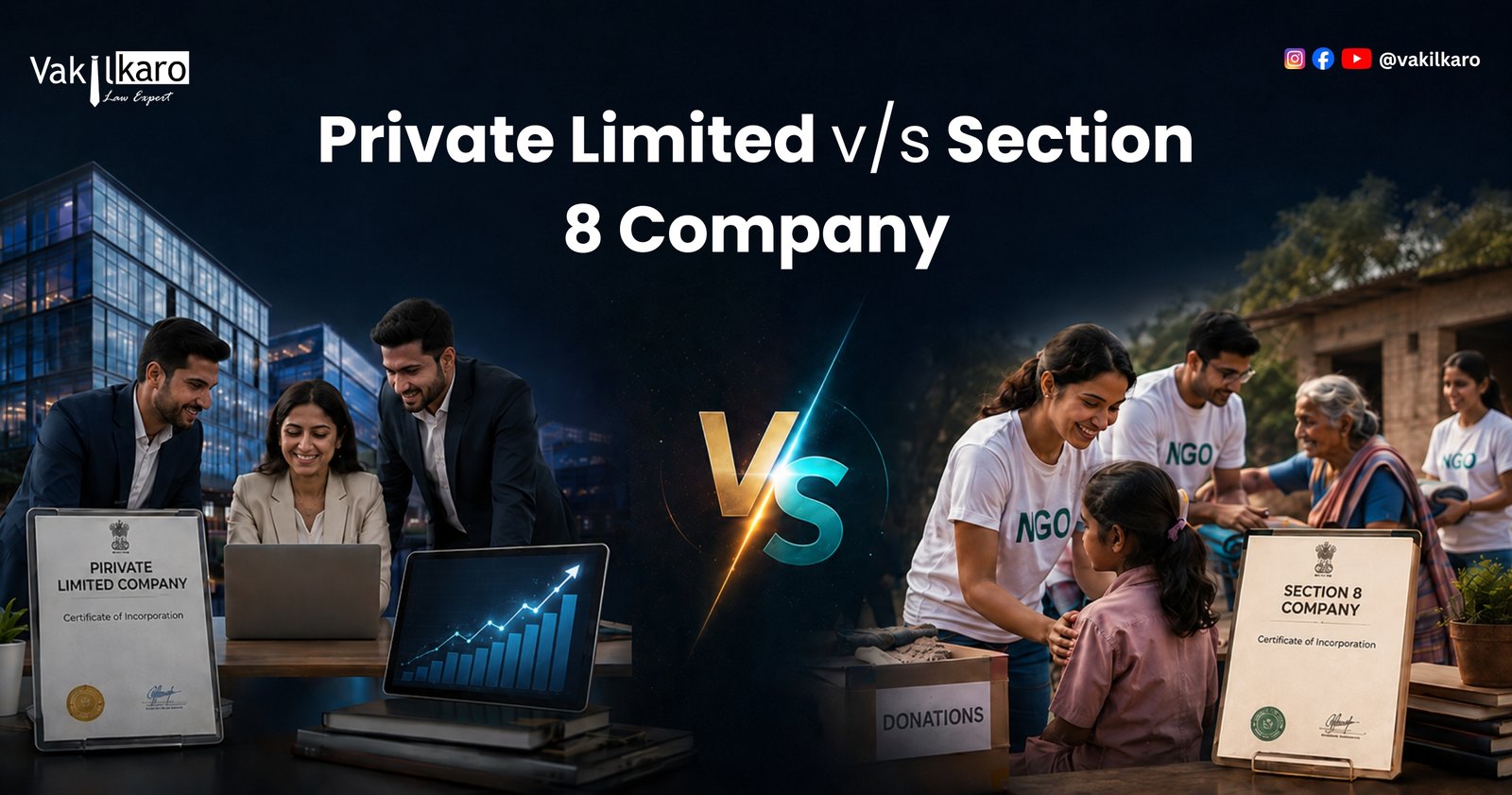
A Private Limited Company and a Section 8 Company are both incorporated under the Companies Act, 2013, but they are created for different purposes. A Private Limited Company is generally established to conduct commercial activities and generate profits for shareholders, whereas a Section 8 Company is formed to promote charitable or socially beneficial objectives. A Section 8 Company does not distribute its income to members and instead applies it towards its stated objectives. The correct structure depends primarily on whether the organisation is being created for commercial profit or public benefit.
The most common misconception is: "A Section 8 Company is simply a cheaper alternative to a Private Limited Company." This is incorrect. The real difference is purpose.
Founders should decide the legal structure only after clearly identifying the organisation's purpose. The legal framework should always follow the mission.
Investment and donation are fundamentally different. Investors generally expect commercial returns. Donors generally expect social impact.
Not every organisation working for social impact should automatically become a Section 8 Company. The deciding factor is how the organisation intends to operate and use its income, not merely the industry in which it works.
Comparison Summary Table
| Parameter | Private Limited Company | Section 8 Company |
|---|---|---|
| Primary Objective | Commercial Business | Charitable / Non-Profit Objectives |
| Governing Law | Companies Act, 2013 | Companies Act, 2013 |
| Separate Legal Entity | ✔ | ✔ |
| Limited Liability | ✔ | ✔ |
| Owners | Shareholders | Members |
| Management | Directors | Directors |
| Profit Distribution | Permitted subject to applicable law | Income applied to organisational objectives; profit distribution is not permitted under the applicable framework |
| Equity Investment | Suitable | Generally Not Applicable |
| Best Suited For | Startups & Commercial Businesses | NGOs & Mission-Driven Organisations |
Key Highlights
- Both Structures Have Separate Legal Identity
- Both Provide Limited Liability
- Commercial Purpose vs Charitable Purpose
- Different Funding Models
- Different Profit Utilisation Framework
- Different Long-Term Objectives
- Different Governance Priorities
- Section 8 is a Non-Profit Structure
- Private Limited Company is Designed for Business Growth
- Founder's Objective Should Determine the Choice
Introduction
One of the biggest mistakes made by first-time founders is comparing a Section 8 Company with a Private Limited Company solely on the basis of registration requirements. Although both are incorporated under the Companies Act, they exist to fulfil entirely different organisational purposes.
A startup developing software, manufacturing products or providing commercial services generally aims to generate profits, attract investors and expand into larger markets. Such businesses require a structure capable of supporting equity investment, corporate governance and enterprise growth.
In contrast, organisations working to promote education, healthcare, environmental protection, social welfare, research or other charitable objectives generally require a structure that ensures income is used to further those objectives rather than being distributed to members.
The comparison between a Private Limited Company and a Section 8 Company should therefore begin with one simple question:
"Is the primary objective to earn profits for owners or to advance a charitable or public-benefit purpose?"
Answering this question correctly usually makes the choice of legal structure much clearer.
What is a Private Limited Company?
A Private Limited Company is a company incorporated under the Companies Act, 2013 to carry on lawful commercial activities.
Ownership is represented through shares, allowing businesses to:
- Raise Equity Investment
- Add Shareholders
- Build Enterprise Value
- Expand Nationally and Internationally
- Establish Structured Corporate Governance
Private Limited Companies are commonly used by:
- Technology Startups
- Manufacturing Businesses
- D2C Brands
- Healthcare Companies
- Export Businesses
- Professional Service Companies
Typical characteristics include:
- Separate Legal Entity
- Limited Liability
- Share-Based Ownership
- Perpetual Succession
- Corporate Governance
- Commercial Profit Objective
What is a Section 8 Company?
A Section 8 Company is a company incorporated under the Companies Act, 2013 for promoting charitable or socially beneficial objectives.
It is established for purposes such as:
- Education
- Healthcare
- Social Welfare
- Environmental Protection
- Scientific Research
- Arts & Culture
- Sports Promotion
- Other permitted non-profit objectives
Unlike a commercial company, a Section 8 Company is not formed to distribute profits among its members. Income generated by the organisation is generally applied towards advancing its stated objects in accordance with the applicable legal framework.
Typical characteristics include:
- Separate Legal Entity
- Limited Liability
- Member-Based Organisation
- Non-Profit Objective
- Structured Governance
- Income Applied to Organisational Purpose
If your goal is to build a commercial business, a Private Limited Company is generally the appropriate structure.
If your goal is to create a mission-driven organisation working for charitable or public-benefit objectives, a Section 8 Company is generally the more appropriate legal framework.
Detailed Comparison: Private Limited Company vs Section 8 Company
Although both a Private Limited Company and a Section 8 Company are incorporated under the Companies Act, 2013, they exist for fundamentally different purposes.
A Private Limited Company is established to carry on commercial business and generate profits for its shareholders.
A Section 8 Company is established to promote charitable, educational, scientific, social, environmental or other approved non-profit objectives.
Understanding this distinction is essential before choosing either structure.
1. Governing Law
| Private Limited Company | Section 8 Company |
|---|---|
| Companies Act, 2013 | Companies Act, 2013 (Section 8 provisions) |
Both entities are governed by the Companies Act.
However, Section 8 Companies are subject to specific provisions relating to their non-profit character.
2. Primary Objective
| Private Limited Company | Section 8 Company |
|---|---|
| Commercial Profit | Charitable / Non-Profit Purpose |
This is the single most important difference.
Private Limited Companies are generally established to:
- Conduct Business
- Generate Profits
- Create Shareholder Value
Section 8 Companies are established to:
- Promote Social Welfare
- Support Education
- Advance Healthcare
- Encourage Research
- Protect the Environment
- Promote Arts, Sports or other permitted charitable objectives
3. Separate Legal Entity
| Private Limited Company | Section 8 Company |
|---|---|
| ✔ Separate Legal Entity | ✔ Separate Legal Entity |
Both structures exist independently from their members.
This allows them to:
- Own Property
- Enter Contracts
- Sue and Be Sued
- Continue Independent of Membership Changes
4. Ownership Structure
| Private Limited Company | Section 8 Company |
|---|---|
| Shareholders | Members |
Private Limited Companies are owned through shares.
Section 8 Companies are generally organised around members rather than shareholders seeking commercial returns.
5. Profit Distribution
| Private Limited Company | Section 8 Company |
|---|---|
| Profit may be distributed to shareholders subject to applicable law | Income is generally applied towards the company's stated charitable objects and is not distributed among members |
This is one of the defining characteristics of a Section 8 Company.
The objective is public benefit rather than shareholder profit.
Vakilkaro Recommendation
If the founder intends to distribute business profits to owners, a Private Limited Company is generally more appropriate.
If the objective is to reinvest income into charitable activities, a Section 8 Company is generally the appropriate framework.
6. Members and Directors
| Private Limited Company | Section 8 Company |
|---|---|
| Shareholders and Directors | Members and Directors |
Both entities are managed through directors.
However, the underlying purpose and governance philosophy differ significantly.
7. Liability
| Private Limited Company | Section 8 Company |
|---|---|
| Generally Limited Liability | Generally Limited Liability |
Both structures generally provide limited liability to their members, subject to the applicable legal framework.
8. Compliance Framework
| Private Limited Company | Section 8 Company |
|---|---|
| Corporate compliance for commercial companies | Corporate compliance together with additional non-profit governance requirements where applicable |
Both structures maintain statutory compliance.
However, Section 8 Companies also focus on ensuring that organisational activities remain consistent with their approved charitable objectives.
9. Funding Sources
| Private Limited Company | Section 8 Company |
|---|---|
| Revenue, Equity Investment, Institutional Finance | Grants, Donations, CSR Support (where applicable), Membership Contributions, Other Permitted Sources |
The funding philosophy differs considerably.
Commercial companies generally generate value through business activities.
Section 8 Companies generally rely on mission-oriented funding models.
10. CSR Alignment (Conceptual)
Section 8 Companies are often considered by organisations implementing eligible Corporate Social Responsibility (CSR) initiatives, subject to the applicable legal framework.
Private Limited Companies generally participate as commercial businesses rather than as non-profit implementation organisations.
11. Taxation Framework
Both entities remain subject to applicable taxation laws.
However, taxation should always be evaluated according to:
- Applicable Legal Provisions
- Nature of Activities
- Organisational Status
- Relevant Regulatory Framework
Founders should never choose a Section 8 Company solely because of assumptions regarding tax benefits.
12. Corporate Governance
| Private Limited Company | Section 8 Company |
|---|---|
| Governance focused on commercial growth | Governance focused on organisational objectives and compliance |
Both structures require organised governance.
However, their governance objectives differ because their organisational purposes differ.
13. Business Activities
| Private Limited Company | Section 8 Company |
|---|---|
| Commercial Business Activities | Charitable and Non-Profit Activities permitted under applicable law |
A Section 8 Company should operate consistently with its approved objectives.
A Private Limited Company generally pursues commercial business activities.
14. Startup India
Eligible entities under both structures may evaluate Startup India Recognition according to the applicable eligibility framework.
However, commercial startups seeking equity investment generally operate as Private Limited Companies.
15. MSME Registration
Eligible organisations may separately evaluate MSME Registration where applicable.
MSME Recognition is independent of whether the organisation is incorporated as a Private Limited Company or a Section 8 Company.
16. International Funding (Conceptual)
Commercial companies generally explore:
- Equity Investment
- Institutional Finance
- Strategic Investment
Section 8 Companies may explore permitted grants or international funding mechanisms in accordance with the applicable legal framework.
The regulatory considerations for such funding should always be evaluated separately.
17. Brand Building
Both structures benefit from:
- Trademark Protection
- Reputation Management
- Organised Governance
However, the purpose differs.
Commercial businesses generally build brands to generate commercial value.
Section 8 Companies generally build credibility to strengthen public trust and support their mission.
Comparison Summary
| Parameter | Private Limited Company | Section 8 Company |
|---|---|---|
| Primary Objective | Commercial Business | Charitable / Non-Profit |
| Separate Legal Entity | ✔ | ✔ |
| Limited Liability | ✔ | ✔ |
| Profit Distribution | Permitted subject to law | Not Permitted |
| Funding | Investment & Business Revenue | Donations, Grants & Other Permitted Sources |
| Equity Investment | Excellent | Generally Not Applicable |
| Governance | Commercial Governance | Mission-Oriented Governance |
| Business Activities | Commercial | Charitable |
| Best For | Businesses | NGOs & Social Enterprises |
Vakilkaro Recommendation
Choose a Private Limited Company if your objective is:
- Commercial Business
- Profit Generation
- Investor Funding
- Enterprise Growth
- Brand Expansion
Choose a Section 8 Company if your objective is:
- Education
- Healthcare
- Social Welfare
- Environmental Protection
- Public Benefit
- Mission-Driven Organisation
The most important deciding factor is purpose.
If the organisation exists to create commercial value, a Private Limited Company is generally appropriate.
If the organisation exists to create social value, a Section 8 Company is generally the more appropriate legal structure.
Which Structure is Better?
One of the most common questions asked by founders is:
"Should I register a Private Limited Company or a Section 8 Company?"
The answer depends almost entirely on why the organisation is being created.
If the objective is to build a commercial business that generates profits for its owners, a Private Limited Company is generally the appropriate structure.
If the objective is to promote education, healthcare, social welfare, environmental protection or other charitable purposes without distributing profits to members, a Section 8 Company is generally more suitable.
Unlike comparisons such as Private Limited vs LLP or Private Limited vs OPC, this comparison begins with purpose, because the legal objectives of these two entities are fundamentally different.
Which Structure is Better for Different Organisations?
Technology Startup
Recommended Structure
- Private Limited Company
Technology startups generally require:
- Angel Investment
- Venture Capital
- ESOP
- Intellectual Property
- Product Commercialisation
- Enterprise Growth
Private Limited Companies provide a stronger framework for these objectives.
D2C Brand
Recommended Structure
- Private Limited Company
Consumer brands typically focus on:
- Revenue Growth
- Trademark Protection
- National Expansion
- Investment
- Franchising
These objectives are generally aligned with a commercial company structure.
Manufacturing Business
Recommended Structure
- Private Limited Company
Manufacturing companies commonly require:
- Institutional Banking
- Working Capital
- Corporate Governance
- Export Growth
- Commercial Expansion
Private Limited Companies generally support these commercial objectives.
Educational Institution
Recommended Structure
- Section 8 Company
Where the primary objective is promoting education rather than distributing commercial profits, founders often evaluate a Section 8 Company.
Examples include:
- Skill Development Organisations
- Educational Foundations
- Academic Research Institutions
subject to the applicable legal framework.
Healthcare NGO
Recommended Structure
- Section 8 Company
Organisations working in:
- Public Health
- Community Healthcare
- Medical Awareness
- Social Healthcare Projects
often evaluate a Section 8 Company because the primary objective is public benefit.
Social Enterprise
Recommended Structure
Depends on Business Model
If the organisation:
- Generates profits for owners
- Builds commercial products
- Plans equity investment
→ Private Limited Company may be appropriate.
If the organisation:
- Exists primarily for charitable objectives
- Reinvests income into its mission
- Operates without profit distribution
→ Section 8 Company is generally more suitable.
Charitable Organisation
Recommended Structure
- Section 8 Company
Organisations established for:
- Social Welfare
- Public Benefit
- Charitable Activities
- Environmental Protection
- Arts & Culture
generally evaluate Section 8 Company registration where appropriate.
CSR Implementation Organisation
Recommended Structure
- Section 8 Company
Organisations intending to implement eligible CSR projects often evaluate Section 8 Company registration, subject to the applicable legal framework.
Microfinance (Non-Profit Model)
Recommended Structure
- Section 8 Company
Where the organisation follows a genuine non-profit model aligned with applicable laws, founders may evaluate whether a Section 8 Company is the appropriate legal structure.
Commercial lending businesses generally require separate legal and regulatory evaluation.
Founder Decision Framework
Before selecting a legal structure, founders should answer the following questions.
Organisational Purpose
Ask yourself:
- Is the objective commercial profit?
- Or is the objective public benefit?
This is the most important decision point.
Profit Distribution
- Will profits eventually be distributed to owners?
If Yes, a Private Limited Company is generally more appropriate.
If income will be applied only towards organisational objectives, a Section 8 Company may be suitable.
Funding Model
- Will the organisation seek equity investors?
- Or will it depend primarily on grants, donations or mission-based funding?
Commercial investment and charitable funding follow different models.
Long-Term Vision
- Build Enterprise Value?
- Build Social Impact?
The answer generally determines the legal structure.
Governance
- Will governance focus on shareholders?
- Or organisational objectives?
Private Limited Companies generally prioritise shareholder value.
Section 8 Companies generally prioritise mission fulfilment.
Organisation Suitability Matrix
| Organisation Type | Recommended Structure |
|---|---|
| Technology Startup | Private Limited Company |
| Manufacturing Company | Private Limited Company |
| D2C Brand | Private Limited Company |
| Healthcare NGO | Section 8 Company |
| Educational Foundation | Section 8 Company |
| Environmental Organisation | Section 8 Company |
| Charitable Institution | Section 8 Company |
| Commercial Consultancy | Private Limited Company |
| Mission-Based Organisation | Section 8 Company |
Founder Decision Tree
Primary Objective?
│
Commercial Business?
│
Yes ─────────► Private Limited Company
│
No
│
Public Benefit / Charitable Purpose?
│
Yes ─────────► Section 8 Company
│
No
│
Need Equity Investment?
│
Yes ─────────► Private Limited Company
│
No
│
Mission-Based Organisation?
│
Yes ─────────► Section 8 Company
Decision Matrix
| Organisation Goal | Recommended Structure |
|---|---|
| Startup | Private Limited Company |
| Commercial Business | Private Limited Company |
| Angel Investment | Private Limited Company |
| Venture Capital | Private Limited Company |
| Brand Building | Private Limited Company |
| Educational Activities | Section 8 Company |
| Healthcare Projects | Section 8 Company |
| Social Welfare | Section 8 Company |
| Environmental Initiatives | Section 8 Company |
| Charitable Activities | Section 8 Company |
Vakilkaro Recommendation
Choose a Private Limited Company if you want to:
- Build a commercial business.
- Generate profits.
- Raise investment.
- Expand nationally or internationally.
- Create enterprise value.
- Build a scalable startup.
Choose a Section 8 Company if you want to:
- Promote charitable or social objectives.
- Operate as a non-profit organisation.
- Reinvest income into organisational activities.
- Build a mission-driven institution.
- Focus on long-term public benefit.
The most important factor is purpose.
If your organisation exists to create commercial value, a Private Limited Company is generally appropriate.
If your organisation exists to create social impact, a Section 8 Company is generally the appropriate legal structure.
Common Myths About Private Limited Company and Section 8 Company
Many entrepreneurs assume that a Section 8 Company is simply another type of company registration with fewer commercial objectives. Others believe a Private Limited Company can easily perform charitable activities without considering the legal implications of its organisational purpose.
In reality, these two structures are designed for fundamentally different missions. Understanding the following misconceptions helps founders choose the correct legal framework from the beginning.
Myth 1 – A Section 8 Company is Just Another Private Limited Company
Reality:
Although both entities are incorporated under the Companies Act, 2013, they are created for entirely different objectives.
- A Private Limited Company is established for commercial business and profit generation.
- A Section 8 Company is established to promote charitable or socially beneficial objectives.
The difference is not merely procedural—it is foundational.
Myth 2 – A Section 8 Company Can Distribute Profits Like Any Other Company
Reality:
A Section 8 Company is not established to distribute profits among its members.
Income generated by the organisation is generally required to be applied towards its stated charitable or non-profit objectives in accordance with the applicable legal framework.
Myth 3 – Every NGO Should Register as a Section 8 Company
Reality:
India recognises multiple legal structures for non-profit organisations, including:
- Trusts
- Societies
- Section 8 Companies
The appropriate structure depends upon:
- Organisational Objectives
- Governance Requirements
- Operational Model
- Long-Term Vision
A Section 8 Company is one option—not the only option.
Myth 4 – A Private Limited Company Cannot Work for Social Causes
Reality:
A Private Limited Company may undertake socially responsible initiatives as part of its business strategy.
However, its primary legal objective remains commercial business and shareholder value.
Businesses intending to operate principally for charitable purposes should evaluate whether a Section 8 Company is more appropriate.
Myth 5 – Section 8 Companies Cannot Generate Revenue
Reality:
Generating income and distributing profits are different concepts.
A Section 8 Company may generate revenue through lawful activities aligned with its objectives.
However, the income is generally applied towards furthering the organisation's stated objects rather than distributed among members.
Myth 6 – Investors and Donors Are the Same
Reality:
Commercial investors generally expect financial returns.
Donors and grant-making organisations generally expect measurable social impact.
The funding philosophy of a Private Limited Company and a Section 8 Company is therefore fundamentally different.
Myth 7 – Company Registration Automatically Determines Tax Benefits
Reality:
Taxation depends upon the applicable legal provisions, registrations and eligibility conditions.
Founders should not select a legal structure solely because of assumptions regarding tax treatment.
Myth 8 – Section 8 Companies Have No Compliance
Reality:
A Section 8 Company remains subject to statutory compliance under the Companies Act and other applicable laws.
The compliance focus differs because the organisational objectives differ.
Myth 9 – Private Limited Companies Cannot Participate in Social Impact Activities
Reality:
Commercial companies frequently undertake social initiatives, CSR collaborations and sustainability programmes.
The distinction lies in the company's primary legal purpose—not in whether it contributes to society.
Myth 10 – The Legal Structure Can Be Chosen Without Defining the Organisation's Mission
Reality:
The organisation's mission should always determine the legal structure.
Choosing a structure before clearly defining organisational objectives often leads to restructuring later.
Vakilkaro Expert Insights
Insight 1
The legal structure should reflect the organisation's mission—not merely its funding strategy.
Insight 2
Commercial businesses and charitable organisations require different governance systems because they pursue different outcomes.
Insight 3
Founders should define how income will be utilised before selecting the legal structure.
This single decision often determines whether a commercial company or a Section 8 Company is appropriate.
Insight 4
A strong governance framework improves public confidence regardless of whether the organisation is commercial or non-profit.
Insight 5
The most successful organisations align:
- Legal Structure
- Governance
- Funding Model
- Organisational Objectives
from the beginning.
Real Business Examples
Case Study 1 – Technology Startup
Background
A technology startup planned to develop commercial software products.
Challenge
The founders considered a Section 8 Company because they believed it would simplify operations.
Vakilkaro Recommendation
After reviewing the business model, a Private Limited Company was recommended because the organisation intended to generate profits, raise investment and scale commercially.
Outcome
The founders selected a legal structure aligned with their commercial objectives.
Learning
Commercial startups should choose structures designed for commercial growth.
Case Study 2 – Educational Foundation
Background
A group of education professionals planned to establish an organisation promoting skill development and educational programmes.
Challenge
The founders initially considered a Private Limited Company.
Vakilkaro Recommendation
After evaluating the mission, governance expectations and intended use of income, a Section 8 Company was recommended.
Outcome
The organisation established a legal framework aligned with its educational objectives.
Learning
The organisational mission should determine the legal structure.
Case Study 3 – Healthcare Initiative
Background
A healthcare organisation intended to conduct community health awareness and public welfare programmes.
Challenge
The founders were uncertain whether to operate as a commercial business or a non-profit entity.
Vakilkaro Recommendation
The organisational objectives, funding model and long-term vision were reviewed before selecting the appropriate structure.
Outcome
The founders aligned their legal structure with their mission rather than with assumptions regarding registration.
Learning
Mission-driven organisations benefit from purpose-based legal planning.
Frequently asked questions
Which is better: Private Limited Company or Section 8 Company?+
Neither is universally better. The appropriate structure depends on whether the organisation is created for commercial profit or charitable objectives.
Can a Section 8 Company distribute profits?+
No. Income is generally applied towards the company's stated objectives in accordance with the applicable legal framework.
Is a Section 8 Company suitable for startups?+
A Section 8 Company is suitable for eligible mission-driven organisations. Commercial startups seeking investment generally evaluate a Private Limited Company.
Can a Private Limited Company undertake social initiatives?+
Yes. Commercial companies may participate in social initiatives while continuing to operate as profit-oriented businesses.
Which structure is preferred for raising equity investment?+
Private Limited Companies are generally preferred for equity investment because of their share-based ownership structure.
Can a Section 8 Company receive donations?+
A Section 8 Company may receive funding through permitted sources in accordance with the applicable legal framework and organisational objectives.
Which structure is suitable for NGOs?+
Depending on organisational objectives and governance requirements, founders may evaluate a Section 8 Company or other recognised non-profit structures.
Can Vakilkaro help determine the correct structure?+
Yes. Vakilkaro evaluates the organisation's objectives, governance requirements, funding model and long-term vision before recommending the appropriate legal framework.
Is a Section 8 Company suitable for CSR implementation?+
Eligible Section 8 Companies may participate in CSR-related activities in accordance with the applicable legal framework.
What is the biggest mistake founders make?+
Choosing a legal structure before clearly defining whether the organisation exists to create commercial value or public benefit.
Final Recommendation+
Choose a Private Limited Company if your organisation intends to: Conduct Commercial Business Generate Profits Raise Investment Build Enterprise Value Expand Nationally or Internationally Create Shareholder Value Choose a Section 8 Company if your organisation intends to: Promote Education Advance Healthcare Support Social Welfare Protect the Environment Operate as a Non-Profit Organisation Apply Income Towards Charitable Objectives The most important deciding factor is purpose. If your organisation exists to create commercial value, a Private Limited Company is generally the appropriate structure. If your organisation exists to create public benefit, a Section 8 Company is generally the appropriate legal framework.
Why Choose Vakilkaro?+
Vakilkaro helps founders choose the correct legal structure before registration by evaluating organisational objectives rather than registration formalities. Our advisory includes: Business Structure Evaluation Private Limited Company Registration Section 8 Company Registration NGO Structuring Corporate Governance Planning Startup Advisory Compliance Strategy Long-Term Organisation Planning Our recommendations are based on your mission, governance requirements and future organisational goals—not on a one-size-fits-all approach.