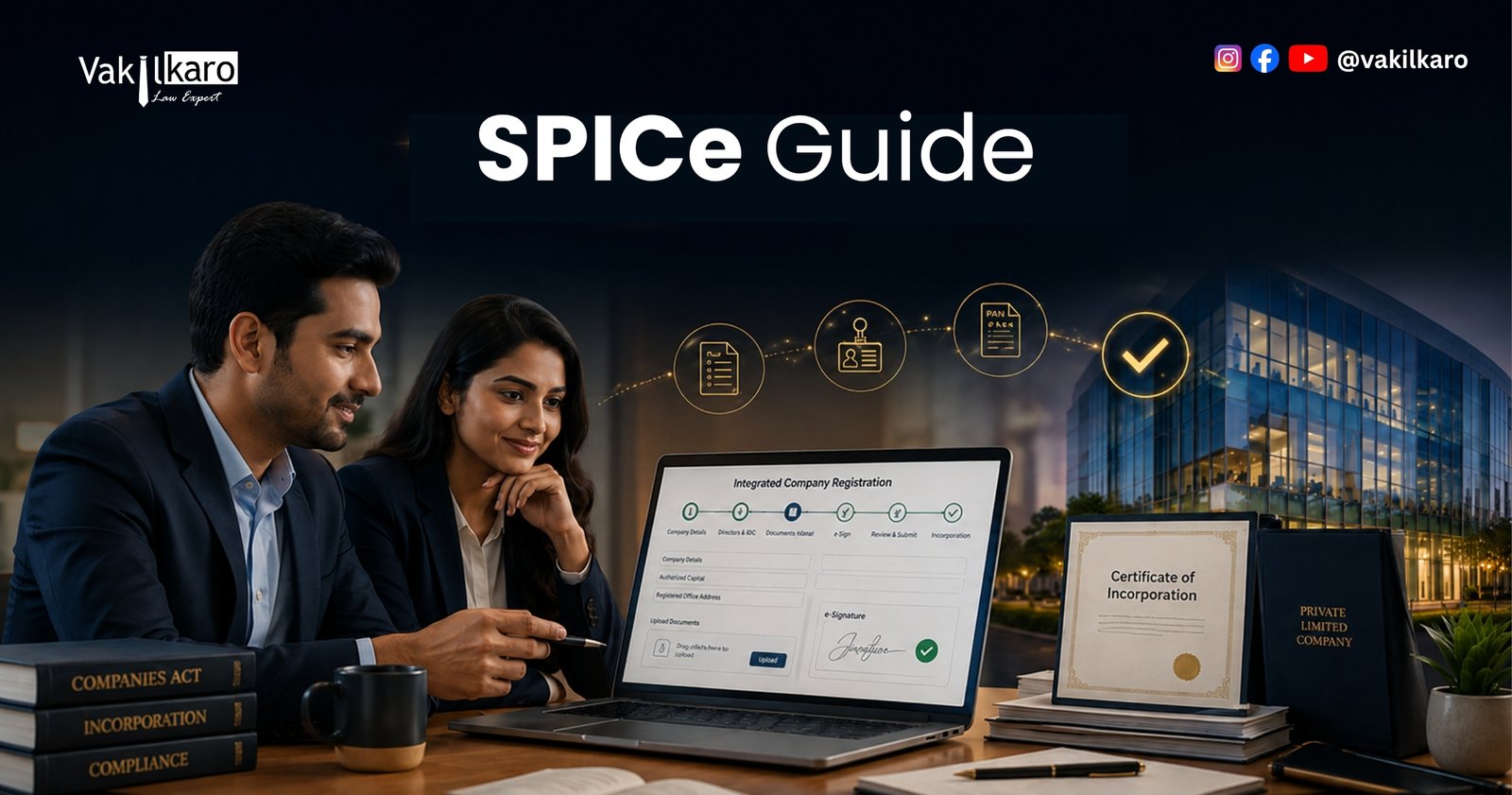
SPICe+ (Simplified Proforma for Incorporating Company Electronically Plus) is the integrated online company incorporation system introduced by the Ministry of Corporate Affairs (MCA). It enables eligible businesses to complete company incorporation along with related registrations through a unified application process. SPICe+ consists of Part A for company name reservation and Part B for incorporation and integrated statutory registrations. It is widely used for incorporating Private Limited Companies, One Person Companies (OPCs) and other eligible entities under the Companies Act, 2013.
Many entrepreneurs assume that SPICe+ is simply another MCA form. In reality, SPICe+ is the foundation of the modern company incorporation process in India. A properly prepared SPICe+ application not only improves approval timelines but also reduces the likelihood of resubmission by ensuring consistency across company details, director information, constitutional documents and statutory registrations. Accurate documentation forms the foundation of successful incorporation.
One of the most common reasons for SPICe+ resubmission is inconsistency between identity documents and information entered into the incorporation application. Cross-check every document before filing. Vakilkaro follows a structured incorporation methodology designed to minimise errors and improve approval timelines.
Although SPICe+ has simplified company incorporation, successful approval still depends upon accurate documentation, correctly drafted constitutional documents and consistency across all forms. Technology simplifies filing, but legal accuracy remains essential. The integrated incorporation system provides several advantages to entrepreneurs, professionals and government authorities.
Many founders submit only one proposed name. Preparing multiple legally compliant alternatives generally reduces delays if the preferred name is unavailable. SPICe+ Part B contains the detailed incorporation application.
Entrepreneurs often assume that these forms are separate applications requiring independent filing. In reality, they operate together as part of the broader SPICe+ incorporation ecosystem. Understanding this relationship helps founders appreciate why consistency across all incorporation documents is essential.
| Particular | Details |
|---|---|
| Form Name | SPICe+ |
| Full Form | Simplified Proforma for Incorporating Company Electronically Plus |
| Governing Law | Companies Act, 2013 |
| Government Authority | Ministry of Corporate Affairs (MCA) |
| Filing Mode | Online |
| Used For | Company Incorporation |
| Applicable Entities | Private Limited Company, OPC and other eligible companies |
| Integrated Registrations | PAN, TAN and other applicable registrations through the integrated framework |
| Processing Time | Subject to document readiness and MCA processing |
Key Highlights
- Integrated Company Incorporation System
- Introduced by Ministry of Corporate Affairs
- Online Filing Process
- Company Name Reservation
- Company Incorporation
- PAN & TAN Integration
- Supports Digital Governance
- Reduces Multiple Applications
- Faster Registration Workflow
- Suitable for Startups and Growing Businesses
Introduction
The process of incorporating a company in India previously required entrepreneurs to submit multiple applications before different authorities. Separate filings were often required for company incorporation, Director Identification Number, Permanent Account Number, Tax Deduction and Collection Account Number and several related registrations. This fragmented approach increased documentation, administrative effort and processing time.
To simplify company incorporation and promote digital governance, the Ministry of Corporate Affairs introduced the SPICe+ system as an integrated online platform. Instead of preparing multiple independent applications, eligible businesses can now complete several incorporation-related formalities through a single coordinated process.
For startup founders and first-time entrepreneurs, SPICe+ has significantly improved the efficiency of company registration. However, despite simplification, incorporation still requires accurate documentation, properly drafted constitutional documents, correct business objects and careful preparation of statutory forms. Errors in these areas continue to result in MCA resubmissions.
Understanding how SPICe+ functions helps founders appreciate not only the filing process but also the legal importance of every document submitted during incorporation.
What is SPICe+?
SPICe+ (Simplified Proforma for Incorporating Company Electronically Plus) is the integrated company incorporation system developed by the Ministry of Corporate Affairs for electronically incorporating eligible companies under the Companies Act, 2013.
Rather than acting as a single form, SPICe+ functions as a structured incorporation framework that combines company registration with several connected statutory processes. The objective is to simplify incorporation, reduce duplication of information and improve the efficiency of government processing.
SPICe+ is generally used for incorporating entities such as Private Limited Companies and One Person Companies (OPCs), along with integrated applications for related registrations wherever applicable.
The system is divided into two principal components:
- Part A, which primarily deals with company name reservation.
- Part B, which captures detailed incorporation information and facilitates the integrated registration process.
This integrated approach enables entrepreneurs to complete multiple incorporation formalities through a coordinated online workflow while maintaining compliance with the Companies Act, 2013.
Documents Required for SPICe+ Filing
The following documents are commonly required during the preparation of the SPICe+ application.
Identity Documents
For every proposed director and subscriber:
- PAN Card
- Aadhaar Card (where applicable)
- Passport (for foreign nationals or where required)
- Passport-size Photograph
Address Proof
Commonly accepted documents include:
- Bank Statement
- Electricity Bill
- Telephone Bill
- Utility Bill
- Passport
The document should generally satisfy the applicable validity requirements.
Registered Office Documents
- Utility Bill
- Rent Agreement (where applicable)
- No Objection Certificate (NOC)
- Ownership Proof (where applicable)
Business Information
- Proposed Company Name
- Alternative Company Names
- Business Objects
- Authorised Capital
- Paid-up Capital
- Shareholding Pattern
Supporting Corporate Documents
Depending upon the circumstances, incorporation may also involve:
- Memorandum of Association (e-MoA)
- Articles of Association (e-AoA)
- Statutory Declarations
- Subscriber Information
Step-by-Step SPICe+ Filing Process
Step 1 – Business Consultation
The incorporation process begins with understanding the proposed business.
This includes reviewing:
- Nature of Business
- Founder Structure
- Investment Plans
- Future Expansion
- Compliance Requirements
Step 2 – Company Name Reservation
Suitable company names are shortlisted and verified.
Vakilkaro generally performs:
- MCA Name Search
- Trademark Availability Review
- Brand Suitability Assessment
before filing Part A.
Step 3 – Document Collection
Identity documents, address proof, registered office details and constitutional information are collected and verified.
Step 4 – Digital Signature Certificate (DSC)
Digital Signature Certificates are obtained for the proposed directors who will digitally authenticate the incorporation documents.
Step 5 – Director Identification Number (DIN)
Where applicable, DIN is obtained through the SPICe+ incorporation process for first-time directors.
Step 6 – Preparation of Constitutional Documents
Vakilkaro prepares:
- e-Memorandum of Association (INC-33)
- e-Articles of Association (INC-34)
according to the company's business model and future expansion plans.
Step 7 – Preparation of SPICe+ Forms
The incorporation application is prepared using verified information relating to:
- Company Name
- Directors
- Shareholders
- Registered Office
- Share Capital
- Business Objects
- Statutory Registrations
Every detail is reviewed before submission.
Step 8 – Submission before MCA
The completed application is electronically submitted to the Ministry of Corporate Affairs.
The Registrar examines:
- Company Name
- Director Information
- Business Objects
- Constitutional Documents
- Identity Records
- Registered Office
- Share Capital
Where clarification becomes necessary, MCA may issue a resubmission request.
Step 9 – Certificate of Incorporation
Upon approval, the company receives:
- Certificate of Incorporation
- Corporate Identification Number (CIN)
- PAN
- TAN
and may proceed with post-incorporation compliances applicable to its business.
Estimated Timeline
Although timelines vary depending upon document readiness and MCA processing, a typical incorporation schedule may be as follows.
| Activity | Estimated Timeline |
|---|---|
| Business Consultation | Same Day |
| Name Finalisation | 1 Day |
| DSC | 1–2 Working Days |
| Document Preparation | 1–2 Working Days |
| SPICe+ Filing | 1 Day |
| MCA Processing | 3–7 Working Days |
| Certificate of Incorporation | Upon Approval |
Overall estimated incorporation timeline:
Approximately 7–10 Working Days
Government Fees
Government charges depend upon factors such as:
- Authorised Share Capital
- State-wise Stamp Duty
- Applicable MCA Fees
- Nature of Company
Since statutory charges may change periodically, applicants should verify the latest fee schedule before filing.
Professional Fees
Professional fees generally depend upon:
- Consultation
- Documentation
- Constitutional Drafting
- SPICe+ Preparation
- MCA Filing
- Compliance Advisory
Vakilkaro provides transparent service quotations before commencement of the incorporation process.
Common Reasons for MCA Resubmission
Even with an integrated filing system, applications may receive resubmission notices where statutory requirements are not satisfied.
Common reasons include:
- Company Name Conflict
- Incorrect Business Objects
- Identity Document Mismatch
- Improper Registered Office Documents
- Incorrect Shareholding Details
- Incomplete Constitutional Documents
- Poor Document Quality
- Missing Digital Authentication
- Inconsistent Director Information
- Incorrect Capital Structure
Careful preparation before filing significantly reduces the possibility of resubmission.
Vakilkaro Recommendation
The speed of company incorporation should never take priority over legal accuracy.
A carefully prepared SPICe+ application not only improves approval timelines but also creates a stronger legal foundation for future compliance, investment and corporate growth.
Why was SPICe+ Introduced?
Before the introduction of SPICe+, incorporating a company in India required entrepreneurs to complete several independent applications before different government authorities. Separate forms were often prepared for company incorporation, Director Identification Number (DIN), Permanent Account Number (PAN), Tax Deduction and Collection Account Number (TAN) and other statutory registrations. This fragmented process increased documentation, duplicated information and delayed incorporation.
To simplify company registration and promote digital governance, the Ministry of Corporate Affairs (MCA) introduced SPICe+ (Simplified Proforma for Incorporating Company Electronically Plus) as an integrated incorporation framework. The objective was to reduce repetitive documentation, improve processing efficiency and provide entrepreneurs with a single electronic workflow for completing multiple incorporation-related formalities.
Today, SPICe+ has become the standard incorporation system for eligible companies registered under the Companies Act, 2013 and represents one of the most significant reforms in India's corporate registration framework.
Objectives of SPICe+
The SPICe+ system was introduced to achieve several important objectives.
These include:
- Simplifying company incorporation.
- Reducing multiple statutory applications.
- Promoting paperless governance.
- Improving processing efficiency.
- Standardising incorporation procedures.
- Supporting ease of doing business.
- Integrating related registrations into one workflow.
- Reducing documentation errors.
- Improving transparency.
For entrepreneurs, this means a more structured and coordinated incorporation experience compared to the earlier multi-form process.
Benefits of SPICe+
Single Integrated Workflow
Instead of preparing multiple independent applications, entrepreneurs can complete company incorporation through one coordinated process.
This reduces:
- Duplicate information.
- Manual errors.
- Administrative effort.
Faster Company Registration
Integrated filing generally improves processing efficiency by reducing repeated submissions across multiple departments.
Although approval timelines depend upon document accuracy and MCA processing, SPICe+ has significantly streamlined incorporation compared with earlier procedures.
Better Document Consistency
Since information flows through an integrated system, entrepreneurs are encouraged to maintain consistency across:
- Director Details
- Registered Office
- Share Capital
- Company Name
- Business Objects
This reduces the possibility of conflicting information appearing in different statutory records.
Digital Governance
SPICe+ supports India's broader objective of promoting digital government services by enabling electronic filing, electronic authentication and integrated processing.
Better Experience for Startups
Startups benefit from:
- Simplified documentation.
- Faster incorporation workflow.
- Coordinated statutory registrations.
- Reduced administrative complexity.
This allows founders to focus more on business development and less on repetitive procedural filings.
Vakilkaro Recommendation
SPICe+ should be viewed as an integrated incorporation system rather than simply another MCA form. Proper planning before filing significantly improves the overall registration experience.
Components of SPICe+
SPICe+ is divided into two principal sections.
Each section performs a different function during company incorporation.
SPICe+ Part A
SPICe+ Part A primarily deals with Company Name Reservation.
At this stage, applicants submit the proposed company name for examination by the Ministry of Corporate Affairs.
The Registrar generally evaluates whether:
- The proposed name is unique.
- The name complies with the Companies Act.
- The name complies with the Companies (Incorporation) Rules.
- The proposed name does not conflict with existing companies.
- The proposed name is legally acceptable.
If approved, the incorporation process proceeds to Part B.
Information Required in Part A
Typical information includes:
- Proposed Company Name
- Alternative Company Name
- Type of Company
- Main Business Activity
SPICe+ Part B
This stage captures all important information relating to the proposed company.
Typical information includes:
- Registered Office Address
- Director Details
- Shareholder Details
- Share Capital
- Business Objects
- Subscriber Details
- Statutory Registrations
This forms the principal incorporation application examined by the Registrar of Companies.
Forms Integrated with SPICe+
The SPICe+ ecosystem integrates several important statutory forms used during company incorporation.
Understanding the role of each form helps founders appreciate how the incorporation process functions as a coordinated system rather than a collection of independent filings.
AGILE-PRO-S
AGILE-PRO-S facilitates integrated registrations relating to applicable statutory requirements such as:
- GST Registration (where applicable)
- EPFO
- ESIC
- Bank Account Integration through participating banks
- Other integrated services notified by the Ministry
INC-33 (e-MoA)
INC-33 represents the Electronic Memorandum of Association.
It digitally records:
- Company Name
- Business Objects
- Liability Clause
- Capital Clause
- Subscriber Details
INC-34 (e-AoA)
INC-34 represents the Electronic Articles of Association.
It establishes the internal governance framework of the company, including provisions relating to:
- Directors
- Share Transfer
- Voting Rights
- Corporate Administration
INC-9
INC-9 is a statutory declaration completed as part of the incorporation process in applicable cases.
It forms part of the integrated documentation submitted before the Ministry of Corporate Affairs.
Where is SPICe+ Used?
The SPICe+ system is primarily used for incorporating eligible companies under the Companies Act, 2013.
Common use cases include:
- Private Limited Company Registration
- One Person Company (OPC) Registration
- Section 8 Company Registration
- Certain other eligible company incorporations
It serves as the central electronic platform through which company incorporation and related statutory registrations are coordinated.
Eligibility for Filing SPICe+
The SPICe+ incorporation system is designed for eligible business entities seeking registration under the Companies Act, 2013. Before initiating the incorporation process, founders should ensure that the proposed company satisfies the statutory requirements applicable to the selected company structure.
Although SPICe+ simplifies electronic filing, eligibility is still determined by the Companies Act, 2013 and the Companies (Incorporation) Rules. The Ministry of Corporate Affairs examines the incorporation application only after verifying that the proposed company satisfies the prescribed legal requirements.
Who Can Use SPICe+?
SPICe+ is generally used for incorporating:
- Private Limited Company
- One Person Company (OPC)
- Section 8 Company
- Producer Company (where applicable)
- Other eligible company structures notified under the Companies Act
The appropriate company structure should be selected before initiating the incorporation process.
Basic Eligibility
Before filing SPICe+, founders should generally ensure:
- Proposed company name is available.
- Directors are finalised.
- Shareholders are identified.
- Registered office details are available.
- Business objects are prepared.
- Identity documents are ready.
- Digital Signature Certificates are available.
- Director Identification Numbers are available or proposed through incorporation where applicable.
Vakilkaro Recommendation
Preparing documentation before initiating SPICe+ significantly reduces the likelihood of MCA resubmission.
Common Mistakes While Filing SPICe+
Although SPICe+ has significantly simplified company incorporation, many applications still receive Resubmission (RSUB) notices from the Ministry of Corporate Affairs because of avoidable mistakes. Most of these issues are related to documentation, drafting errors or inconsistencies rather than the SPICe+ system itself.
Understanding these common mistakes before filing improves approval timelines and reduces unnecessary delays.
1. Choosing an Incorrect Company Name
The proposed company name should comply with the Companies Act and the Companies (Incorporation) Rules.
Common mistakes include:
- Selecting a name identical to an existing company.
- Choosing a name similar to an existing LLP.
- Ignoring Trademark availability.
- Using prohibited expressions.
- Choosing a name that does not reflect the proposed business activity.
2. Poorly Drafted Business Objects
Many applicants copy object clauses from unrelated companies.
Improper business objects may:
- Delay approval.
- Restrict future expansion.
- Create issues during investment due diligence.
- Require later alteration of the Memorandum.
3. Identity Document Mismatch
The following information should remain consistent across all documents:
- Name
- Father's Name
- Date of Birth
- Address
Minor spelling differences frequently result in MCA resubmission.
4. Incorrect Registered Office Documents
Common issues include:
- Expired utility bill.
- Missing No Objection Certificate.
- Incorrect address.
- Incomplete ownership documentation.
5. Incorrect Shareholding Pattern
Shareholding percentages should be finalised before preparing incorporation documents.
Changes after filing may require correction and additional compliance.
6. Wrong Capital Planning
Selecting unnecessarily high authorised capital increases stamp duty in many states without providing immediate commercial benefit.
Capital planning should align with the business plan.
7. Improper Digital Authentication
Incorrect use of Digital Signature Certificates frequently prevents successful filing.
DSCs should be valid and properly configured before submission.
8. Incomplete Constitutional Documents
The Memorandum and Articles of Association should accurately reflect:
- Business Activities
- Share Capital
- Corporate Governance
- Internal Administration
Generic templates may create future legal issues.
9. Last-Minute Filing
Preparing SPICe+ immediately before an intended launch frequently results in avoidable delays.
Early preparation provides sufficient time for document verification and correction.
10. Filing Without Professional Review
Many applications receive resubmission because founders submit forms without verifying legal consistency.
A professional legal review generally reduces filing errors and improves approval timelines.
Vakilkaro Expert Insights
Insight 1
Company incorporation should begin with business planning rather than document collection.
A well-planned structure generally results in smoother compliance and future expansion.
Insight 2
Trademark availability should be checked before filing the company name.
Company name approval and trademark protection are different legal processes.
Insight 3
Business Objects should describe not only current activities but also foreseeable future expansion.
Proper drafting often avoids future amendments.
Insight 4
Keep authorised capital realistic.
Higher capital does not automatically improve business credibility but may increase incorporation costs.
Insight 5
Treat SPICe+ as the beginning of the company's legal journey rather than the final objective.
Post-incorporation compliance planning is equally important.
Real Case Studies
Case Study 1 – Technology Startup
Background
A software startup filed SPICe+ using only one proposed company name.
Challenge
The name was rejected because of similarity with an existing company.
Vakilkaro Solution
Three legally compliant alternative names were prepared after MCA and Trademark searches.
Outcome
The second proposed name received approval and incorporation proceeded without further delay.
Learning
Always prepare multiple legally compliant name options before filing Part A.
Case Study 2 – Manufacturing Company
Background
A manufacturing company copied business objects from another entity.
Challenge
The object clause did not accurately reflect its manufacturing activities.
Vakilkaro Solution
Vakilkaro drafted fresh object clauses covering manufacturing, trading and future expansion.
Outcome
The revised incorporation application was approved.
Learning
Business objects should be customised according to the company's actual business model.
Case Study 3 – Healthcare Startup
Background
A healthcare startup delayed obtaining Digital Signature Certificates until the final stage of incorporation.
Challenge
DSC verification delayed the planned filing schedule.
Vakilkaro Solution
The verification process was completed before document preparation and the incorporation application was filed thereafter.
Learning
Complete DSC verification before preparing SPICe+ documentation.
Frequently asked questions
What is SPICe+?+
SPICe+ is the integrated online company incorporation system introduced by the Ministry of Corporate Affairs for registering eligible companies under the Companies Act, 2013.
Is SPICe+ mandatory for company registration?+
Yes. Eligible companies are generally incorporated through the SPICe+ framework prescribed by the Ministry of Corporate Affairs.
What is the difference between Part A and Part B?+
Part A is primarily used for company name reservation. Part B captures the detailed incorporation information and integrated statutory registrations.
Does SPICe+ provide DIN?+
Where applicable, Director Identification Numbers are generally allotted through the SPICe+ incorporation process for first-time directors.
Is DSC required before filing SPICe+?+
Yes. Proposed signatories generally require valid Digital Signature Certificates before electronically signing incorporation documents.
Does SPICe+ include PAN and TAN?+
The integrated incorporation process facilitates PAN and TAN allotment along with company incorporation.
Can GST Registration be applied through SPICe+?+
The SPICe+ ecosystem integrates AGILE-PRO-S for applicable registrations, including GST where relevant and subject to the applicant's requirements.
How long does SPICe+ approval take?+
Where documents are complete and no resubmission is required, incorporation generally takes around 7–10 working days, subject to MCA processing.
What happens if MCA raises a resubmission?+
The applicant should rectify the deficiencies identified by the Registrar and submit the corrected application within the prescribed timeline.
Can Vakilkaro handle the complete SPICe+ process?+
Yes. Vakilkaro provides end-to-end assistance, including company name search, DSC, DIN, drafting of constitutional documents, SPICe+ filing and post-incorporation guidance.
Why Choose Vakilkaro?+
Vakilkaro provides complete professional assistance throughout the SPICe+ incorporation process. Our support includes: Company Structure Consultation Name Availability Review Trademark Search Guidance DSC & DIN Assistance Drafting of eMoA and eAoA SPICe+ Preparation and Filing MCA Coordination Post-Incorporation Compliance Guidance Our objective is not merely to complete filing but to help founders establish legally compliant, investment-ready companies.
Final Call to Action+
Planning to Incorporate a Company through SPICe+? Whether you are registering your first startup or incorporating an established business into a corporate structure, Vakilkaro can assist you throughout the complete SPICe+ process—from business consultation and company name reservation to incorporation, PAN, TAN and post-registration compliance. Speak with a Vakilkaro Expert today and complete your company incorporation through a professionally managed SPICe+ process.
Internal Linking Notes (Developer)+
Link naturally to:
Core Service+
Private Limited Company Registration
Supporting Guides+
Digital Signature Certificate (DSC) Director Identification Number (DIN) Memorandum of Association (MoA) Articles of Association (AoA) Company Name Search Certificate of Incorporation Annual Compliance ROC Filing
External Authority Notes (Developer)+
Reference only official authorities: Ministry of Corporate Affairs (MCA) Companies Act, 2013 MCA e-Filing Portal
Schema Recommendation+
Recommended structured data: Service Schema FAQ Schema Organization Schema Breadcrumb Schema Article Schema
Developer Notes+
Place the Summary Table immediately after the Quick Answer. Implement FAQ Schema for all FAQs. Use accordions for FAQ sections. Add a "Related Guides" section linking to DSC, DIN, MoA, AoA and Company Registration. Display CTA after the Hero and again at the end of the guide.