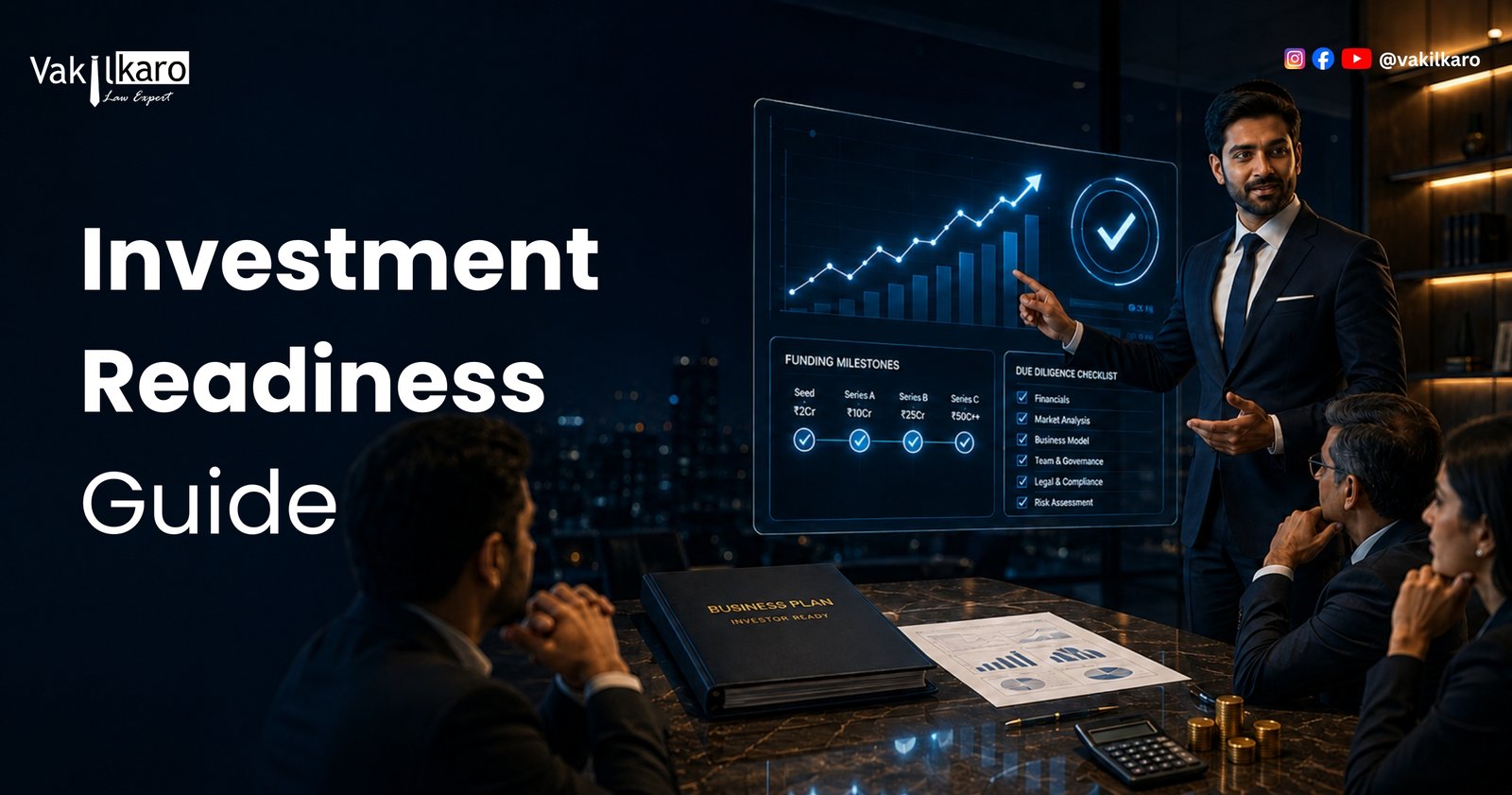
Investment Readiness is the process of preparing a business to successfully attract and manage external investment. For a Private Limited Company, this generally includes establishing legal compliance, maintaining organised financial records, protecting intellectual property, implementing corporate governance and preparing documentation required during investor due diligence. Businesses that become investment-ready before approaching investors generally present a stronger commercial profile and are better positioned for long-term growth.
Many founders spend months perfecting their pitch deck but only a few days organising their legal and financial records. Professional investors often spend far more time reviewing company documentation than presentation slides. Strong compliance, organised records and clear governance frequently influence investment decisions as much as the business idea itself.
Most investment rejections occur before valuation discussions begin. Investors first evaluate whether the company is legally, financially and operationally organised enough to justify detailed due diligence. Investment readiness should be viewed as a combination of several interconnected systems rather than one single activity.
Many startups own valuable intellectual property but fail to organise ownership properly. Investors frequently review whether the company—not individual founders—controls its key business assets. Investors rarely invest only in products.
The objective of due diligence is not simply to verify documents. It is to determine whether the business has systems capable of supporting long-term growth after investment. Every investment-ready company should maintain organised corporate records.
Many early-stage startups neglect Cap Table management until investors request it. Updating ownership records from the beginning significantly reduces future legal complications. Growing startups often consider implementing Employee Stock Option Plans (ESOPs) to attract and retain talented employees.
| Particular | Details |
|---|---|
| Objective | Prepare the business for external investment |
| Suitable For | Private Limited Companies |
| Potential Investors | Angel Investors, Venture Capital, Strategic Investors, Institutional Investors |
| Primary Focus | Legal, Financial, Operational and Governance Readiness |
| Key Outcome | Investor-Ready Business |
| Important Components | Compliance, Documentation, Financial Discipline, Intellectual Property |
Key Highlights
- Build an Investor-Ready Company
- Organise Legal Documentation
- Strengthen Financial Reporting
- Improve Corporate Governance
- Protect Intellectual Property
- Prepare for Due Diligence
- Build Investor Confidence
- Organise Shareholding
- Establish Compliance Systems
- Support Long-Term Business Growth
Introduction
Every entrepreneur dreams of raising investment, but very few understand what professional investors actually evaluate before investing. Contrary to popular belief, investors rarely make decisions based only on innovative ideas or revenue projections. They seek businesses that demonstrate discipline, transparency and the ability to manage growth responsibly.
A company that lacks organised legal documentation, proper accounting, intellectual property protection or statutory compliance may face significant challenges during investor due diligence—even if its products or services are commercially successful.
Investment readiness is therefore a structured business preparation process rather than a fundraising activity. It involves building the systems, records and governance mechanisms that enable the company to confidently engage with investors, lenders and strategic partners.
For founders, investment readiness also provides benefits beyond fundraising. Organised documentation improves operational efficiency, strengthens financial reporting, supports business expansion and reduces legal risk. Even businesses that do not intend to raise immediate investment benefit from establishing these systems early.
What is Investment Readiness?
Investment Readiness refers to the overall preparedness of a business to receive external investment. It measures whether the company has established the legal, financial, operational and governance systems that investors generally expect before committing capital.
An investment-ready company typically demonstrates:
- Proper Company Incorporation
- Organised Shareholding Structure
- Accurate Financial Records
- Corporate Compliance
- Intellectual Property Protection
- Business Documentation
- Transparent Governance
- Professional Decision-Making
Investment readiness does not guarantee funding.
Instead, it improves the company's ability to participate in investment discussions with greater confidence and stronger documentation.
Investment Readiness Checklist
Before approaching investors, founders should confirm:
- Company Incorporated
- Legal Documentation Complete
- Financial Statements Updated
- Accounting Organised
- Compliance Up to Date
- Trademark Protected
- Shareholding Clearly Documented
- Banking Records Organised
- Data Room Prepared
- Capital Utilisation Plan Ready
Vakilkaro Recommendation
Investment readiness should become a continuous business process rather than a last-minute fundraising activity.
Businesses that maintain organised documentation throughout their lifecycle generally complete due diligence faster, negotiate with greater confidence and build stronger long-term investor relationships.
Common Myths About Investment Readiness
Many founders believe that investment readiness begins when they start preparing a pitch deck or scheduling meetings with investors. In reality, investment readiness is a long-term business discipline that starts much earlier.
The following misconceptions frequently delay fundraising or reduce investor confidence.
Myth 1 – A Great Business Idea is Enough to Raise Investment
Reality:
Investors rarely invest solely because an idea sounds promising.
They generally evaluate:
- Founder Capability
- Business Model
- Legal Structure
- Financial Discipline
- Market Opportunity
- Execution Ability
A strong idea without organised execution rarely attracts professional investment.
Myth 2 – Investment Readiness Begins After Revenue
Reality:
Investment readiness should begin immediately after company incorporation.
Building:
- Legal Documentation
- Accounting Systems
- Compliance
- Governance
from the beginning significantly improves long-term fundraising prospects.
Myth 3 – Investors Only Review Financial Statements
Reality:
Professional investors typically examine:
- Corporate Structure
- Shareholding
- Intellectual Property
- Compliance
- Founder Agreements
- Customer Contracts
- Financial Records
Investment decisions are based on the overall quality of the business rather than financial statements alone.
Myth 4 – A Pitch Deck is the Most Important Investment Document
Reality:
A pitch deck starts the conversation.
Due diligence documents complete the investment process.
Professional investors often spend substantially more time reviewing:
- Corporate Records
- Financial Documentation
- Intellectual Property
- Compliance
than presentation slides.
Myth 5 – Every Startup Needs Venture Capital
Reality:
Different businesses require different funding strategies.
Some companies grow successfully through:
- Founder Capital
- Customer Revenue
- Bank Finance
- Strategic Partnerships
Venture Capital is only one funding option.
Myth 6 – Higher Valuation is Always Better
Reality:
A higher valuation is not always the best outcome.
Founders should also evaluate:
- Investor Quality
- Strategic Alignment
- Governance Rights
- Long-Term Partnership
- Future Fundraising Flexibility
Long-term business success often depends more on the quality of the investor relationship than on the initial valuation.
Myth 7 – Compliance Can Be Organised After Investment
Reality:
Professional investors generally expect compliance before investment.
Delaying governance and legal documentation often slows due diligence.
Myth 8 – Investors Do Not Care About Intellectual Property
Reality:
Businesses built around technology, branding or innovation often undergo detailed intellectual property review.
Proper ownership of:
- Trademarks
- Copyrights
- Patents
- Domain Names
may significantly strengthen investor confidence.
Myth 9 – Founders Can Explain Missing Documents Later
Reality:
Organised documentation demonstrates professionalism.
Repeated explanations for missing records often reduce confidence during due diligence.
Myth 10 – Investment Readiness Ends After Funding
Reality:
Investment increases governance expectations.
Businesses generally continue improving:
- Reporting
- Compliance
- Internal Controls
- Financial Management
- Board Governance
after investment.
Vakilkaro Expert Insights
Insight 1
Investment readiness should become part of the company's operating culture rather than a fundraising project.
Insight 2
Investors generally trust businesses that demonstrate consistency rather than perfection.
Well-maintained records often create stronger confidence than ambitious projections unsupported by documentation.
Insight 3
Strong governance increases enterprise value irrespective of whether immediate fundraising is planned.
Investment readiness therefore benefits every growth-oriented business.
Insight 4
Founders should organise legal, financial and operational systems before they become urgent.
Preparation completed under pressure often produces avoidable mistakes.
Insight 5
An investment-ready company is generally also:
- Better Governed
- Better Managed
- Better Documented
- Better Positioned for Banking
- Better Prepared for Expansion
Investment readiness therefore strengthens the business even if external funding is never raised.
Real Business Case Studies
Case Study 1 – Angel Investment
Industry
SaaS Startup
Background
A software company approached angel investors shortly after completing its product.
Challenge
Although the product demonstrated strong customer interest, legal documentation and shareholding records were incomplete.
Vakilkaro Solution
The founders organised constitutional documents, updated shareholding records, protected key trademarks and prepared an investor data room before restarting fundraising discussions.
Outcome
The company presented a significantly stronger investment profile.
Learning
Legal readiness should precede investor meetings.
Case Study 2 – Venture Capital Due Diligence
Industry
HealthTech
Background
A rapidly growing healthcare technology company attracted venture capital interest.
Challenge
Financial reporting and compliance documentation required further organisation before due diligence could be completed.
Vakilkaro Solution
The company established structured accounting, completed pending compliance and organised financial reporting.
Outcome
Investor due diligence proceeded more efficiently.
Learning
Financial discipline is as important as business growth.
Case Study 3 – Strategic Investment
Industry
Manufacturing
Background
A manufacturing company entered discussions with a strategic investor for business expansion.
Challenge
The investor identified inconsistencies in corporate records and intellectual property ownership.
Vakilkaro Solution
The company updated statutory registers, reviewed ownership of key intellectual property assets and organised governance documentation.
Outcome
The business entered negotiations with improved legal preparedness.
Learning
Investment readiness extends beyond fundraising—it strengthens overall business quality.
Why Investment Readiness Matters?
Preparing for investment creates value even before the first investor meeting.
An investment-ready company generally benefits through:
- Better Corporate Governance
- Improved Financial Discipline
- Faster Due Diligence
- Stronger Banking Relationships
- Better Strategic Planning
- Improved Business Credibility
- Higher Organisational Transparency
As the company grows, these systems also support acquisitions, partnerships, expansion and long-term enterprise development.
Why Investors Reject Startups
Many founders assume that startups fail to raise investment because of weak pitch decks or insufficient networking.
In reality, investors reject businesses for a much wider range of reasons.
Professional investors generally evaluate whether the company is prepared to responsibly manage external capital.
Common reasons for rejection include:
- Poor legal documentation.
- Unclear shareholding structure.
- Weak financial records.
- Lack of product-market fit.
- Poor governance.
- Compliance deficiencies.
- Founder conflicts.
- Weak intellectual property protection.
- Unrealistic business projections.
- Inadequate execution capability.
A business with organised governance often appears significantly more investable than a business with similar revenue but weak documentation.
The Seven Pillars of Investment Readiness
1. Legal Readiness
Legal readiness establishes the company's legal foundation.
Investors generally expect the business to maintain organised constitutional and corporate documentation.
Typical areas include:
- Certificate of Incorporation
- Memorandum of Association (MOA)
- Articles of Association (AOA)
- Shareholder Records
- Board Resolutions
- Statutory Registers
- Material Contracts
Strong legal documentation reduces uncertainty during due diligence.
2. Financial Readiness
Financial readiness demonstrates whether the company manages money responsibly.
Businesses should maintain:
- Organised Accounting
- Financial Statements
- Banking Records
- Revenue Records
- Expense Records
- Cash Flow Visibility
Financial transparency often contributes significantly to investor confidence.
Vakilkaro Recommendation
Investors generally prefer businesses with consistent financial reporting rather than businesses that prepare accounts only before fundraising.
3. Compliance Readiness
Compliance reflects the company's operational discipline.
Businesses should organise:
- ROC Compliance
- Income Tax Compliance
- GST Compliance (where applicable)
- Director Compliance
- Statutory Registers
- Corporate Filings
Poor compliance frequently delays investment transactions.
4. Operational Readiness
Operational readiness evaluates whether the business has repeatable systems capable of supporting growth.
Examples include:
- Business Processes
- Customer Management
- Vendor Management
- Internal Controls
- Reporting Systems
- Operational Documentation
Businesses dependent entirely on one founder often appear less scalable.
5. Governance Readiness
Professional investors generally value structured governance.
Governance includes:
- Board Structure
- Decision-Making Framework
- Internal Policies
- Shareholder Rights
- Delegation of Authority
- Compliance Monitoring
Strong governance reduces operational risk.
6. Brand & Intellectual Property Readiness
A growing business should evaluate ownership of its intellectual property.
Examples include:
- Trademark Registration
- Copyright
- Patents
- Design Registration
- Domain Portfolio
Intellectual property often becomes an important business asset during investment discussions.
7. Team Readiness
They invest in teams capable of executing business plans.
Businesses should demonstrate:
- Defined Founder Roles
- Management Structure
- Operational Leadership
- Hiring Strategy
- Organisational Stability
A capable team strengthens investor confidence.
Investment Readiness Scorecard
Before approaching investors, founders should evaluate their readiness across multiple dimensions.
Legal Readiness
Financial Readiness
Compliance Readiness
Operational Readiness
Governance Readiness
Brand & IP Readiness
Team Readiness
Investor Documentation
Data Room
Business Strategy
The objective is not perfection.
The objective is to identify weaknesses before investors identify them.
Angel Investors vs Venture Capital Expectations
Different investors evaluate businesses differently.
| Angel Investor | Venture Capital |
|---|---|
| Founder capability is often a major consideration | Scalability and growth potential are typically examined in greater depth |
| May invest at an earlier stage | Generally expects stronger business maturity |
| Often focuses on product validation | Often evaluates market size and execution capability |
| Governance expectations vary | Structured governance is commonly expected |
| Documentation remains important | Comprehensive due diligence is usually conducted |
There is no universal investment formula.
Preparation should always reflect the type of investor the business intends to approach.
Vakilkaro Recommendation
Founders should avoid preparing identical investment material for every investor.
Different categories of investors frequently evaluate:
- Different Risks
- Different Opportunities
- Different Growth Expectations
Customising preparation according to the intended investor often improves fundraising discussions.
Investment Readiness is More Than Fundraising
Investment readiness creates business value even where no immediate fundraising is planned.
Benefits include:
- Better Corporate Governance
- Improved Financial Reporting
- Faster Decision-Making
- Organised Documentation
- Reduced Legal Risk
- Better Banking Relationships
- Stronger Business Discipline
Businesses prepared for investment are generally also better prepared for expansion.
Founder Decision Framework
Before approaching investors, every founder should ask:
- Is the company legally organised?
- Are financial records complete?
- Is compliance up to date?
- Is intellectual property protected?
- Is governance documented?
- Is the shareholding structure clear?
- Are business records organised?
- Can the company withstand investor due diligence today?
If several answers are No, investment readiness should be strengthened before beginning fundraising discussions.
Final Founder Recommendation
Investment readiness should not begin when funding becomes urgent.
It should become part of the company's operating philosophy from the day the business is incorporated.
Companies that consistently maintain organised legal, financial and governance systems generally attract stronger investor confidence than companies attempting to prepare everything immediately before fundraising.
Due Diligence Preparation
One of the most important stages before raising investment is Due Diligence Preparation.
Professional investors rarely make investment decisions immediately after a pitch meeting. Instead, they generally perform a detailed review of the company's legal, financial and operational records to understand potential risks before investing.
Due diligence is not intended to find reasons to reject a business.
Its purpose is to verify:
- Legal Ownership
- Corporate Compliance
- Financial Accuracy
- Operational Stability
- Business Risks
Companies that organise their documentation before fundraising generally complete due diligence more efficiently.
Legal Due Diligence
Legal due diligence focuses on whether the company has been properly incorporated and governed.
Typical areas reviewed include:
- Certificate of Incorporation
- Memorandum of Association (MOA)
- Articles of Association (AOA)
- Shareholding Structure
- Board Resolutions
- Share Certificates
- Statutory Registers
- Material Contracts
Well-maintained legal records demonstrate organisational discipline.
Financial Due Diligence
Investors generally evaluate the financial health of the company through organised records.
Typical documents include:
- Financial Statements
- Accounting Records
- Bank Statements
- Revenue Reports
- Expense Records
- Tax Compliance Records
Accurate financial reporting improves investor confidence.
Operational Due Diligence
Operational review helps investors understand how the business functions.
Areas commonly evaluated include:
- Business Processes
- Customer Acquisition
- Sales Model
- Vendor Management
- Technology Infrastructure
- Operational Controls
Businesses dependent entirely on founders often receive greater scrutiny.
Corporate Documentation
Typical documents include:
Incorporation Documents
- Certificate of Incorporation
- PAN
- CIN
- Company Registration Records
Constitutional Documents
- Memorandum of Association
- Articles of Association
Governance Records
- Board Meeting Minutes
- Shareholder Resolutions
- Director Appointments
- Statutory Registers
Regulatory Records
- ROC Filings
- GST Records (where applicable)
- Tax Compliance
- MSME Registration (where applicable)
- Startup India Recognition (where applicable)
Intellectual Property
Businesses should maintain organised records relating to:
- Trademark Registration
- Copyright
- Patents
- Domain Names
- Design Registration
Vakilkaro Recommendation
Maintain one central corporate documentation folder instead of collecting documents only when investors request them.
Financial Documentation
Professional investors expect organised financial reporting.
Businesses should maintain:
- Books of Account
- Financial Statements
- Management Reports
- Cash Flow Reports
- Revenue Analysis
- Banking Records
Consistent financial reporting demonstrates management maturity.
Shareholding Structure (Cap Table)
Every investment-ready business should maintain an accurate Capitalisation Table (Cap Table).
The Cap Table generally records:
- Founders
- Shareholders
- Number of Shares
- Shareholding Percentage
- Share Issuances
- Transfers (where applicable)
A clear shareholding structure simplifies investment discussions and reduces ownership disputes.
Employee Stock Option Plan (ESOP) Readiness
Before introducing an ESOP, founders should evaluate:
- Existing Shareholding
- Future Dilution
- Governance Framework
- Employee Incentive Strategy
Although not every startup requires an ESOP immediately, planning for future employee ownership often supports long-term scalability.
Intellectual Property (IP) Portfolio
Many startups create significant intellectual property before raising investment.
Typical IP assets include:
- Trademarks
- Copyrights
- Patents
- Design Registrations
- Domain Names
Investors frequently review:
- Ownership
- Registration Status
- Commercial Relevance
Where appropriate, the company should own the intellectual property rather than individual founders.
Vakilkaro Recommendation
If intellectual property is central to the business model, founders should organise ownership before approaching investors.
Compliance Review
Before fundraising, businesses should evaluate whether corporate compliance is up to date.
Typical review areas include:
- ROC Compliance
- Tax Compliance
- GST Compliance (where applicable)
- Director KYC
- Statutory Registers
- Banking Records
Outstanding compliance issues frequently delay investment transactions.
Founder Preparation
Investors evaluate founders as carefully as they evaluate businesses.
Founders should be prepared to explain:
- Business Vision
- Revenue Model
- Growth Strategy
- Market Opportunity
- Competitive Advantage
- Capital Utilisation Plan
Confidence supported by organised documentation generally creates stronger investor discussions.
Data Room Preparation
Professional investors frequently request access to a secure collection of company documents during due diligence.
A well-organised data room typically includes:
Legal Folder
- Incorporation Documents
- MOA
- AOA
- Shareholding Records
Finance Folder
- Financial Statements
- Bank Records
- Tax Compliance
Compliance Folder
- ROC Records
- GST Records
- Regulatory Filings
Intellectual Property Folder
- Trademark Certificates
- Copyright
- Patent Records
Business Folder
- Business Plan
- Product Information
- Customer Information
- Key Contracts
A structured data room demonstrates professionalism and reduces delays during investment discussions.
Frequently asked questions
What is investment readiness?+
Investment readiness is the process of preparing a business to successfully engage with investors through organised legal, financial, operational and governance systems.
Does investment readiness guarantee funding?+
No. It improves the company's preparedness and investor confidence but does not guarantee investment.
When should founders begin preparing?+
Ideally from the earliest stages of business operations rather than immediately before fundraising.
Is legal documentation important?+
Yes. Corporate records form a significant part of investor due diligence.
Should intellectual property be organised before fundraising?+
Where intellectual property forms part of the business model, organised ownership generally strengthens investor confidence.
Is compliance important during fundraising?+
Yes. Professional investors generally review compliance together with financial and operational records.
What is a data room?+
A data room is an organised collection of company documents prepared for investor review during due diligence.
Can Vakilkaro help prepare my company for investment?+
Yes. Vakilkaro assists with corporate structuring, documentation, compliance, intellectual property, governance and investment readiness planning.
Do investors evaluate founders as well as businesses?+
Yes. Execution capability, governance approach and leadership quality often influence investment decisions.
Is investment readiness useful even without immediate fundraising?+
Yes. Organised legal, financial and governance systems improve overall business quality irrespective of fundraising plans.
Why Choose Vakilkaro?+
Vakilkaro helps businesses become genuinely investment-ready by strengthening the legal and operational foundations that professional investors typically evaluate. Our services include: Company Structuring Investment Readiness Assessment Due Diligence Preparation Shareholding Planning Corporate Governance Trademark & Intellectual Property Strategy Startup Advisory Annual Compliance Legal Documentation Founder Advisory Rather than focusing only on fundraising, we help founders build businesses that are legally organised, financially disciplined and prepared for long-term growth.